4,068 posters, 219 videos, 101 topics, 69 sessions, 14,365 authors, 6,128 institutions
ePostersLive by SciGen Technologies S.A. All rights reserved.
Alzheimer's Association International Conference 2026
July 12-15, 2026 | London, United Kingdom, and Online

13522
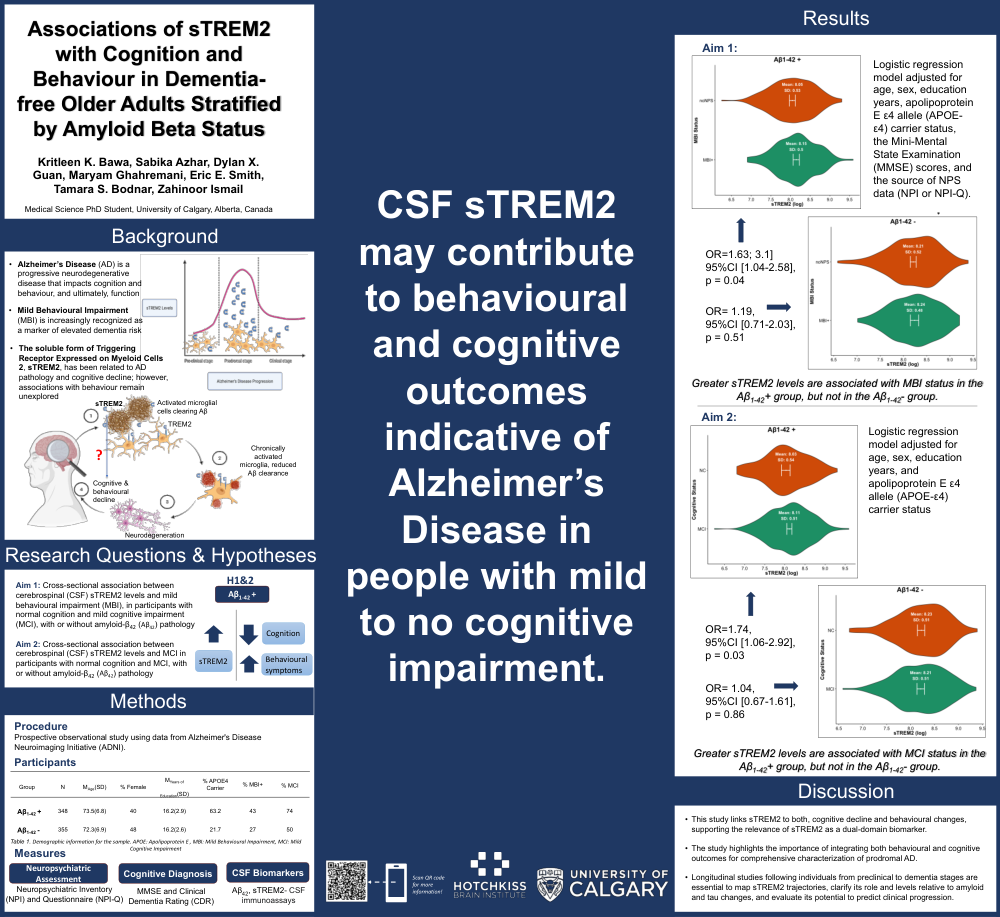
Associations Of Strem2 With Cognition And Behaviour In Dementia-free Older Adults Stratified By Amyloid Beta Status
Poster Presenter
Authors
Kritleen K. Bawa, Sabika Azhar, Dylan X. Guan, Maryam Ghahremani, Eric E. Smith, Tamara S. Bodnar, Zahinoor Ismail
Affiliations
Faculty of Graduate Studies, University of Calgary, AB, Canada, Cumming School of Medicine, University of Calgary, AB, Canada, Hotchkiss Brain Institute, University of Calgary, AB, Canada, Department of Biological Sciences, University of Calgary, AB, Canada
Part of Topic
Virtual
Background: The soluble variant of Triggering Receptor Expressed on Myeloid Cells 2 (sTREM2) is implicated in cognitive decline and Alzheimer disease (AD). As a marker of vascular inflammation, sTREM2 has also been associated with white matter hyperintensity volumes in small vessel disease and AD. However, links with behavioural symptoms remain unexplored. Here we investigated the associations of cerebrospinal fluid (CSF) sTREM2 with mild behavioural impairment (MBI) and mild cognitive impairment (MCI) in dementia-free individuals, stratified by amyloid pathology. We also explored whether sex moderates these associations.
Methods: Data were obtained from the Alzheimer’s Disease Neuroimaging Initiative. MBI-status was operationalized using the Neuropsychiatric Inventory (NPI) and NPI-Questionnaire. MCI was diagnosed using multiple measures and clinical judgement. CSF sTREM2 was measured using electrochemiluminescence-based ELISA, and amyloid-β 1-42 (Aβ42) using Roche Elecsys® electrochemiluminescence immunoassay. Logistic regressions modelled associations of sTREM2 with MBI and MCI, stratified by Aβ42 status. The MCI model was adjusted for age, sex, years of education, and apolipoprotein E ε4 allele carrier status, and MBI model was adjusted for the same covariates along with cognition using the Mini Mental State Examination scores.
Results: Among 703 participants (mean age= 72.9±6.9 years, 44% females, 49% Aβ42+), higher sTREM2 levels were associated with higher odds of MCI (OR=1.74, 95%CI[1.06-2.92], p = 0.03) in Aβ42+ individuals, but not in the Aβ42– group (OR= 1.04, 95%CI[0.67-1.61], p = 0.86). Higher sTREM2 levels were also associated with higher odds of MBI (OR=1.63; 95%CI[1.04-2.58], p = .04) in the Aβ42+ group, but not in the Aβ42– group (OR: 1.19, 95%CI[0.71-2.03], p = .51). Moderation by sex was not observed in the associations between sTREM2 and cognition (β: 0.63, 95%CI[-0.35-1.62], p = .21), and behaviour (β: 0.34, 95%CI[-0.56-1.27], p = .46), in the Aβ42+ subgroup.
Conclusions: sTREM2 and related vascular inflammation may contribute to both behavioural and cognitive outcomes indicative of AD, specifically in individuals with Aβ pathology. sTREM2 may represent a protective and modulatory immune response to Aβ pathology in the early disease stages of AD. Understanding how sTREM2 contributes to clinical symptomatology may improve early risk detection and lead to immunomodulatory therapies for AD.
Comments
Email is required but is not shown publicly.
Loading comments...