4,068 posters, 219 videos, 101 topics, 69 sessions, 14,365 authors, 6,128 institutions
ePostersLive by SciGen Technologies S.A. All rights reserved.
Alzheimer's Association International Conference 2026
July 12-15, 2026 | London, United Kingdom, and Online

12861
Usage And Feasibility Of Web App Use To Support Intervention In Primary Progressive Aphasia: Insights From The Communication Bridge-2 Trial
Poster Presenter
Authors
Affiliations
Healthy Aging and Alzheimer’s Care Center, University of Chicago, Chicago, IL; Department of Psychiatry and Behavioral Sciences, Northwestern University Feinberg School of Medicine, Chicago, IL, Healthy Aging and Alzheimer’s Care Center, University of Chicago, Chicago, IL, Department of Computer Science, Western University, London, ON; School of Communication Sciences and Disorders, Western University, London, ON; Department of Communication Sciences and Disorders, Northwestern University, Evanston, IL, USA, Healthy Aging and Alzheimer’s Care Center, University of Chicago, Chicago, IL; Department of Neurology, Biological Sciences Division, University of Chicago, Chicago, IL
Part of Topic
Virtual
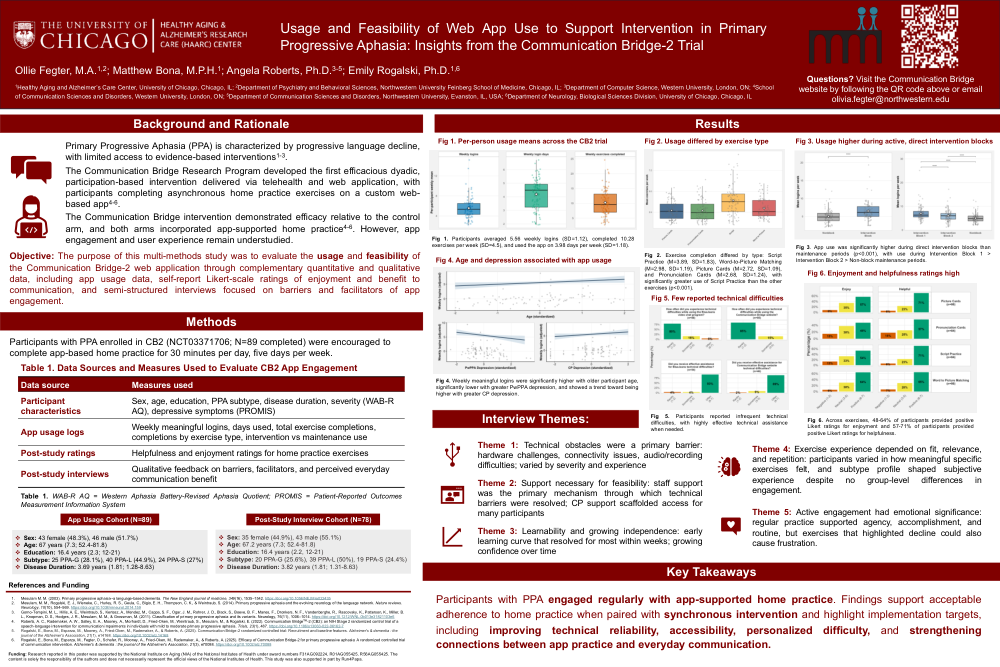
Background: Primary Progressive Aphasia (PPA) is characterized by progressive language decline, with limited access to evidence-based interventions. Communication Bridge-2 (CB2) was a 12-month randomized controlled trial of telehealth speech-language intervention in PPA. The Communication Bridge intervention demonstrated efficacy relative to the control arm, and both arms incorporated app-supported home practice. However, app engagement and user experience remain understudied. This multi-methods study evaluated app usage and user experience in CB2.
Methods: Participants with PPA enrolled in CB2 (NCT03371706; N=89 completed) were encouraged to complete app-based home practice for 30 minutes per day, five days per week. Quantitative usage metrics included weekly logins, days of use, and exercise completions across four exercise types: Picture Cards (picture naming), Pronunciation Cards (spoken word production), Word-to-Picture Matching, and Script Practice (functional phrases). User experience was further examined through reflexive thematic analysis of post-study interviews (N=79). Likert-scale ratings assessed helpfulness and enjoyment of the exercises.
Results: Participants averaged 5.56 weekly logins (SD=1.12), completed 10.28 exercises per week (SD=4.5), and used the app on 3.98 days per week (SD=1.18). Eighty-four percent of participants (n=75) met a high-adherence threshold, defined as completing at least 80% of recommended practice. Exercise completion differed by type: Script Practice (M=3.89, SD=1.83), Word-to-Picture Matching (M=2.98, SD=1.19), Picture Cards (M=2.72, SD=1.09), and Pronunciation Cards (M=2.68, SD=1.24), with significantly greater use of Script Practice than the other exercises (p<0.001). App use was significantly higher during direct intervention blocks than maintenance periods (p<0.001). Higher education was associated with increased usage (p=0.03), whereas PPA subtype and severity were not. Across exercises, 72-88% of participants provided positive Likert ratings for helpfulness. Qualitative analysis identified six themes influencing engagement: clinician contact promoted accountability and motivation; technical difficulties reduced use; accessibility barriers limited usability; care partner involvement supported engagement; exercise difficulty variably affected engagement depending on individual needs; and participants were uncertain whether app practice improved everyday communication.
Conclusions: Participants with PPA engaged regularly with app-supported home practice. Findings support acceptable adherence to home practice when paired with synchronous intervention and highlight implementation targets, including improving technical reliability, accessibility, personalized difficulty, and strengthening connections between app practice and everyday communication.
Comments
Email is required but is not shown publicly.
Loading comments...