4,068 posters, 219 videos, 101 topics, 69 sessions, 14,365 authors, 6,128 institutions
ePostersLive by SciGen Technologies S.A. All rights reserved.
Alzheimer's Association International Conference 2026
July 12-15, 2026 | London, United Kingdom, and Online

13793
Physical Activity And Cognition Across Diverse Populations In Eighteen Countries
Poster Presenter
Authors
Lucas Povala, Lucas Uglione da Ros, João Pedro Uglione da Ros, Débora G. Souza, Bruna Bellaver, João Pedro Ferrari-Souza, Tharick Pascoal, Pedro Rosa-Neto, Marco Antônio De Bastiani, Guilherme Povala, Eduardo Zimmer
Affiliations
Universidade Federal do Rio Grande do Sul, Porto Alegre, Brazil, University of Pittsburgh, Pittsburgh, PA, USA, McGill University, Montreal, QC, Canada
Part of Topic
Virtual
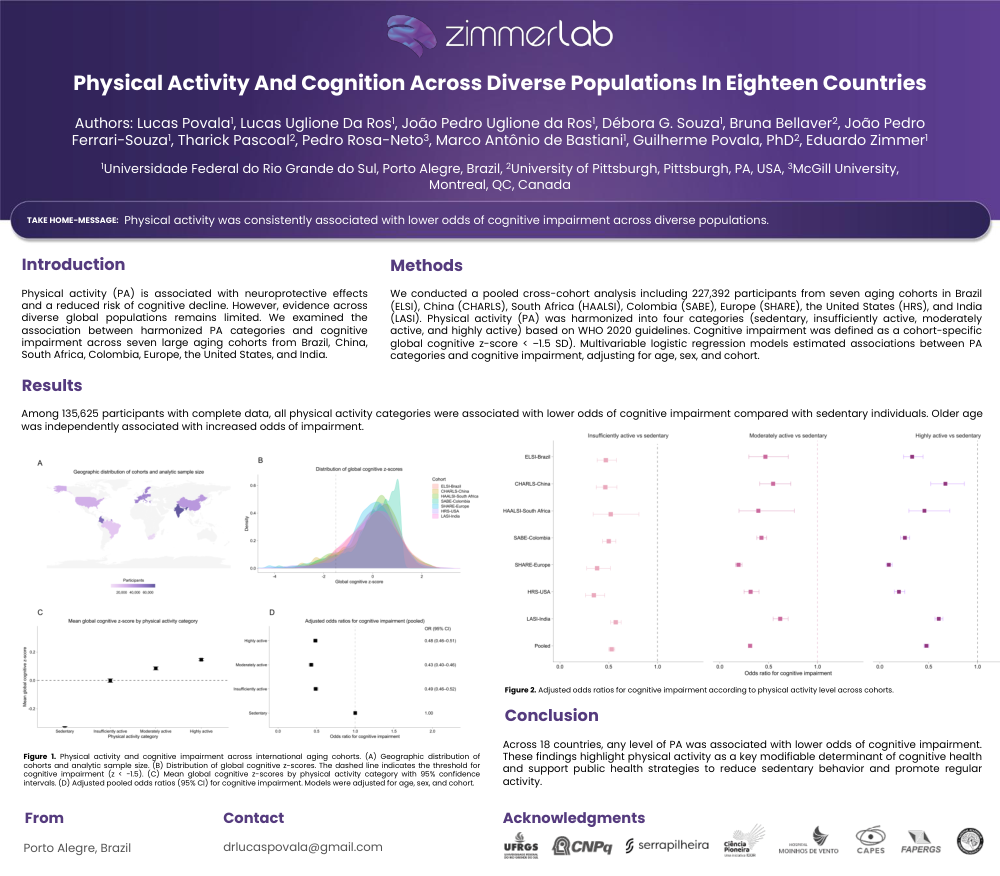
Introduction: Physical activity (PA) is associated with neuroprotective effects and a reduced risk of cognitive decline. However, evidence across diverse global populations remains limited. We examined the association between harmonized PA categories and cognitive impairment across seven large aging cohorts from Brazil, China, South Africa, Colombia, Europe, the United States, and India.
Methods: We conducted a pooled cross-cohort analysis including 227,392 participants from seven aging cohorts in Brazil (ELSI), China (CHARLS), South Africa (HAALSI), Colombia (SABE), Europe (SHARE), the United States (HRS), and India (LASI). Physical activity (PA) was harmonized into four categories (sedentary, insufficiently active, moderately active, and highly active) based on WHO 2020 guidelines. Cognitive impairment was defined as a cohort-specific global cognitive z-score < −1.5 SD). Multivariable logistic regression models estimated associations between PA categories and cognitive impairment, adjusting for age, sex, and cohort.
Results: Among 135,625 participants with complete data, all physical activity categories were associated with lower odds of cognitive impairment compared with sedentary individuals. Older age was independently associated with increased odds of impairment.
Conclusion: Across 18 countries, any level of PA was associated with lower odds of cognitive impairment. These findings highlight physical activity as a key modifiable determinant of cognitive health and support public health strategies to reduce sedentary behavior and promote regular activity.
Comments
Email is required but is not shown publicly.
Loading comments...