4,068 posters, 219 videos, 101 topics, 69 sessions, 14,365 authors, 6,128 institutions
ePostersLive by SciGen Technologies S.A. All rights reserved.
Alzheimer's Association International Conference 2026
July 12-15, 2026 | London, United Kingdom, and Online

13256
Determinants And Capacity Gaps For Harmonizing Memory Clinic Practice: Evidence From The REMEMVER Initiative
Poster Presenter
Authors
Ignacio López - Barrenechea, Teresa Rubilar-Ruiz, María José Alarcón Plasser, Paulina Vergara, Natalia Pozo Castro, Teresita de Jesús Ramos Franco, Claudia Reyes, Teresa Castillo, Lorena Morante, Francisco Chong, Fernando Henríquez, Carlos Orellana, Pamela Guevara Alvez, Loreto Olavarría, Francisco Gutierrez, Mauricio Cerda, Andrea Slachevsky
Affiliations
Memory Clinic, Neurology Department, Hospital Clínico Dr. Guillermo Grant Benavente, Concepción, Chile, Hospital San Borja Arriarán, Santiago, Chile, Unidad de Memoria Neurology, Hospital del Salvador, Santiago, Chile, Memory Clinic, Neurology Department, Hospital Clínico Regional de Temuco, Temuco, Chile, Hospital de Castro, Castro, Chile, Neurology Unit, Hospital San José, Santiago, Chile, Faculty of Medicine, University of Chile, Neuropsychology and Clinical Neuroscience Laboratory (LANNEC), Physiopathology Department, Institute of Biomedical Sciences (ICBM), Santiago, Chile, Faculty of Medicine, University of Chile, Department of Psychiatry and Mental Health East, Santiago, Chile, Psychiatry, Hospital Las Higueras, Talcahuano, Chile, Biomedical Engineering Department, Universidad de Concepción, Concepción, Chile, University of Chile, Geroscience Center for Brain Health and Metabolism (GERO), Santiago, Chile, Memory and Neuropsychiatric Center(CMYN), Neurology Department, Hospital del Salvador and Faculty of Medicine, Universidad de Chile, University of Chile, Biomedical Neuroscience Institute (BNI), ICBM, Santiago, Chile, 5 Hospital San Borja Arriarán, Santiago, Chile, Memory Clinic, Neurology Department, Hospital Base de Valdivia, Valdivia, Chile
Part of Topic
Virtual
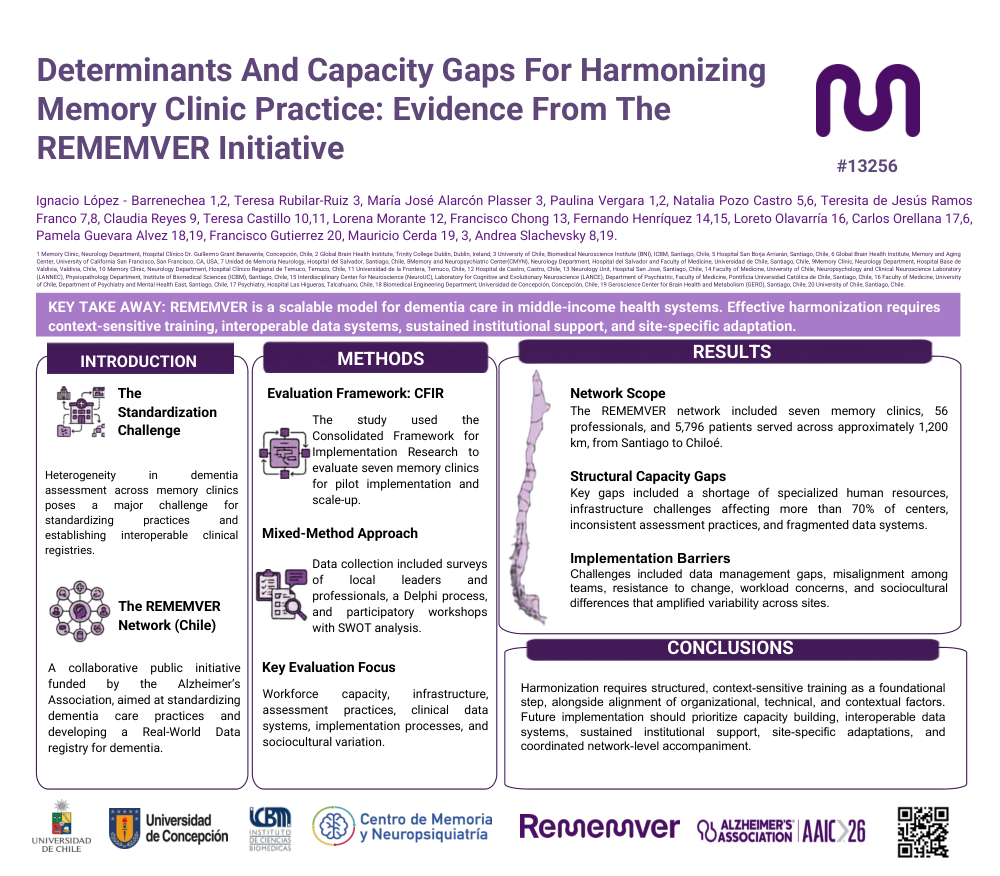
Background: Heterogeneity in the assessment of individuals with dementia across memory clinics poses a significant challenge for standardizing practices and establishing interoperable clinical registries. The REMEMVER network in Chile, a collaborative public initiative supported by the Alzheimer's Association, seeks to address these challenges through the standardization of practices and the development of a Real-World Data registry for dementia in Latin America. To implement effective standardization and capacity-building strategies, it is vital to understand local capacities and factors influencing implementation. Therefore, identifying the structural capacities, gaps, and determinants that affect the harmonization of practices among the seven memory clinics participating in the REMEMVER network is essential.
Methods: We conducted a study that included surveys of local leaders and non-medical professionals, a Delphi process, and a participatory workshop with guided discussions and SWOT analysis. Using the CFIR (Consolidated Framework for Implementation Research) framework, we evaluated seven memory clinics to assess pilot implementation and inform scale-up, focusing on workforce capacity, infrastructure, assessment practices, clinical data systems, and implementation processes while considering sociocultural variations.
Results: Substantial variability was noted across clinics in a network of 56 professionals, serving 5,796 patients across 1,200 KM from Santiago to Castro. The teams mainly consisted of non-medical staff like speech therapists, occupational therapists, neuropsychologists, and social workers. Key structural gaps included a shortage of specialized human resources, infrastructure challenges affecting over 70% of centers, inconsistent assessment practices, and fragmented data systems. Sociocultural differences amplified this variability. Implementation challenges included data management gaps, misalignment among teams, resistance to change, and concerns about workload. Effective interoperability with hospital systems was identified as a crucial enabling factor.
Conclusion: Harmonization of memory clinic practices requires prioritizing structured, context-sensitive training as a foundational step, alongside alignment of organizational, technical, and contextual factors. Implementation efforts should focus on capacity building, the development of interoperable data systems, and sustained institutional support, while ensuring site-specific adaptations and coordinated network-level accompaniment. These findings support REMEMVER as a scalable model for dementia care in middle-income health systems.
Comments
Email is required but is not shown publicly.
Loading comments...