4,068 posters, 219 videos, 101 topics, 69 sessions, 14,365 authors, 6,128 institutions
ePostersLive by SciGen Technologies S.A. All rights reserved.
Alzheimer's Association International Conference 2026
July 12-15, 2026 | London, United Kingdom, and Online

11824
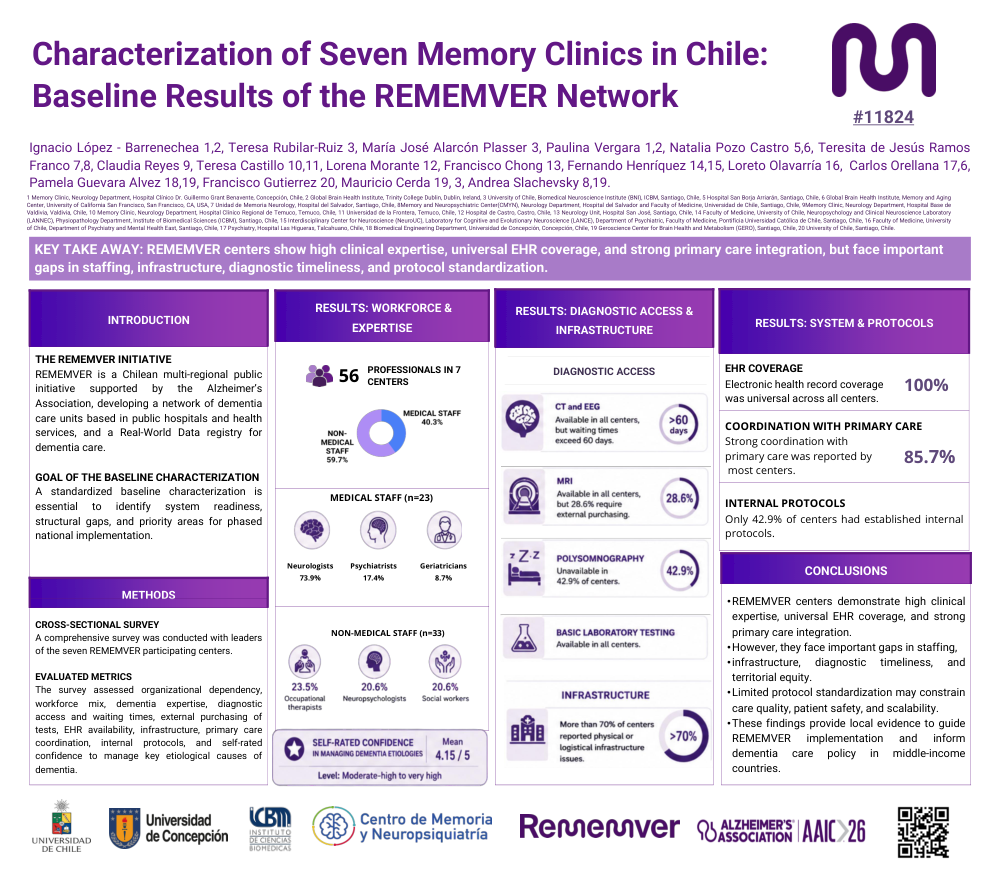
Characterization Of Seven Memory Clinics In Chile: Baseline Results Of The REMEMVER Network
Poster Presenter
Authors
Ignacio López - Barrenechea, Teresa Rubilar-Ruiz, María José Alarcón Plasser, Paulina Vergara, Natalia Pozo Castro, Teresita de Jesús Ramos Franco, Claudia Reyes, Teresa Castillo, Lorena Morante, Francisco Chong, Fernando Henríquez, Loreto Olavarría, Carlos Orellana, Pamela Guevara Alvez, Francisco Gutierrez, Mauricio Cerda, Andrea Slachevsky
Affiliations
Memory Clinic, Neurology Department, Hospital Clínico Dr. Guillermo Grant Benavente, Concepción, Chile, University of Chile, Biomedical Neuroscience Institute (BNI), ICBM, Santiago, Chile, Hospital San Borja Arriarán, Santiago, Chile, Unidad de Memoria Neurology, Hospital del Salvador, Santiago, Chile, Memory Clinic, Neurology Department, Hospital Base de Valdivia, Valdivia, Chile,, Memory Clinic, Neurology Department, Hospital Clínico Regional de Temuco, Temuco, Chile, Hospital de Castro, Castro, Chile, Neurology Unit, Hospital San José, Santiago, Chile, Faculty of Medicine, University of Chile, Neuropsychology and Clinical Neuroscience Laboratory (LANNEC), Physiopathology Department, Institute of Biomedical Sciences (ICBM), Santiago, Chile, Faculty of Medicine, University of Chile, Department of Psychiatry and Mental Health East, Santiago, Chile, Psychiatry, Hospital Las Higueras, Talcahuano, Chile, Biomedical Engineering Department, Universidad de Concepción, Concepción, Chile, University of Chile, Geroscience Center for Brain Health and Metabolism (GERO), Santiago, Chile, Memory and Neuropsychiatric Center(CMYN), Neurology Department, Hospital del Salvador and Faculty of Medicine, Universidad de Chile
Part of Topic
Virtual
Background: The REd MEMoria Viva Electronic Registry (REMEMVER) is a Chilean initiative supported by the Alzheimer’s Association, developing a multi-regional network of dementia care units based on public hospitals and health services in Chile. Implementation planning, harmonising care pathways, and prioritising capacity strengthening require a standardised baseline characterisation of participating centres to identify system readiness and structural gaps that can guide phased national implementation. Seven centres in different locations and with varying levels of complexity were involved, providing a nationally informative picture of current service capacity.
Methods: The survey technique was a cross-sectional survey of the leaders of the seven REMEMVER participating centres. The tool determined staff, organisational dependency, workforce mix, and expertise in dementia, access to primary diagnostic and allied-health assessment (waiting times and external purchasing), availability of electronic health record (EHR), physical/logistical infrastructure, connection with primary care, internal protocols, and self-rated confidence (1-5) to manage key etiological causes of dementia.
Results: The participant centres have 56 professionals, with 40.4% medical (n=23) and 59.9% non-medical (n=33). Medical staff included neurologists (73.9%), Psychiatrists (17,4%), and Geriatricians (8.7%). Non-medical staff consisted mainly of Occupational Therapists (23.5%), Neuropsychologists (20.6%), and social workers (20.6%). All centres had basic labs, but advanced tests faced access restrictions. CT and EEG were available in all centres and took over 60 days; MRI was available in all centres, but 28.6% required outside purchase, and polysomnography was unavailable in 42.9%. EHR coverage was universal (100%). Over 70% reported infrastructure issues. Coordination with primary care was strong (85.7%), but only 42.9% had internal protocols. There was a moderate-high to very high rating of self-confidence in the ability to deal with important aetiologies of dementia (mean 4.15).
Conclusion: REMEMVER centres demonstrate high clinical expertise, universal EHR coverage, and strong primary care integration, but face gaps in staffing, infrastructure, diagnostic timeliness, and territorial inequities. Limited protocol standardisation constrains care quality, patient safety, and scalability. These findings inform public policy in middle-income countries and enhance the added value that REMEMVER protocol implementations will have in improving internal protocols among the participating centres, and to inform public policy with local data.
Comments
Email is required but is not shown publicly.
Loading comments...