4,068 posters, 219 videos, 101 topics, 69 sessions, 14,365 authors, 6,128 institutions
ePostersLive by SciGen Technologies S.A. All rights reserved.
Alzheimer's Association International Conference 2026
July 12-15, 2026 | London, United Kingdom, and Online

13634
Breadth Of Leisure Activity Engagement And Cognitive Resilience Among Older Chinese Adults: A 10-year Longitudinal Study
Part of Topic
Virtual
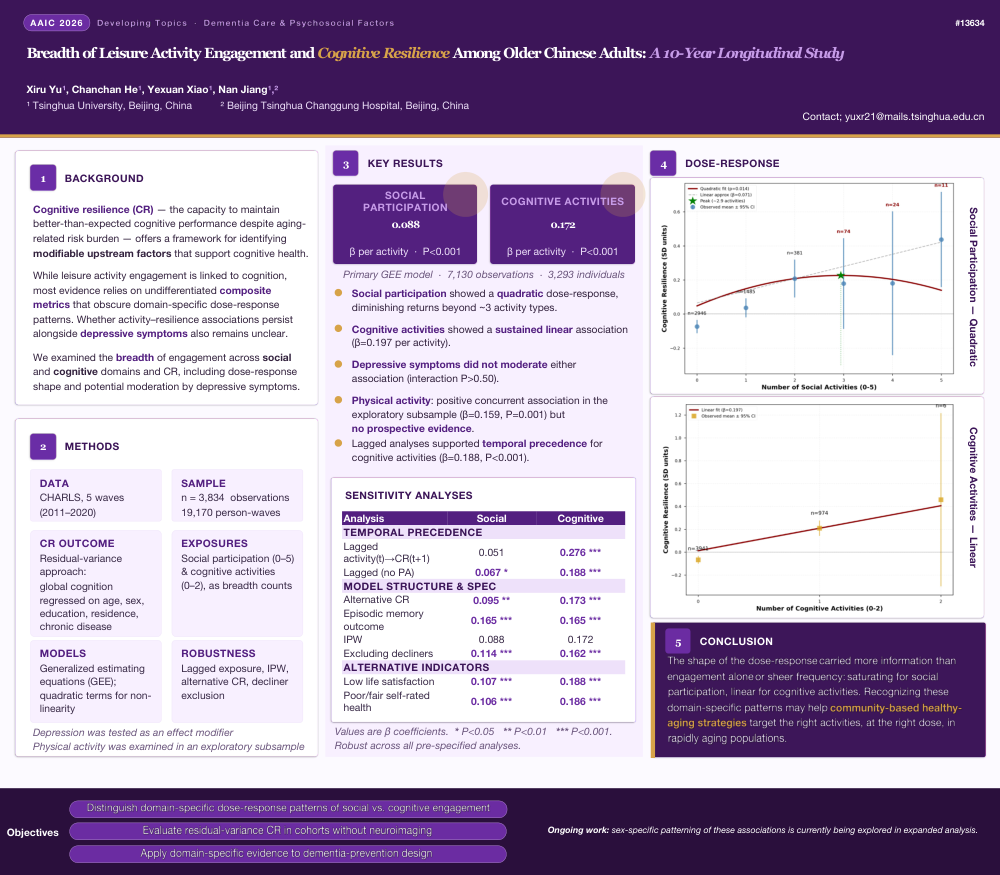
Background. Cognitive resilience (CR) — the capacity to maintain better-than-expected cognitive performance despite aging-related risk burden — offers a framework for identifying modifiable upstream factors that support cognitive health. While leisure activity engagement is linked to cognition, most evidence relies on undifferentiated composite metrics that obscure domain-specific dose-response patterns. Whether activity-resilience associations persist alongside depressive symptoms also remains unclear. We examined the breadth of engagement across social and cognitive domains and CR, including dose-response shape and potential moderation by depressive symptoms.
Methods. Data: CHARLS, 5 waves (2011–2020); n=3,834 observations, 19,170 person-waves. CR outcome: residual-variance approach, with global cognition regressed on age, sex, education, residence, and chronic disease count. Exposures: social participation (0–5) and cognitive activities (0–2), as breadth-of-engagement counts. Models: generalized estimating equations (GEE) with quadratic terms for non-linearity. Depression was tested as an effect modifier, and physical activity was examined in an exploratory subsample. Robustness: lagged exposure, inverse probability weighting (IPW), alternative CR, and decliner exclusion.
Key Results. In the primary GEE model (7,130 observations, 3,293 individuals), social participation (beta=0.088 per activity, P<0.001) and cognitive activities (beta=0.172 per activity, P<0.001) were positively associated with CR. Social participation showed a quadratic dose-response, with diminishing returns beyond ~3 activity types. Cognitive activities showed a sustained linear association (beta=0.197 per activity). Depressive symptoms did not moderate either association (interaction P>0.50). Physical activity showed a positive concurrent association in the exploratory subsample (beta=0.159, P=0.001) but no prospective evidence. Lagged analyses supported temporal precedence for cognitive activities (beta=0.188, P<0.001). Associations were robust across all pre-specified sensitivity analyses.
Conclusion. The shape of the dose-response carried more information than engagement alone or sheer frequency: saturating for social participation, linear for cognitive activities. Recognizing these domain-specific patterns may help community-based healthy-aging strategies target the right activities, at the right dose, in rapidly aging populations.
Objectives. Distinguish domain-specific dose-response patterns of social vs. cognitive engagement; evaluate residual-variance CR in cohorts without neuroimaging; apply domain-specific evidence to dementia-prevention design.
Ongoing work. Sex-specific patterning of these associations is currently being explored in expanded analysis.
Comments
Email is required but is not shown publicly.
Loading comments...