4,068 posters, 219 videos, 101 topics, 69 sessions, 14,365 authors, 6,128 institutions
ePostersLive by SciGen Technologies S.A. All rights reserved.
Alzheimer's Association International Conference 2026
July 12-15, 2026 | London, United Kingdom, and Online

13390
Safety And Tolerability Of Posdinemab In Early Alzheimer's Disease: Results From The Phase 2 Autonomy Trial
Poster Presenter
Authors
Part of Topic
Virtual
Background
• Posdinemab (JNJ 63733657), an immunoglobulin (Ig)G1 monoclonal antibody, binds mid-domain phosphorylated tau at the p-tau217 epitope.
• Auτonomy (NCT04619420) was a Phase 2b, randomised, double-blind (DB), placebo controlled, common-close study that assessed the efficacy and safety of posdinemab in early Alzheimer’s disease (AD; mild cognitive impairment [MCI] or mild dementia).
• The trial did not meet its primary endpoint of slowing clinical decline as measured by the integrated AD Rating Scale for Mild Cognitive Impairment (iADRS-MCI).
• Here, we present safety data from the primary DB analysis.
Methods
• 523 participants aged 55–80 years with early AD and intermediate tau positron emission tomography (PET) burden were randomised 1:1:1 to posdinemab 1000 mg, posdinemab 3000 mg, or placebo, administered intravenously every 4 weeks. Safety and tolerability were evaluated as a secondary objective.
• Safety and tolerability were assessed by treatment-emergent adverse events (TEAEs), vital signs, physical examinations, laboratory evaluations, electrocardiograms (ECGs), suicidal ideation and behaviour assessment (C-SSRS), and brain magnetic resonance imaging (MRI).
• An Independent Data Monitoring Committee was established to ensure the continuing safety of the participants enrolled in this study while the study sponsor was blinded.
• Cases of alanine aminotransferase (ALT) and/or aspartate aminotransferase (AST) ≥3x upper limit of normal (ULN) were evaluated with additional hepatic laboratory tests (e.g. trending ALT, AST, alkaline phosphatase [ALP], bilirubin, gamma-glutamyl transferase [GGT], glutamate dehydrogenase [GLDH] until improvement), along with international normalised ratio (INR), C-reactive protein (CRP), and ferritin, where feasible. However, most of this was implemented after several cases were identified, so these data are not available for most retrospective cases.
• An independent blinded Hepatic Adjudication Committee (HAC) reviewed these cases to determine the likelihood of drug-induced liver injury (DILI).
• Comprehensive mechanistic investigations were undertaken, where feasible, to evaluate potential etiologies of these hepatic findings.
- Viral serology: Hepatitis A IgM antibody; HBsAg and total HBcAb (IgG and IgM antibodies) with reflex to HBV-DNA if positive; Hepatitis C IgG antibody with reflex to HCV-RNA if positive; cytomegalovirus IgM; Epstein-Barr virus capsid antigen IgM; Hepatitis E IgM; and HSV-1 and -2 IgG.
- Autoimmune antibodies: Anti-nuclear antibody, anti-smooth muscle antibody, Type 1 anti-liver kidney microsomal antibodies, and quantitative total IgG or gamma globulins.
- Liver biopsy immunopathology: Liver biopsy was performed if clinically indicated in consultation with local hepatology specialist. In addition to standard histopathology by a hepatopathologist, exploratory analyses (e.g., immunofluorescence stains for cluster of differentiation [CD]4, CD8, CD3, CD20, CD138, Granzyme B, and FoxP3) to further characterize the immune cell infiltrate were performed.
- Pharmacokinetics and immunogenicity (PK/ADA): The potential influence of the systemic posdinemab exposure (steady state AUCτ, Cmax, and Ctrough) or treatment-emergent anti-drug antibody (ADA) status on the probability to have an ALT and/or AST ≥3xULN event was investigated using binomial logistic regression.
Results
• Out of 523 randomised participants, 521 participants were included in the DB safety analysis set.
• Overall rates of TEAEs (including deaths and serious TEAEs) were similar across posdinemab and placebo groups.1
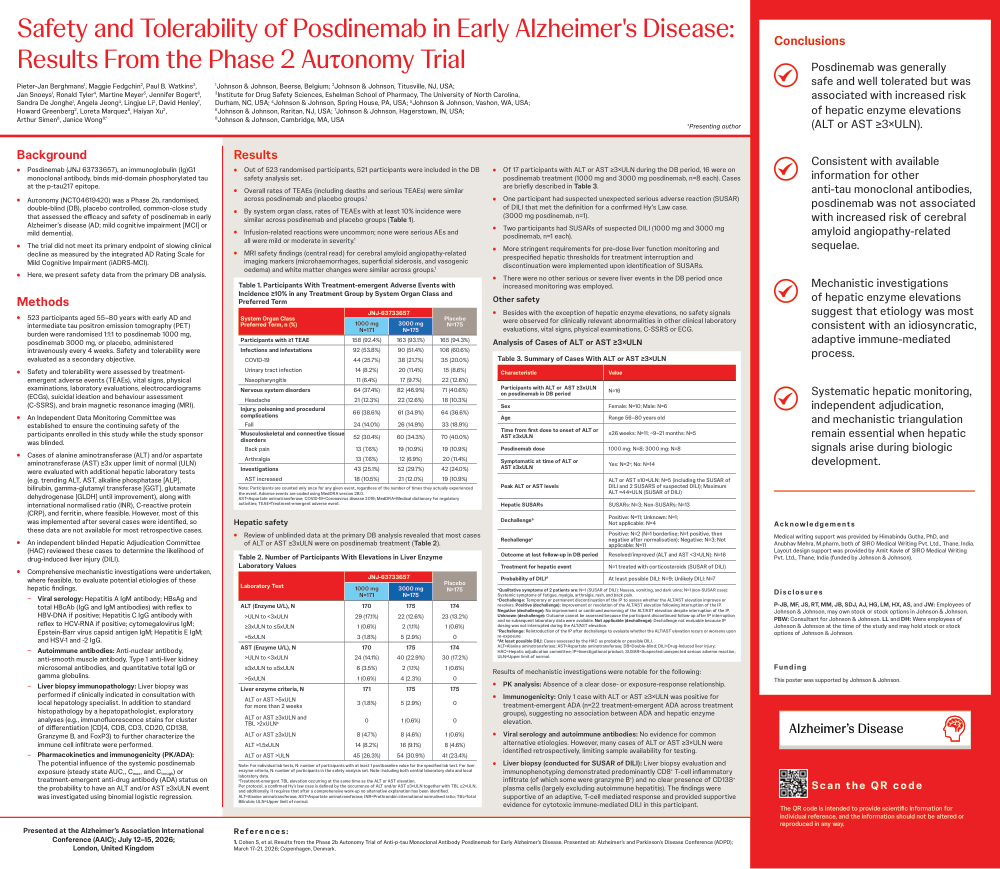
• By system organ class, rates of TEAEs with at least 10% incidence were similar across posdinemab and placebo groups (Table 1).
• Infusion-related reactions were uncommon; none were serious AEs and all were mild or moderate in severity.1
• MRI safety findings (central read) for cerebral amyloid angiopathy-related imaging markers (microhaemorrhages, superficial siderosis, and vasogenic oedema) and white matter changes were similar across groups.1
Hepatic safety
• Review of unblinded data at the primary DB analysis revealed that most cases of ALT or AST ≥3xULN were on posdinemab treatment (Table 2).
• Of 17 participants with ALT or AST ≥3×ULN during the DB period, 16 were on posdinemab treatment (1000 mg and 3000 mg posdinemab, n=8 each). Cases are briefly described in Table 3.
• One participant had suspected unexpected serious adverse reaction (SUSAR) of DILI that met the definition for a confirmed Hy's Law case. (3000 mg posdinemab, n=1).
• Two participants had SUSARs of suspected DILI (1000 mg and 3000 mg posdinemab, n=1 each).
• More stringent requirements for pre-dose liver function monitoring and prespecified hepatic thresholds for treatment interruption and discontinuation were implemented upon identification of SUSARs.
• There were no other serious or severe liver events in the DB period once increased monitoring was employed.
Other safety
• Besides with the exception of hepatic enzyme elevations, no safety signals were observed for clinically relevant abnormalities in other clinical laboratory evaluations, vital signs, physical examinations, C-SSRS or ECG.
• Results of mechanistic investigations were notable for the following:
- PK analysis: Absence of a clear dose- or exposure-response relationship.
- Immunogenicity: Only 1 case with ALT or AST ≥3×ULN was positive for treatment-emergent ADA (n=22 treatment-emergent ADA across treatment groups), suggesting no association between ADA and hepatic enzyme elevation.
- Viral serology and autoimmune antibodies: No evidence for common alternative etiologies. However, many cases of ALT or AST ≥3×ULN were identified retrospectively, limiting sample availability for testing.
- Liver biopsy (conducted for SUSAR of DILI): Liver biopsy evaluation and immunophenotyping demonstrated predominantly CD8+ T-cell inflammatory infiltrate (of which some were granzyme B+) and no clear presence of CD138+ plasma cells (largely excluding autoimmune hepatitis). The findings were supportive of an adaptive, T-cell mediated response and provided supportive evidence for cytotoxic immune-mediated DILI in this participant
Conclusions
• Posdinemab was generally safe and well tolerated but was associated with increased risk of hepatic enzyme elevations (ALT or AST ≥3×ULN).
• Consistent with available information for other anti-tau monoclonal antibodies, posdinemab was not associated with increased risk of cerebral amyloid angiopathy-related sequelae.
• Mechanistic investigations of hepatic enzyme elevations suggest that etiology was most consistent with an idiosyncratic, adaptive immune-mediated process.
• Systematic hepatic monitoring, independent adjudication, and mechanistic triangulation remain essential when hepatic signals arise during biologic development.
Comments
Email is required but is not shown publicly.
Loading comments...