4,068 posters, 219 videos, 101 topics, 69 sessions, 14,365 authors, 6,128 institutions
ePostersLive by SciGen Technologies S.A. All rights reserved.
Alzheimer's Association International Conference 2026
July 12-15, 2026 | London, United Kingdom, and Online

12937
Reliability Of EEG Phase Estimation In People Living With Dementia
Poster Presenter
Authors
Affiliations
Part of Topic
Virtual
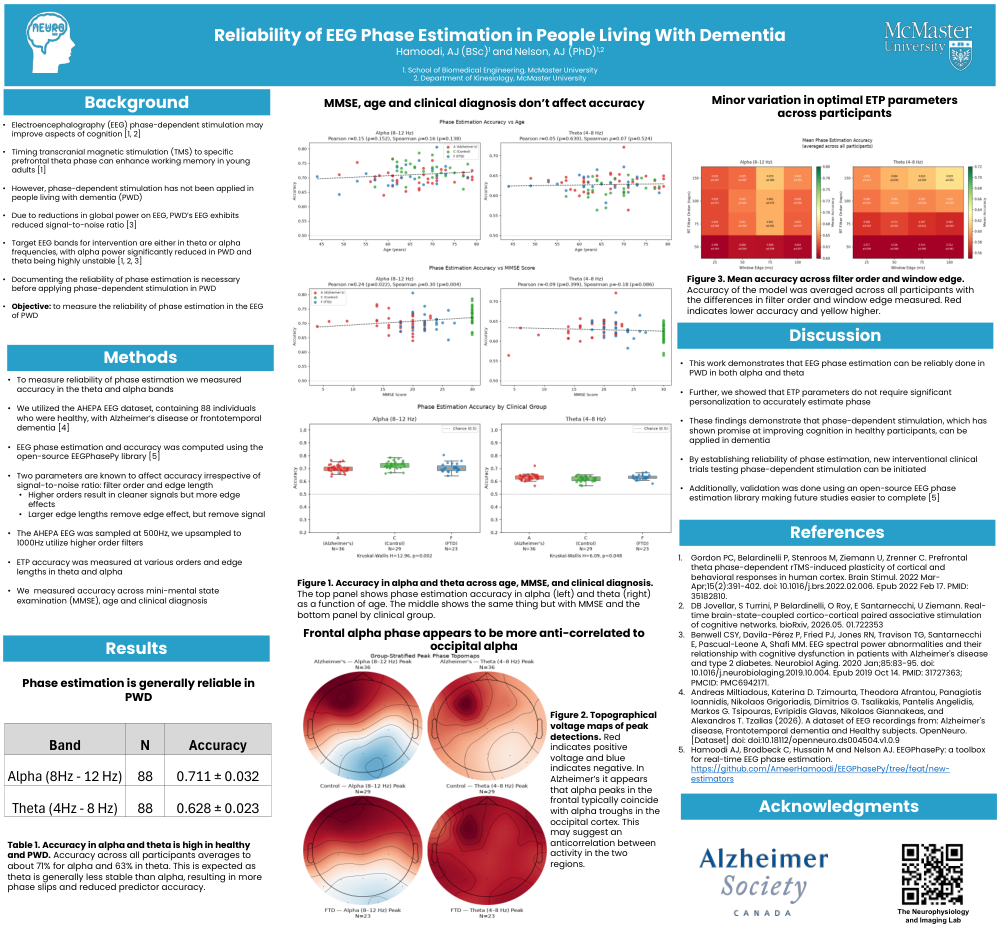
Background: While dementia has commonly been characterized by cerebral structural changes, there is a significant degree of functional change to electrophysiological networks that underly various cognitive processes. If connectivity between nodes within these networks could be enhanced, then it is plausible that the underlying cognitive process could also be enhanced. Electroencephalography (EEG) phase triggered transcranial magnetic stimulation (TMS) may be able to modify functional connectivity between nodes within an EEG network and therefore potentially modify cognitive symptoms of dementia. However, EEG-TMS would require targeting specific EEG phases with high accuracy as demonstrated in healthy controls. Importantly, all EEG-phase triggered TMS experiments to date have taken place in individuals without dementia. It is known that dementia results in substantial electrophysiological changes that can reduce the stability of various EEG rhythms. Thus, prior to EEG-TMS interventions taking place in people with dementia, the reliability and feasibility of phase estimation in people living with dementia must be established.
Methods: We simulated real-time EEG phase estimation using an open-source EEG phase estimation library developed by our lab known as EEGPhasePy on an open-dataset of resting-state EEG data from 88 older adults, people with Alzheimer’s disease and frontotemporal dementia (MMSE between 4-30). We benchmarked accuracy, mean phase, and circular standard deviation for different target phases in both the alpha (8-12Hz) and theta (4-8Hz) bands.
Results: We found that EEG phase estimation can be performed in real-time with similar accuracy as in healthy older adults. The mean accuracy of phase estimation across all 88 participants was 78% ± 6%, which is comparable to studies done in healthy adults. No significant relationship between dementia severity and accuracy was found.
Conclusion: EEG phase triggered TMS appears to be technically feasible in people living with dementia, regardless of severity.
Comments
Email is required but is not shown publicly.
Loading comments...