4,068 posters, 219 videos, 101 topics, 69 sessions, 14,365 authors, 6,128 institutions
ePostersLive by SciGen Technologies S.A. All rights reserved.
Alzheimer's Association International Conference 2026
July 12-15, 2026 | London, United Kingdom, and Online

13918
Insulin Eye Drops For Mci And Early Alzheimer's Disease: A Case Series
Poster Presenter
Authors
Part of Topic
Virtual
INTRODUCTION
Insulin, delivered intra-nasally, has been explored as a treatment for Alzheimer’s disease.1 When applied as an eye drop, commercially available human recombinant insulin has been shown to reversibly increase the thickness of the retinal fiber layer.2 Insulin has been measured in rat CSF after topical ocular application with the use of a corneal penetration enhancer.3 We compounded human recombinant insulin with an ethical corneal penetration enhancer to enhance ocular-CNS absorption (patent pending).
We report 3 pilot cases treated with this novel insulin eye drop composition, who demonstrated improvements in informant-based functional assessments and cognitive screening measures over 10 days and over several months of use.
METHODS
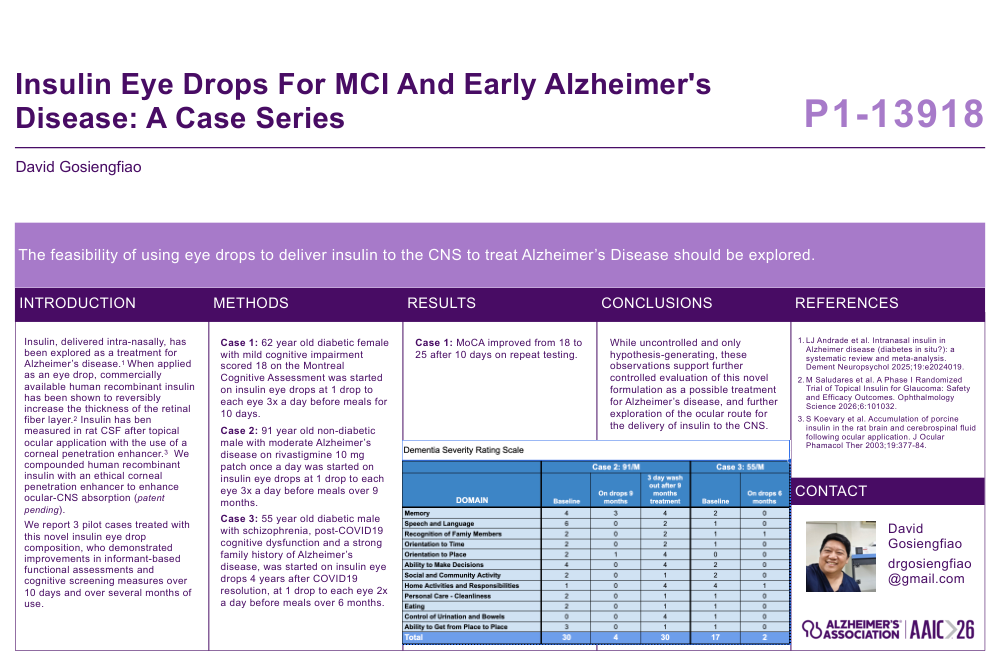
Case 1: 62 year old diabetic female with mild cognitive impairment scored 18 on the Montreal Cognitive Assessment was started on insulin eye drops at 1 drop to each eye 3x a day before meals for 10 days. Case 2: 91 year old non-diabetic male with moderate Alzheimer’s disease on rivastigmine 10 mg patch once a day was started on insulin eye drops at 1 drop to each eye 3x a day before meals over 9 months. Case 3: 55 year old diabetic male with schizophrenia, post-COVID19 cognitive dysfunction and a strong family history of Alzheimer’s disease, was started on insulin eye drops 4 years after COVID19 resolution, at 1 drop to each eye 2x a day before meals over 6 months.
RESULTS
Case 1: MoCA improved from 18 to 25 after 10 days on repeat testing.
Dementia Severity Rating Scale
| Case 2: 91/M | Case 3: 55/M | ||||
| DOMAIN | Baseline | On drops 9 months | 3 day wash out after 9 months treatment | Baseline | On drops 6 months |
| Memory | 4 | 3 | 4 | 2 | 0 |
| Speech and Language | 6 | 0 | 2 | 1 | 0 |
| Recognition of Famiy Members | 2 | 0 | 2 | 1 | 1 |
| Orientation to Time | 2 | 0 | 2 | 1 | 0 |
| Orientation to Place | 2 | 1 | 4 | 0 | 0 |
| Ability to Make Decisions | 4 | 0 | 4 | 2 | 0 |
| Social and Community Activity | 2 | 0 | 1 | 2 | 0 |
| Home Activities and Responsibilities | 1 | 0 | 4 | 4 | 1 |
| Personal Care - Cleanliness | 2 | 0 | 1 | 1 | 0 |
| Eating | 2 | 0 | 1 | 1 | 0 |
| Control of Urination and Bowels | 0 | 0 | 4 | 1 | 0 |
| Ability to Get from Place to Place | 3 | 0 | 1 | 1 | 0 |
| Total | 30 | 4 | 30 | 17 | 2 |
CONCLUSIONS
While uncontrolled and only hypothesis-generating, these observations support further controlled evaluation of this novel formulation as a possible treatment for Alzheimer’s disease, and further exploration of the ocular route for the delivery of insulin to the CNS.
REFERENCES
- LJ Andrade et al. Intranasal insulin in Alzheimer disease (diabetes in situ?): a systematic review and meta-analysis. Dement Neuropsychol 2025;19:e2024019.
- M Saludares et al. A Phase I Randomized Trial of Topical Insulin for Glaucoma: Safety and Efficacy Outcomes. Ophthalmology Science 2026;6:101032.
- S Koevary et al. Accumulation of porcine insulin in the rat brain and cerebrospinal fluid following ocular application. J Ocular Pharmacol Ther 2003;19:377-84.
Comments
Email is required but is not shown publicly.
Loading comments...