4,068 posters, 219 videos, 101 topics, 69 sessions, 14,365 authors, 6,128 institutions
ePostersLive by SciGen Technologies S.A. All rights reserved.
Alzheimer's Association International Conference 2026
July 12-15, 2026 | London, United Kingdom, and Online

11872
The Clinical Application Of Plasma Biomarkers For Alzheimer’S Disease In A Hong Kong Cohort With Cognitive Impairment
Poster Presenter
Authors
Affiliations
Part of Topic
Virtual
Title: Clinical Utility of Plasma P-tau 181 and 217 Biomarkers for Alzheimer's Disease Diagnosis in a Hong Kong Cohort
Authors: Dr. Yat Fung Shea MBBS(HK), FRCP(Lond),a,* Shun Shun So MSc,b Hok Pui Chan BSc,b Dr. Ka Keung Yam MBBS(HK), FRCP(Lond), a Dr. Felix Chi Kin Wong MBBS(HK), FRCPA,b Dr. Tsz King Wong MBBS(HK),a Whitney Chin Tung Ip, MBBS(HK), a Krystal Xiwing Yau MSc,a Zifei Zhang BSC,a, c Mr. Pak Lam Chan MSc,b Dr. King Pui Florence Chan MBBS(HK), MD,a Dr. Yi Wah Eva Cheung PhD,d Dr. Henry Ka Fung Mak MD, FRCR,d Prof. Sau Man Mary Ip MD, FRCP(Lond),a Dr. Patrick Ka Chun Chiu MBBS(HK), FRCP(Glas),a Prof. Ching Wan Lam PhD FRCP(Glas), b, e,* Prof. Koon Ho Chan MD, PhD *
Affiliations:
a Department of Medicine, Queen Mary Hospital, Li Ka Shing Faculty of Medicine, University of Hong Kong
b Division of Chemical Pathology, Department of Pathology, Queen Mary Hospital
c Neuroimmunology and Neuroinflammation Research Laboratory, Li Ka Shing Faculty of Medicine, University of Hong Kong
d Department of Diagnostic Radiology, Queen Mary Hospital, Li Ka Shing Faculty of Medicine, University of Hong Kong
e Department of Pathology, Li Ka Shing Faculty of Medicine, University of Hong Kong
* Authors contributed equally to the manuscript
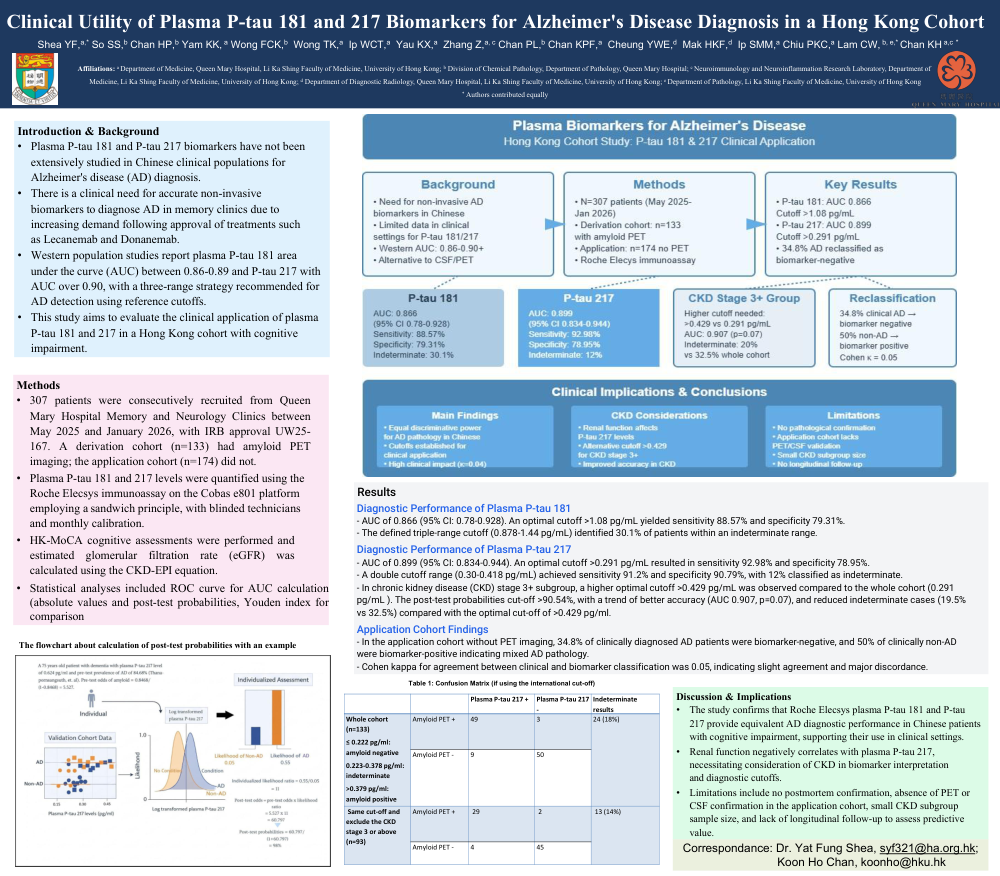
Abstract Background: Plasma phosphorylated tau (P-tau181 and P-tau217) have not been extensively studied for AD diagnosis in Chinese populations in real-world clinics. Methods: We enrolled 306 consecutive memory/neurology patients at Queen Mary Hospital, Hong Kong (May 2025–Jan 2026). In a validation cohort (n=133 with amyloid PET), we determined Roche Elecsys cut-offs for P-tau181 and P-tau217 and estimated post-test probabilities using a Bayesian ROC approach. The cut-offs were applied to an application cohort (n=174) without PET to assess clinical impact. Results: Using P-tau181 > 1.08 pg/mL and P-tau217 > 0.291 pg/mL, sensitivity/specificity were 88.6%/93.0% and 79.3%/79.0% (AUC 0.87 and 0.90). A dual-cutoff for P-tau217 (0.30–0.418 pg/mL) yielded 91.2% sensitivity and 90.8% specificity. Bayesian post-test probabilities favored P-tau217 in patients with stage ≥3 disease (AUC 0.91 vs 0.82). In the application cohort, applying the P-tau217 cut-off reclassified 34.8% of clinically diagnosed AD as non-AD and 50% of non-AD as AD. Conclusions: Plasma P-tau181 and P-tau217 are useful for diagnosing AD in Chinese patients seen in memory/neurology clinics, across diverse etiologies of cognitive impairment.
Keywords: aged; Alzheimer’s disease; dementia; tau Protein; memory
Comments
Email is required but is not shown publicly.
Loading comments...