4,068 posters, 219 videos, 101 topics, 69 sessions, 14,365 authors, 6,128 institutions
ePostersLive by SciGen Technologies S.A. All rights reserved.
Alzheimer's Association International Conference 2026
July 12-15, 2026 | London, United Kingdom, and Online

13730
State-dependent Spectral Slowing In Lewy Body Dementia Using Resting-state Meg And Hidden Markov Modeling
Poster Presenter
Authors
Simon Griffin, Isaac Yu, Zohreh Morshedizad, Melissa Armstrong, Anastasia Barnes, Abbas Babajani-Feremi
Affiliations
Part of Topic
Virtual
Background: Lewy body dementia (LBD) is the second most common neurodegenerative
dementia and remains underrecognized in clinical practice. Although resting-state
electrophysiologic slowing is a promising biomarker in LBD, objective markers of its temporal
instability are limited. Cognitive fluctuations (CF) are a core feature of LBD, yet the
relationship between spectral slowing and CF severity remains poorly understood. We
investigated whether resting-state MEG with hidden Markov modeling (HMM) can identify
state-dynamic and spectral signatures associated with LBD and CF severity.
Methods: We studied 60 participants across four groups: LBD (n=9; 71±6 years; 7 male),
Parkinson’s disease (PD, n=11; 72±6 years; 7 male), Alzheimer’s disease or amnestic mild
cognitive impairment (AD/aMCI, n=8; 72±11 years; 5 male), and healthy controls (HC, n=32;
71±7 years; 11 male). Cognitive fluctuations were quantified with the Clinician Assessment of
Fluctuation (CAF). Each participant underwent five 2-minute resting-state
magnetoencephalography (MEG) runs. Data were preprocessed and source reconstructed with
an LCMV beamformer into 52 cortical parcels. An 8-state HMM was used to identify transient
brain states. Fractional occupancy (FO), switching rate (SR), and transition-probability metrics
were derived. Spectral slowing was quantified using power spectral density and theta/beta
ratio (TBR).
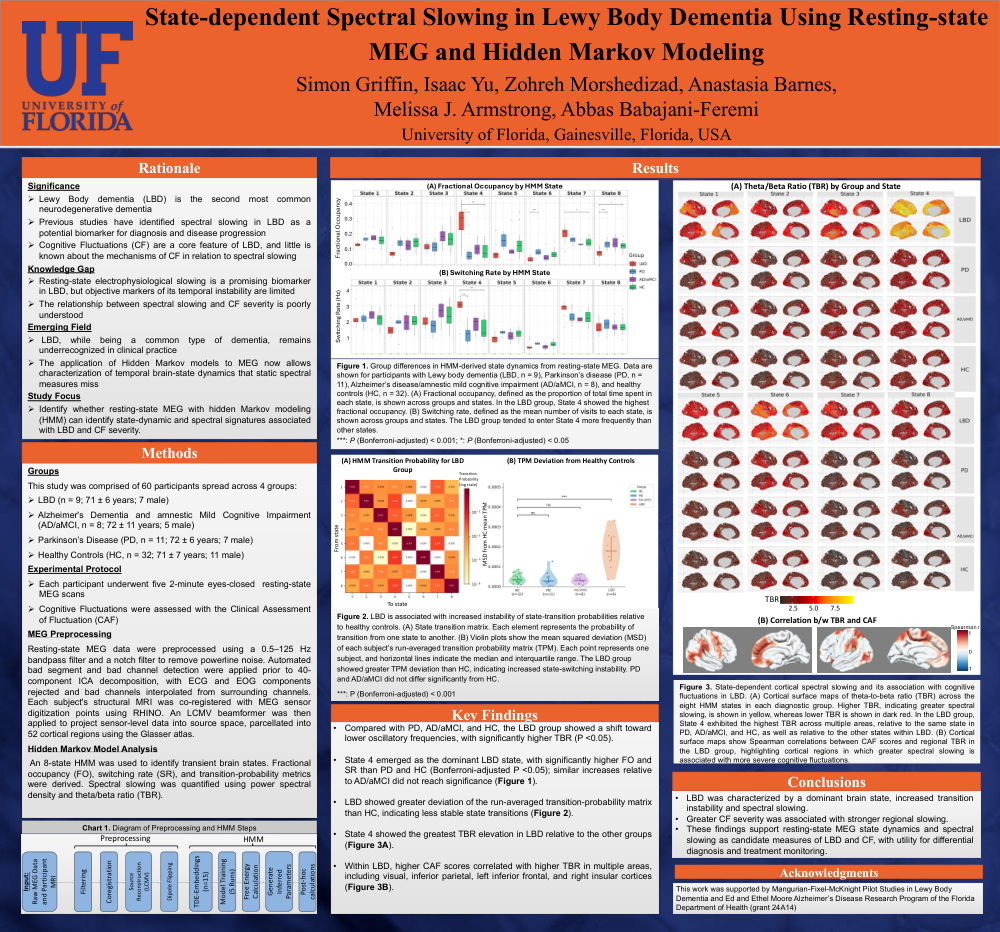
Results: Compared with PD, AD/aMCI, and HC, the LBD group showed a shift toward lower
oscillatory frequencies, with significantly higher TBR (P <0.05). State 4 emerged as the
dominant LBD state, with significantly higher FO and SR than PD and HC (Bonferroni-adjusted
P <0.05); similar increases relative to AD/aMCI did not reach significance (Figure 1). LBD
showed greater deviation of the run-averaged transition-probability matrix than HC,
indicating less stable state transitions (Figure 2). State 4 showed the greatest TBR elevation
in LBD relative to the other groups (Figure 3A). Within LBD, higher CAF scores correlated with
higher TBR in multiple areas, including visual, inferior parietal, left inferior frontal, and right
insular cortices (Figure 3B).
Conclusion: LBD was characterized by a dominant brain state, increased transition instability,
and spectral slowing. Greater CF severity was associated with stronger regional slowing.
These findings support resting-state MEG state dynamics and spectral slowing as candidate
measures of LBD and CF, with utility for di"erential diagnosis and treatment monitoring.
Comments
Email is required but is not shown publicly.
Loading comments...