4,068 posters, 219 videos, 101 topics, 69 sessions, 14,365 authors, 6,128 institutions
ePostersLive by SciGen Technologies S.A. All rights reserved.
Alzheimer's Association International Conference 2026
July 12-15, 2026 | London, United Kingdom, and Online

13292
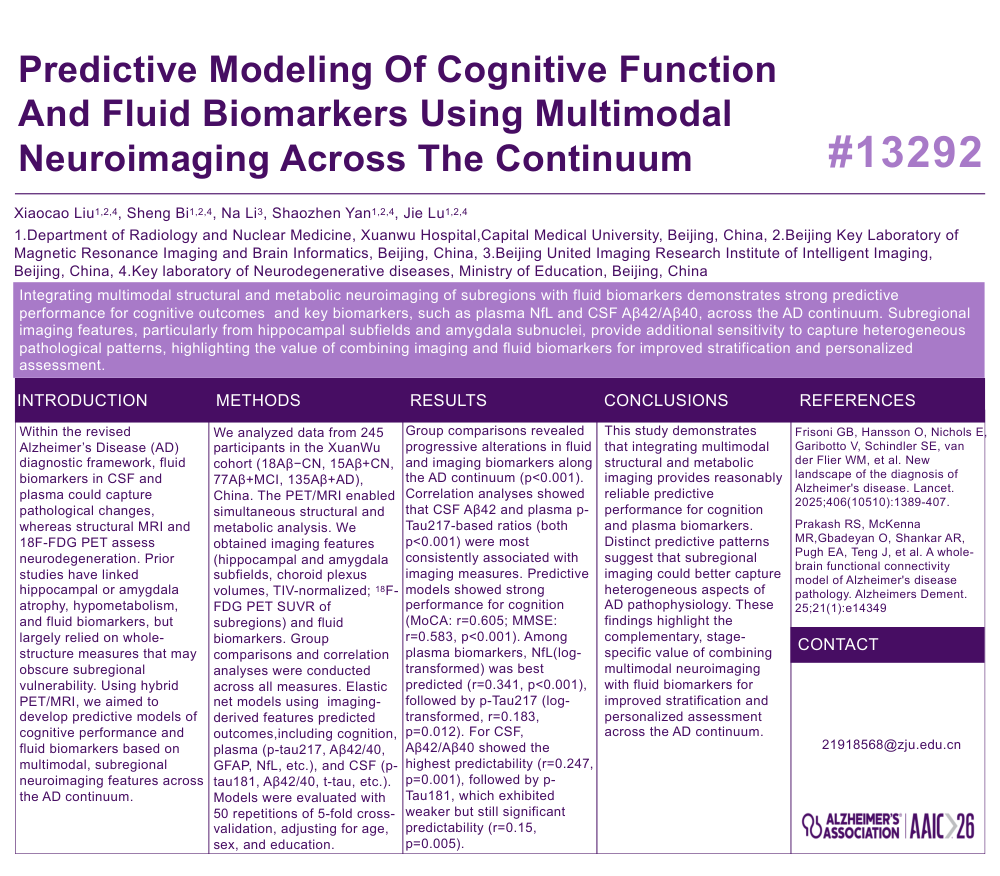
Predictive Modeling Of Cognitive Function And Fluid Biomarkers Using Multimodal Neuroimaging Across The Continuum
Poster Presenter
Part of Topic
Virtual
Introduction:Within the revised Alzheimer’s Disease (AD) diagnostic framework, fluid biomarkers in CSF and plasma could capture pathological changes, whereas structural MRI and 18F-FDG PET assess neurodegeneration. Prior studies have linked hippocampal or amygdala atrophy, hypometabolism, and fluid biomarkers, but largely relied on whole-structure measures that may obscure subregional vulnerability. Using hybrid PET/MRI, we aimed to develop predictive models of cognitive performance and fluid biomarkers based on multimodal, subregional neuroimaging features across the AD continuum.
Methods:We analyzed data from 245 participants in the XuanWu cohort (18Aβ−CN, 15Aβ+CN, 77Aβ+MCI, 135Aβ+AD), China. The PET/MRI enabled simultaneous structural and metabolic analysis. We obtained imaging features (hippocampal and amygdala subfields, choroid plexus volumes, TIV-normalized; 18F-FDG PET SUVR of subregions) and fluid biomarkers. Group comparisons and correlation analyses were conducted across all measures. Elastic net models using imaging-derived features predicted outcomes,including cognition, plasma (p-tau217, Aβ42/40, GFAP, NfL, etc.), and CSF (p-tau181, Aβ42/40, t-tau, etc.). Models were evaluated with 50 repetitions of 5-fold cross-validation, adjusting for age, sex, and education.
Results:Group comparisons revealed progressive alterations in fluid and imaging biomarkers along the AD continuum (p<0.001). Correlation analyses showed that CSF Aβ42 and plasma p-Tau217-based ratios (both p<0.001) were most consistently associated with imaging measures. Predictive models showed strong performance for cognition (MoCA: r=0.605; MMSE: r=0.583, p<0.001). Among plasma biomarkers, NfL(log-transformed) was best predicted (r=0.341, p<0.001), followed by p-Tau217 (log-transformed, r=0.183, p=0.012). For CSF, Aβ42/Aβ40 showed the highest predictability (r=0.247, p=0.001), followed by p-Tau181, which exhibited weaker but still significant predictability (r=0.15, p=0.005).
Conclusion:This study demonstrates that integrating multimodal structural and metabolic imaging provides reasonably reliable predictive performance for cognition and plasma biomarkers. Distinct predictive patterns suggest that subregional imaging could better capture heterogeneous aspects of AD pathophysiology. These findings highlight the complementary, stage-specific value of combining multimodal neuroimaging with fluid biomarkers for improved stratification and personalized assessment across the AD continuum.
Comments
Email is required but is not shown publicly.
Loading comments...