4,068 posters, 219 videos, 101 topics, 69 sessions, 14,365 authors, 6,128 institutions
ePostersLive by SciGen Technologies S.A. All rights reserved.
Alzheimer's Association International Conference 2026
July 12-15, 2026 | London, United Kingdom, and Online

13013
Plasma GFAP As A Prognostic Biomarker Of Cognitive Decline In FTD
Poster Presenter
Part of Topic
Virtual
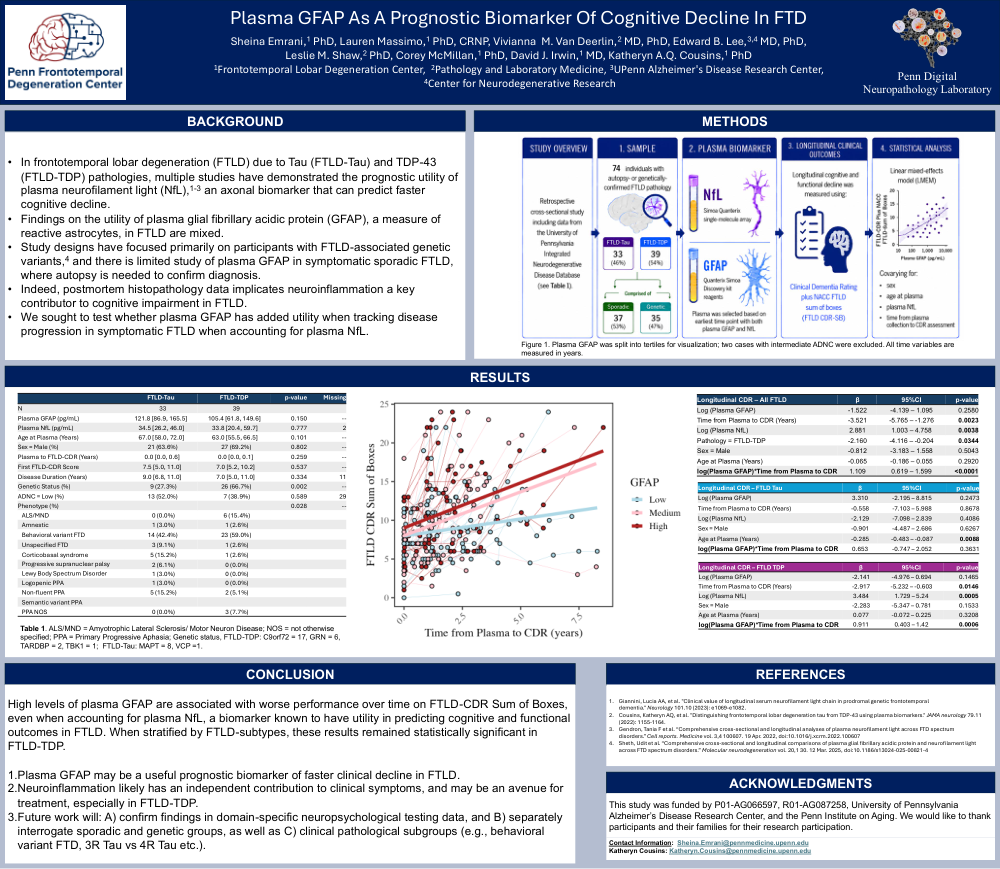
Objective: In frontotemporal lobar degeneration (FTLD) due to tau and TDP-43 pathologies, multiple studies have demonstrated the prognostic utility of plasma neurofilament light (NfL), which predicts faster cognitive decline. Findings on the utility of plasma glial fibrillary acidic protein (GFAP), a measure of reactive astrocytes, in FTLD are mixed, in part due to study designs that focus on participants with FTLD-associated pathogenic variants in presymptomatic and symptomatic disease stages. There is limited study of plasma GFAP in symptomatic sporadic FTLD, where autopsy is needed to confirm diagnosis. Indeed, postmortem histopathology data implicates neuroinflammation a key contributor to cognitive impairment in FTLD. We sought to test whether plasma GFAP has added utility when tracking disease progression in symptomatic FTLD when accounting for plasma NfL.
Methods: This retrospective cross-sectional study included data from the University of Pennsylvania Integrated Neurodegenerative Disease Database (see Table 1). The sample included 74 individuals with autopsy- or genetically-confirmed FTLD pathology (34 FTLD-tau, 40 FTLD-TDP; 39 sporadic and 35 familial). Antemortem plasma samples were analyzed for NfL using the Quanterix single-molecule array (Simoa) for GFAP using the Quanterix Simoa Discovery kit reagents. Longitudinal cognitive and functional decline was measured using the Clinical Dementia Rating plus NACC FTLD sum of boxes (FTLD CDR-SB).
Results: Individuals with higher levels of plasma GFAP at baseline had worse cognitive and functional outcomes (FTLD CDR-SB) (Fig 1). This finding was confirmed by a linear mixed effects model, with a significant time by plasma GFAP interaction (Figure 1; β=0.88, 95%CI = 0.432 – 1.334, p<0.001, Table 2), when covarying for baseline FTLD-CDR score, sex, age at plasma, and plasma NfL (Table 2). When stratifying by pathology, this effect was significant in FTLD-TDP but not FTLD-Tau (β=-1.27, 95%CI = -2.443 – -0.095, p=0.04).
Conclusion: This data indicates that plasma GFAP as a prognostic biomarker of faster clinical decline in FTLD, even when accounting for plasma NfL. Therefore, neuroinflammation likely has an independent contribution to clinical symptoms, and may be an avenue for treatment, especially in FTLD-TDP. Future work will confirm findings in domain-specific neuropsychological testing data and interrogate sporadic and familial groups as well as clinical pathological subgroups (e.g., bvFTD, 3R Tau vs 4R Tau etc.).
Comments
Email is required but is not shown publicly.
Loading comments...