4,068 posters, 219 videos, 101 topics, 69 sessions, 14,365 authors, 6,128 institutions
ePostersLive by SciGen Technologies S.A. All rights reserved.
Alzheimer's Association International Conference 2026
July 12-15, 2026 | London, United Kingdom, and Online

11957
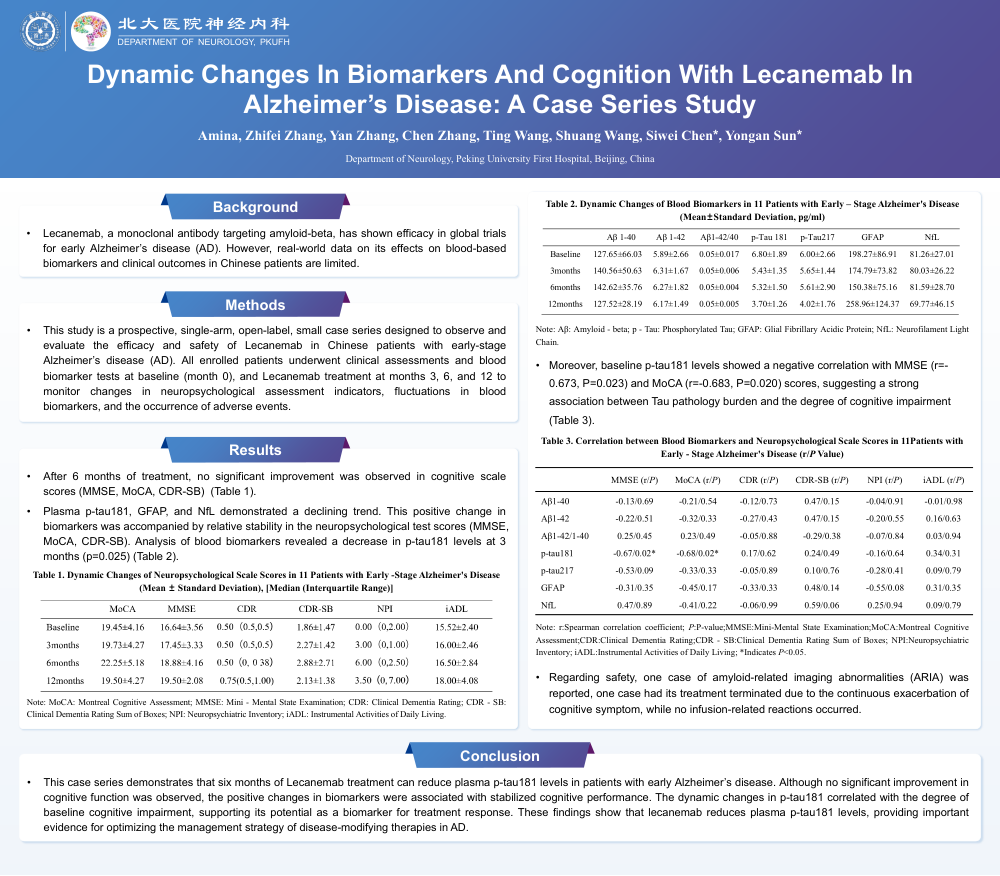
Dynamic Changes In Biomarkers And Cognition With Lecanemab In Alzheimer's Disease: A Case Series Study
Part of Topic
Virtual
Background: Lecanemab, a monoclonal antibody targeting amyloid-beta, has shown efficacy in global trials for early Alzheimer's disease (AD). However, real-world data on its effects on blood-based biomarkers and clinical outcomes in Chinese patients are limited. This study aimed to observe the dynamic changes in plasma biomarkers and cognition following lecanemab treatment in a Chinese cohort.
Objective: This study is a prospective, single-arm, open-label, small case series designed to observe and evaluate the efficacy and safety of lecanemab in Chinese patients with early-stage Alzheimer's disease (AD). All enrolled patients underwent clinical assessments and blood biomarker tests at baseline (month 0), and lecanemab treatment at months 3, 6, and 12 to monitor changes in neuropsychological assessment indicators, fluctuations in blood biomarkers, and the occurrence of adverse events.
Results: The mean age of the patients was 71.75 years. After 6 months of treatment, no significant improvement was observed in cognitive scale scores (MMSE, MoCA, CDR-SB). Plasma p-tau181, GFAP, and NfL demonstrated a declining trend. This positive change in biomarkers was accompanied by relative stability in the neuropsychological test scores (MMSE, MoCA, CDR-SB). Analysis of blood biomarkers revealed a decrease in p-tau181 levels at 3 months (p = 0.025). Moreover, baseline p-tau181 levels showed a negative correlation with MMSE (r = -0.673, P = 0.023) and MoCA (r = -0.683, P = 0.020) scores, suggesting a strong association between Tau pathology burden and the degree of cognitive impairment. Regarding safety, one case of amyloid-related imaging abnormalities (ARIA) was reported, one case had its treatment terminated due to the continuous exacerbation of cognitive symptom, while no infusion-related reactions occurred.
Conclusions: This case series demonstrates that six months of Lecanemab treatment can reduce plasma p-tau181 levels in patients with early Alzheimer's disease. Although no significant improvement in cognitive function was observed, the positive changes in biomarkers were associated with stabilized cognitive performance. The dynamic changes in p-tau181 correlated with the degree of baseline cognitive impairment, supporting its potential as a biomarker for treatment response. These findings show that lecanemab reduces plasma p-tau181 levels, providing important evidence for optimizing the management strategy of disease-modifying therapies in AD.
Comments
Email is required but is not shown publicly.
Loading comments...