4,068 posters, 219 videos, 101 topics, 69 sessions, 14,365 authors, 6,128 institutions
ePostersLive by SciGen Technologies S.A. All rights reserved.
Alzheimer's Association International Conference 2026
July 12-15, 2026 | London, United Kingdom, and Online

13736
Design Of A Reproducible Resting-state Functional Mri Analysis Pipeline For Dementia Research In Resource-limited Settings
Poster Presenter
Authors
Kimberley Clare Williams, Maxwell Adu, Mercy Nathaniel, Philip Nkwam, Jasmine Cakmak, Kesavi Kanagasaba, Ethan Draper, Abdalla Z Mohamed, Oumayma Soula
Affiliations
Neuroscience Institute, Department of Psychiatry and Mental Health, University of Cape Town, Komfo Anokye Teaching Hospital, Kumasi,Ghana, Ahmadu Bello University, Zaria, Nigeria, University of Lagos, Lagos, Nigeria, Montreal Neurological Institute, McGill University, Montreal, Canada, Western University, London, Ontario, Canada, Arab Emirates University, Al Ain, Abu Dhabi, United Arab Emirates, Faculty of Medicine of Sfax, University of Sfax, Tunisia
Part of Topic
Virtual
Title: Design of a Reproducible Resting-state Functional MRI Analysis Pipeline for Dementia Research in Resource-Limited Settings
Authors and Affiliation:
Kimberley Clare Williams¹,. Maxwell Adu²,. Mercy Nathaniel³,. Philip Nkwam4,. Jasmine Cakmak5,. Kesavi Kanagasabai6,. Ethan Draper5,7,8,. Abdalla Z Mohamed8,. Oumayma Soula9
¹ Neuroscience Institute, University of Cape Town, Cape Town, South Africa
² Komfo Anokye Teaching Hospital, Kumasi,Ghana
³ Ahmadu Bello University, Zaria, Nigeria
4 University of Lagos, Lagos, Nigeria
5 Montreal Neurological Institute, McGill University, Montreal, Canada
6 Western University, London, Ontario, Canada
7 Department of Bioengineering, Imperial College London, UK
8 Arab Emirates University, Al Ain, Abu Dhabi, United Arab Emirates
9 Faculty of Medicine of Sfax, University of Sfax, Tunisia
Keywords: rs-fMRI, preprocessing, ALFF, fALFF, ReHo, Africa, low-to-middle income countries, resource constraint
Background
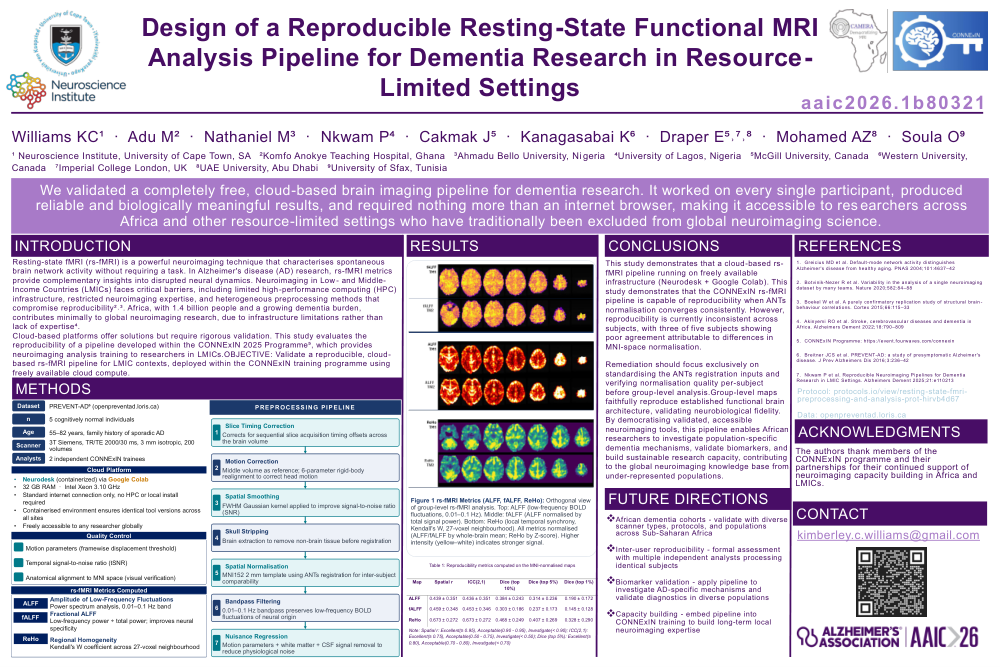
Resting-state functional MRI(rs-fMRI) is a powerful neuroimaging technique used to characterise brain network activity. In the context of Alzheimer's disease research, metrics including the Amplitude of Low-Frequency Fluctuations (ALFF), fractional ALFF(fALFF), and Regional Homogeneity(ReHo) provide complementary insights into disrupted neural dynamics. The purpose of this study was to evaluate reproducibility of a pipeline produced within the COmprehensive Neuroimaging aNalysis Experience In resource-constrained Settings(CONNExIN) 2025 Programme, which provides neuroimaging analysis training to researchers in Low- and Middle-Income Countries(LMICs).
Methods
Two CONNExIN Trainees independently analyzed the baseline rs-fMRI scans of 5 individuals from the Pre-symptomatic Evaluation of Novel or Experimental Treatments for Alzheimer's Disease (PREVENT-AD) dataset(https://openpreventad.loris.ca/) to validate a resource-efficient pipeline(protocols.io link) deployed on Neurodesk via Google Colab, accessible through standard internet connections. The workflow included slice-timing correction, motion correction, skull-stripping, and spatial normalization. The pipeline was validated by comparing the ALFF, fALFF, and ReHo maps produced on the same dataset, measuring spatial correlation, intraclass correlation, and percentile-based spatial overlap to assess reproducibility across implementations.
Results
The pipeline generated single ALFF, fALFF and ReHo maps(Figure1). The validation reveals highly heterogeneous reproducibility across subjects. One subject was successful, achieving near-perfect ReHo agreement(r=0.979) and good ALFF/fALFF agreement, Table1. Two subjects showed near-zero correlations across all metrics, indicating substantial reproducibility failure, likely driven by inconsistencies in ANTs-based spatial normalization. Across subjects, ReHo showed higher reproducibility (r = 0.673 ± 0.272) compared to ALFF and fALFF (r ≈ 0.44–0.46), indicating greater robustness of local synchrony measures to pipeline variability.
Conclusions
This study demonstrates that the CONNExIN rs-fMRI pipeline is capable of reproducibility when ANTs normalisation converges consistently. However, reproducibility is currently inconsistent across subjects, with three of five subjects showing poor agreement attributable to differences in MNI-space normalisation. Remediation should focus exclusively on standardising the ANTs registration inputs and verifying normalisation quality per-subject before group-level analysis.
Comments
Email is required but is not shown publicly.
Loading comments...