4,068 posters, 219 videos, 101 topics, 69 sessions, 14,365 authors, 6,128 institutions
ePostersLive by SciGen Technologies S.A. All rights reserved.
Alzheimer's Association International Conference 2026
July 12-15, 2026 | London, United Kingdom, and Online

13632
Depression Severity Predicts Accelerated Hypometabolism In Alzheimer’s Brain Regions Independent Of Insomnia
Poster Presenter
Authors
Affiliations
null,
Part of Topic
Virtual
Hanadi Kamal, Daniel Silverman
Depression Severity Predicts Accelerated Hypometabolism In Alzheimer’s Brain Regions Independent Of Insomnia
Abstract:
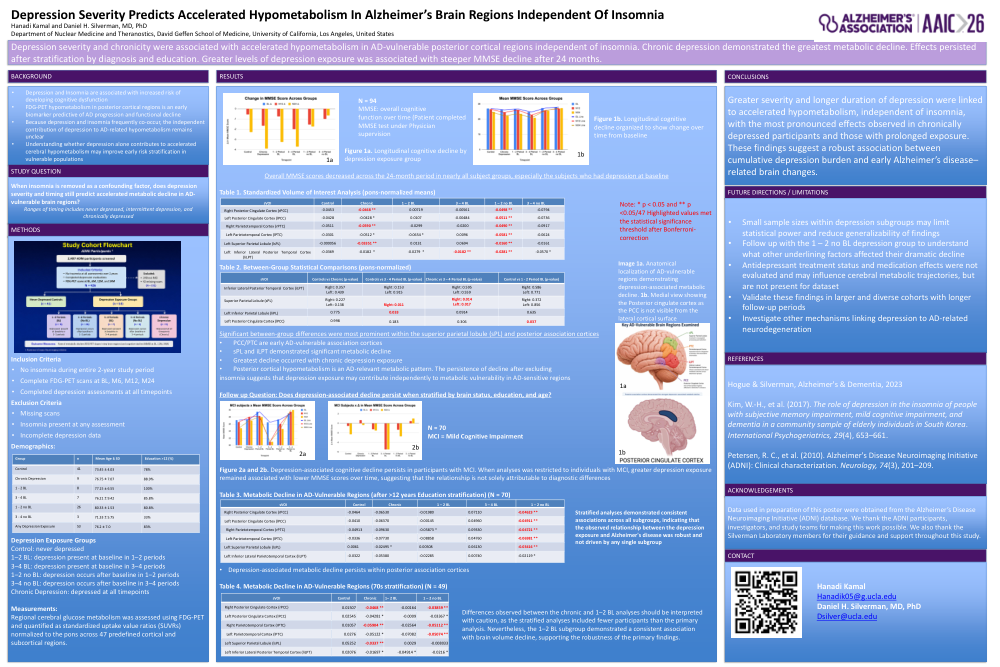
Background: Both depression and insomnia are associated with increased risk of developing cognitive dysfunction. Hypometabolism in certain posterior cortical regions has been found to predict subsequent cognitive and functional decline among people at increased risk for developing AD. As sleep disorders and depression are often comorbid conditions, the relative contributions of both conditions to hypometabolism that portends development of dementia remains to be clarified. The present analysis took advantage of the opportunity presented by the large number of subjects with pertinent data in the Alzheimer’s Disease Neuroimaging Initiative (ADNI), to study depression in subjects without insomnia, to better assess the metabolic impact of depression per se.
Methods: A consecutive series of 2,407 participants enrolled in ADNI were screened and all participants who were free of insomnia at all assessment points over a two-year period and had complete longitudinal clinical and FDG-PET data at baseline, 6 months, 12 months, and 24 months were included in the present analysis. Cumulative depression exposure was defined as the number of semiannual time points at which depression was present. Rate of metabolic decline was quantified as the slope of pons-normalized FDG uptake across 47 pre-defined standardized volumes of interest.
Results: Subjects who were cognitively normal at baseline demonstrated cortical metabolic decline in multiple brain regons over two years. Among participants with baseline depression, greater cumulative exposure was associated with more pronounced regional metabolic decline, particularly in parietotemporal, posterior cingulate, and superior parietal regions. Participants with depression onset occurring after baseline demonstrated the steepest overall metabolic decline; those with post-baseline exposure scores of 3 or 4 demonstrated particularly severe decline. After correction for multiple comparisons, significant decline was most consistently localized to inferior lateral temporal and, more superiorly, parietotemporal cortical regions.
Conclusion: Both timing of onset and severity of depression accelerated cerebral metabolic decline in patients documented to be free of insomnia throughout the the two-year study period, demonstrating that the association between depressed mood and metabolic dementia risk persists in absence of the sleep disruption frequently associated with depression.
Comments
Email is required but is not shown publicly.
Loading comments...