193 posters, 19 videos, 10 audios, 3 topics, 28 sessions, 714 authors, 278 institutions
ePostersLive by SciGen Technologies S.A. All rights reserved.
9th World Congress on Vascular Access 2026
15 - 17 April, 2026 | Valencia, Spain

91
Comparative safety of PICC-ports and chest ports in oncolgy : A monocentric retrospective cohort study
Poster Presenter
Part of Topic
Title: Comparative safety of PICC-ports and chest ports in oncology: a monocentric retrospective cohort study
Description:
Totally implantable venous access devices are widely used in oncology for the administration of chemotherapy and supportive treatments. Recently, PICC-ports have emerged as an alternative to conventional chest ports, potentially offering easier insertion with ultrasound guidance and improved patient comfort. However, comparative safety data between these two devices remain limited.
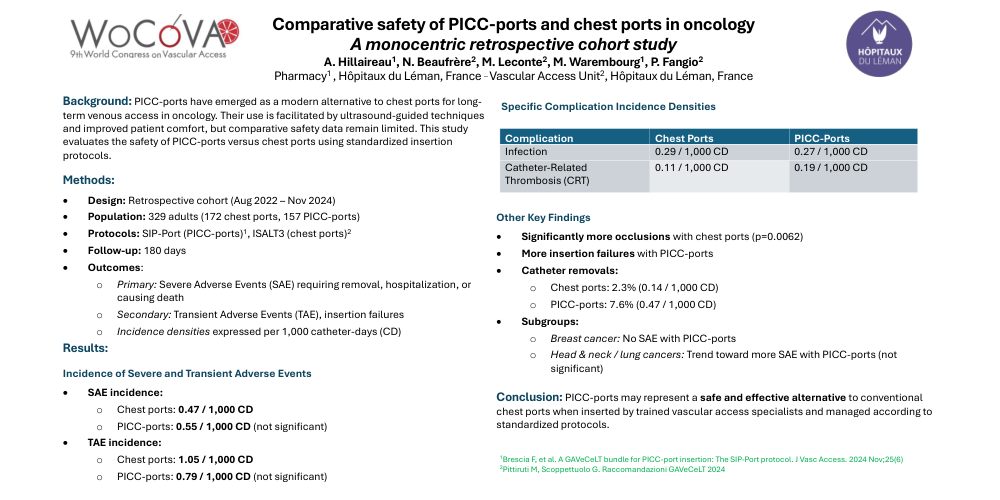
This monocentric retrospective cohort study conducted at Hôpitaux du Léman (France) evaluated the safety of PICC-ports compared with chest ports in adult oncology patients. A total of 329 patients were included between August 2022 and November 2024 (172 chest ports and 157 PICC-ports) with a follow-up period of 180 days. Devices were inserted and managed according to standardized protocols (SIP-Port protocol for PICC-ports and ISALT3 recommendations for chest ports).
The primary outcome was the incidence of severe adverse events (SAE) requiring device removal, hospitalization, or resulting in death. Secondary outcomes included transient adverse events (TAE) and insertion failures. Incidence densities were expressed per 1,000 catheter-days.
Results showed no statistically significant difference in the incidence of severe or transient adverse events between the two devices. Infection and catheter-related thrombosis rates were comparable. Chest ports were associated with significantly more occlusions, whereas PICC-ports had a higher rate of insertion failures and catheter removals. Subgroup analysis showed no severe adverse events with PICC-ports in breast cancer patients, while a non-significant trend toward higher SAE incidence was observed in head-and-neck and lung cancer patients.
Overall, PICC-ports appear to be a safe and effective alternative to conventional chest ports when inserted by trained vascular access specialists and managed according to standardized protocols.
wocova2026.084012e
Keywords: PICC-port, chest port, oncology, vascular access device, catheter-related complications, retrospective cohort study.