193 posters, 19 videos, 10 audios, 3 topics, 28 sessions, 714 authors, 278 institutions
ePostersLive by SciGen Technologies S.A. All rights reserved.
9th World Congress on Vascular Access 2026
15 - 17 April, 2026 | Valencia, Spain

103
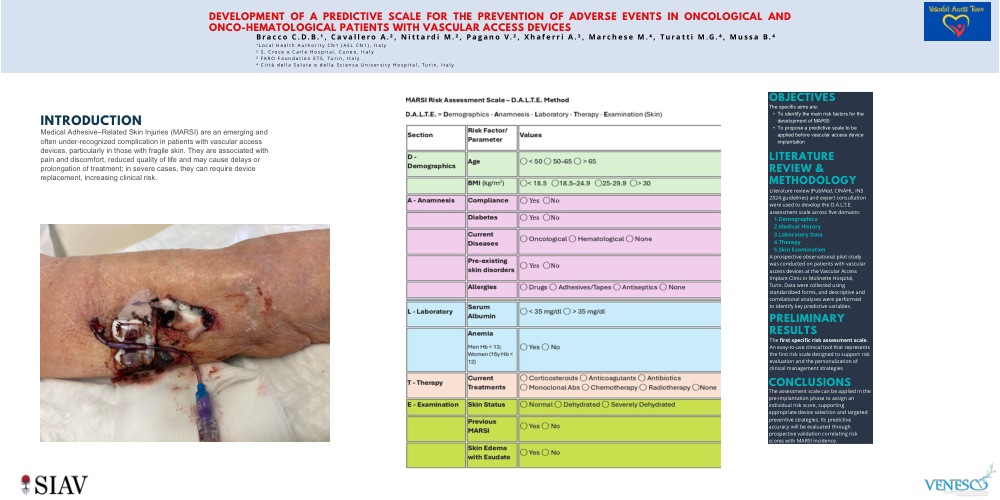
Development of a Predictive Scale (D.A.L.T.E.) for MARSI Prevention in Oncological Patients with Vascular Access
Poster Presenter
Part of Topic
Review
Video
Title:
Development of a Predictive Scale (D.A.L.T.E.) for Prevention of MARSI in Oncology Patients with Vascular Access Devices
Background
• Medical adhesive–related skin injury (MARSI) is a frequent but under‑recognized complication in oncology patients with central and peripheral vascular access devices.
• Repeated dressing changes, fragile skin, and antineoplastic therapy increase MARSI risk, yet no validated risk‑prediction tool specifically addresses vascular‑access–related MARSI in this population.
Objectives
• To develop a clinically applicable predictive scale (D.A.L.T.E.) to estimate a patient’s risk of developing MARSI at vascular access sites.
• To identify modifiable factors that can guide preventive strategies and dressing selection.
Methods
• Prospective observational study of adult oncology patients with central or peripheral vascular access devices in a tertiary cancer center.
• Baseline assessment included demographic data, comorbidities, nutritional status, treatment characteristics, skin condition, device type and site, adhesive/dressing characteristics, and care practices.
• Patients were monitored for the occurrence and characteristics of MARSI, classified according to international consensus definitions.
• Multivariable analysis identified independent predictors of MARSI; these were converted into a weighted bedside score (D.A.L.T.E.) and grouped into risk categories.
Results
• Several independent predictors emerged, including age‑related skin fragility, previous dermatologic disease or radiotherapy, type and frequency of adhesive/dressing use, perspiration/moisture, and specific chemotherapy regimens.
• The D.A.L.T.E. score stratified patients into low‑, moderate‑, and high‑risk groups with clear separation of MARSI incidence across strata.
• The scale was easy to apply at the bedside and could be completed in a few minutes by nursing staff.
Conclusions
• The D.A.L.T.E. scale provides a structured method to estimate MARSI risk in oncology patients with vascular access devices.
• Integration of the score into routine assessment may support individualized selection of dressings and securement methods, optimization of dressing‑change intervals, and early dermatologic referral for high‑risk patients.
• External validation and refinement in larger, multicenter cohorts are warranted.