193 posters, 19 videos, 10 audios, 3 topics, 28 sessions, 714 authors, 278 institutions
ePostersLive by SciGen Technologies S.A. All rights reserved.
9th World Congress on Vascular Access 2026
15 - 17 April, 2026 | Valencia, Spain

90
Initial clinical outcomes of the first nurse-inserted peripherally inserted central catheters in Poland
Poster Presenter
Authors
Affiliations
Part of Topic
** Background and Objective
The concept of organized vascular access teams (VATs) had not been systematically implemented in Poland until recent years. The COVID-19 pandemic accelerated the introduction of midline catheters and underscored the need for structured vascular access services. In response, the first interdisciplinary nurse-based VAT was established. Building on this initiative, a prospective observational study was initiated to assess the feasibility and outcomes of nurse-inserted peripherally inserted central catheters (PICC). This abstract presents the initial clinical experience of the team during the early implementation phase.
** Methods
The study was registered on ClinicalTrials.gov and approved by the Bioethics Committee (KB/35/2025). The study commenced in May 2025 in a university hospital in Poland. Ultrasound-guided PICC insertion was performed by trained nurses, with tip position confirmed using intracavitary ECG under physician supervision. To date, 112 PICCs have been successfully inserted.
** Results
Population
A total of 127 PICC insertion procedures were performed during the implementation of a nurse-led PICC program. Of these, 117 patients were included in the analysis, and 112 successfully inserted PICCs were available for follow-up, corresponding to 3007 catheter-days. The most common indications for PICC insertion were antimicrobial therapy (40.2%), total parenteral nutrition (38.5%), blood sampling (36.8%), intravenous drug administration (35.9%), and chemotherapy (35.9%). Implementation of the program enabled de-escalation from centrally inserted central catheters (CICC) in 67.5% of patients.
Procedure
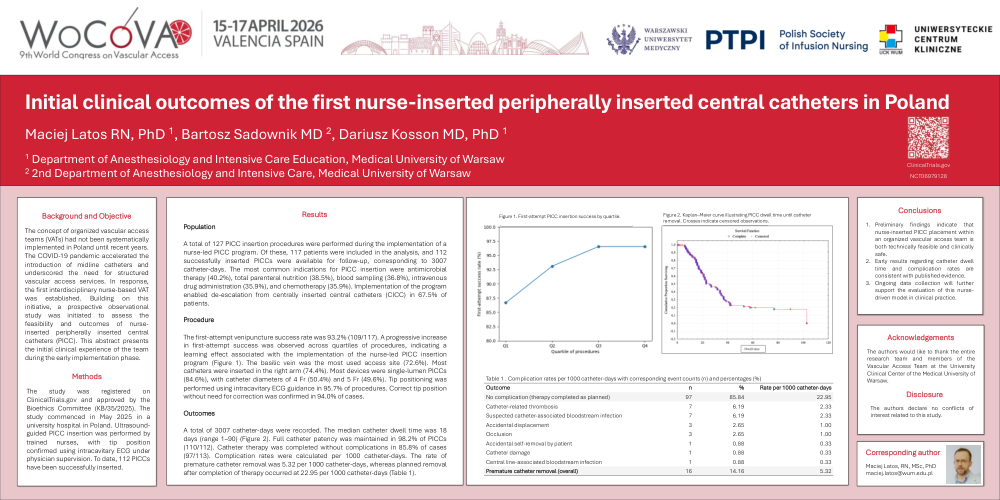
The first-attempt venipuncture success rate was 93.2% (109/117). A progressive increase in first-attempt success was observed across quartiles of procedures, indicating a learning effect associated with the implementation of the nurse-led PICC insertion program (Figure 1). The basilic vein was the most used access site (72.6%). Most catheters were inserted in the right arm (74.4%). Most devices were single-lumen PICCs (84.6%), with catheter diameters of 4 Fr (50.4%) and 5 Fr (49.6%). Tip positioning was performed using intracavitary ECG guidance in 95.7% of procedures. Correct tip position without need for correction was confirmed in 94.0% of cases.
Outcomes
A total of 3007 catheter-days were recorded. The median catheter dwell time was 18 days (range 1–90) (Figure 2). Full catheter patency was maintained in 98.2% of PICCs (110/112). Catheter therapy was completed without complications in 85.8% of cases (97/113). Complication rates were calculated per 1000 catheter-days. The rate of premature catheter removal was 5.32 per 1000 catheter-days, whereas planned removal after completion of therapy occurred at 22.95 per 1000 catheter-days (Table 1).
** Conclusions