193 posters, 19 videos, 10 audios, 3 topics, 28 sessions, 714 authors, 278 institutions
ePostersLive by SciGen Technologies S.A. All rights reserved.
9th World Congress on Vascular Access 2026
15 - 17 April, 2026 | Valencia, Spain

309
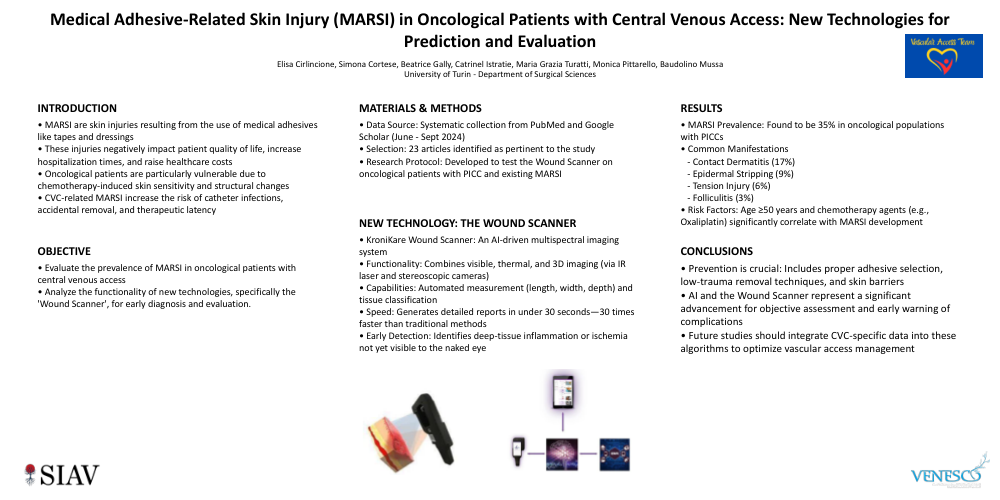
Design and development of a predictive risk scale for the preventive management of Medical Adhesive-Related Skin Injuries (MARSI) in oncological patients with vascular access devices
Poster Presenter
Authors
Baudolino Mussa, Camila Dias Braga Bracco, Arianna Cavallero, Marta Nittardi, Valentina Pagano, Alessia Xhaferri, Mara Marchese, Maria Grazia Turatti
Affiliations
Città della salute e della scienza di Torino, Città della Salute e della Scienza University Hospital, Local Health Authority - ASL CN1, Santa Croce e Carle Hospital - CN, FARO Foundation ETS
Part of Topic
Other
Video
Title:
Design and development of a predictive risk scale for the preventive management of Medical Adhesive-Related Skin Injuries (MARSI) in oncological patients with vascular access devices
Background: Medical adhesive-related skin injuries (MARSI) are an underestimated complication in oncological patients with vascular access devices. They may impair skin integrity, increase discomfort, prolong care, and raise healthcare costs, especially in patients undergoing repeated dressing changes and chemotherapy.
Aim: This study aimed to explore the burden of MARSI in oncological patients with central vascular access and to support the development of a predictive risk scale for preventive management. A secondary aim was to evaluate the potential role of the Wound Scanner in the early assessment of MARSI.
Methods: A literature search was conducted mainly in PubMed, with additional support from Google Scholar, using keywords related to MARSI, oncology, central venous catheters, prevalence, incidence, prevention, and wound-scanning technologies. After screening the available evidence, 23 articles were included in the thesis work.
Results: Reported MARSI prevalence in oncological patients with central venous access was high, reaching 35% in the reviewed data, with 29.83% of skin injuries reported at the PICC insertion site in one oncology cohort. The most frequent MARSI subtype was irritant contact dermatitis, followed by epidermal stripping, tension injury, and folliculitis. Key risk factors included advanced age, chemotherapy-related skin fragility, repeated adhesive removal, and prolonged catheter use.
Conclusions: MARSI are potentially preventable events and should be addressed through systematic risk assessment, skin surveillance, appropriate dressing selection, and nursing education. A predictive risk scale may help identify high-risk patients early and support targeted preventive strategies. The Wound Scanner appears promising for early assessment, but further clinical validation is needed before routine use.