193 posters, 19 videos, 10 audios, 3 topics, 28 sessions, 714 authors, 278 institutions
ePostersLive by SciGen Technologies S.A. All rights reserved.
9th World Congress on Vascular Access 2026
15 - 17 April, 2026 | Valencia, Spain

58
Time efforts, waste generation and risks associated with the replacement of single components of a typical infusion setup
Poster Presenter
Authors
David Thalmann, Nico Hillebrand, Katharina Berger, Wolfgang Waxenberger
Affiliations
Part of Topic
Other
Introduction
Infusion devices such as 3-way-stopcocks, back-check valves and needlefree connectors are exposed to various parenteral
drugs.
However, there are incompatibilities between certain plastics and drugs which may lead to stress cracks of infusion devices. Defective devices require immediate replacement, but time efforts, waste generation and risks associated with such replacements have not been evaluated yet.
Methods
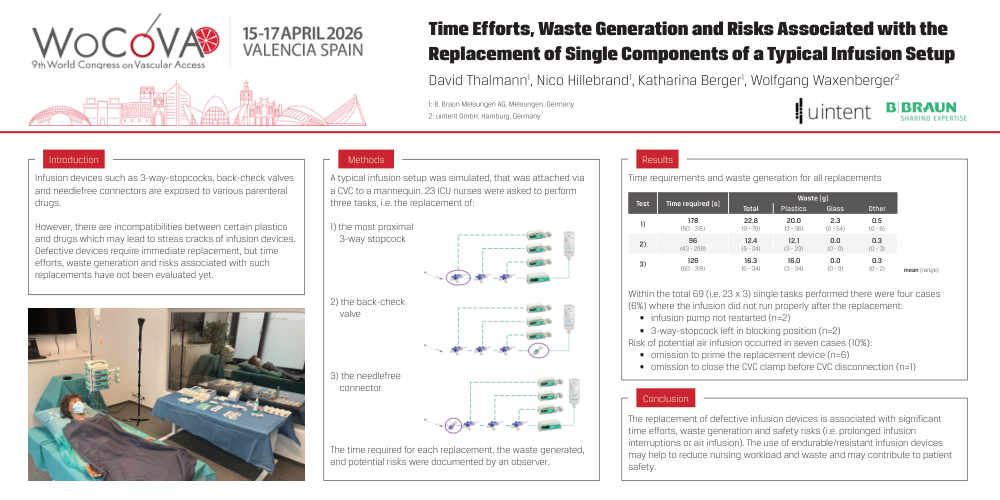
A typical infusion setup was simulated, that was attached via a CVC to a mannequin. 23 ICU nurses were asked to perform three tasks, i.e. the replacement of:
1) the most proximal 3-way stopcock
2) the back-check valve
3) the needlefree connector
The time required for each replacement, the waste generated, and potential risks were documented by an observer.
Results
Time requirements and waste generation for all replacements: (see table)
Within the total 69 (i.e. 23 x 3) single tasks performed there were four cases (6%) where the infusion did not run properly after the replacement:
• infusion pump not restarted (n=2)
• 3-way-stopcock left in blocking position (n=2)
Risk of potential air infusion occurred in seven cases (10%):
• omission to prime the replacement device (n=6)
• omission to close the CVC clamp before CVC disconnection (n=1)
Conclusion
The replacement of defective infusion devices is associated with significant time efforts, waste generation and safety risks (i.e. prolonged infusion
interruptions or air infusion). The use of endurable/resistant infusion devices may help to reduce nursing workload and waste and may contribute to patient
safety.