193 posters, 19 videos, 10 audios, 3 topics, 28 sessions, 709 authors, 279 institutions
ePostersLive by SciGen Technologies S.A. All rights reserved.
9th World Congress on Vascular Access 2026
15 - 17 April, 2026 | Valencia, Spain

334
MORBIDITY OF INSTALLATION OF AN IMPLANTABLE CATHETER PORT: A Porspective MONOCENTRIC STUDY CONDUCTED in LMIC settings
Poster Presenter
Authors
Montassar Ghalleb, Amine Bouida, Hanen Bouaziz, Mehdi Mbarek, Yosr Zenzri, Amina Mokrani, Tarek Ben dhieb
Affiliations
Medical oncology department Institut Salah Azaiez of oncology, Medical oncology department Institut Salah Azaiez of oncology, Surgical oncology Institut Salah Azaiez de cancerologie, Surgical oncology Institut Salah Azaiez de cancerologie, Surgical oncology Institut Salah Azaiez de cancerologie, Surgical oncology Institut Salah Azaiez de cancerologie,
Part of Topic
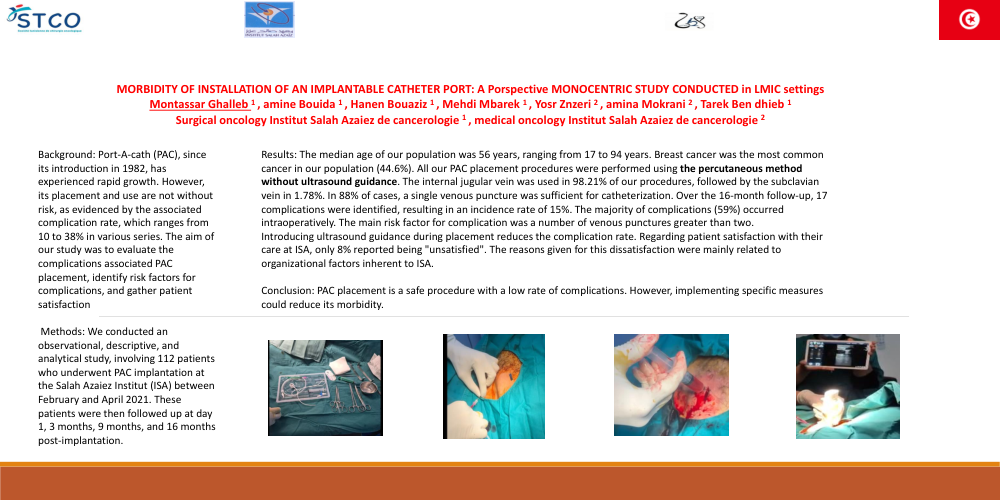
This E-poster presents a prospective monocentric study titled "MORBIDITY OF INSTALLATION OF AN IMPLANTABLE CATHETER PORT: A Porspective MONOCENTRIC STUDY CONDUCTED in LMIC settings," authored by Montassar Ghalleb and colleagues from the Institut Salah Azaiez de cancerologie. The study aimed to evaluate the complications, identify risk factors, and assess patient satisfaction associated with Port-A-cath (PAC) placements, noting that historically, complication rates range from 10 to 38%. To achieve this, the researchers conducted an observational and analytical study on 112 patients who had PACs implanted between February and April 2021, with follow-ups extending up to 16 months. The patient cohort had a median age of 56, and breast cancer was the most frequent diagnosis, representing 44.6% of the cases. Procedurally, all placements were performed percutaneously without ultrasound guidance, predominantly utilizing the internal jugular vein (98.21%), and 88% of the cases required only a single venous puncture. Over the 16-month follow-up, the study recorded a 15% complication rate, with the majority of these complications (59%) occurring intraoperatively; the primary risk factor identified was needing more than two venous punctures. The authors highlighted that introducing ultrasound guidance during placement could help reduce this complication rate. Patient satisfaction was notably high, with only 8% expressing dissatisfaction, which was primarily attributed to organizational factors at the institute rather than the clinical care. Visually, the poster is supported by four clinical photographs illustrating the surgical setup, the incision and port insertion, and the application of an ultrasound device. Ultimately, the study concludes that while PAC placement is a safe procedure with a low complication rate, implementing specific measures could further minimize morbidity