193 posters, 19 videos, 10 audios, 3 topics, 28 sessions, 709 authors, 279 institutions
ePostersLive by SciGen Technologies S.A. All rights reserved.
9th World Congress on Vascular Access 2026
15 - 17 April, 2026 | Valencia, Spain
420
<p>Anesthesia-Sparing Strategy for Port-a-Cath Implantation in a Pediatric Pompe Disease Patient: A Case Report</p>
Poster Presenter
Authors
Affiliations
Part of Topic
Video
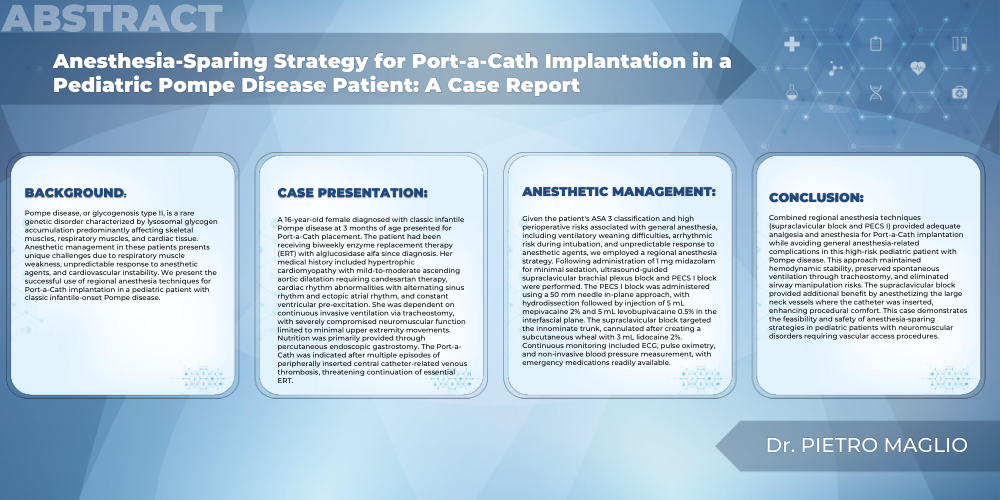
Anesthesia-Sparing Strategy for Port-a-Cath Implantation in a Pediatric Pompe Disease Patient: A Case Report
BACKGROUND:
Pompe disease, or glycogenosis type II, is a rare genetic disorder characterized by lysosomal glycogen accumulation predominantly affecting skeletal muscles, respiratory muscles, and cardiac tissue. Anesthetic management in these patients presents unique challenges due to respiratory muscle weakness, unpredictable response to anesthetic agents, and cardiovascular instability. We present the successful use of regional anesthesia techniques for Port-a-Cath implantation in a pediatric patient with classic infantile-onset Pompe disease.
CASE PRESENTATION:
A 16-year-old female diagnosed with classic infantile Pompe disease at 3 months of age presented for Port-a-Cath placement. The patient had been receiving biweekly enzyme replacement therapy (ERT) with alglucosidase alfa since diagnosis. Her medical history included hypertrophic cardiomyopathy with mild-to-moderate ascending aortic dilatation requiring candesartan therapy, cardiac rhythm abnormalities with alternating sinus rhythm and ectopic atrial rhythm, and constant ventricular pre-excitation. She was dependent on continuous invasive ventilation via tracheostomy, with severely compromised neuromuscular function limited to minimal upper extremity movements. Nutrition was primarily provided through percutaneous endoscopic gastrostomy. The Port-a-Cath was indicated after multiple episodes of peripherally inserted central catheter-related venous thrombosis, threatening continuation of essential ERT.
ANESTHETIC MANAGEMENT:
Given the patient’s ASA 3 classification and high perioperative risks associated with general anesthesia, including ventilatory weaning difficulties, arrhythmic risk during intubation, and unpredictable response to anesthetic agents, we employed a regional anesthesia strategy. Following administration of 1 mg midazolam for minimal sedation, ultrasound-guided supraclavicular brachial plexus block and PECS I block were performed. The PECS I block was administered using a 50 mm needle in-plane approach, with hydrodissection followed by injection of 5 mL mepivacaine 2% and 5 mL levobupivacaine 0.5% in the interfascial plane. The supraclavicular block targeted the innominate trunk, cannulated after creating a subcutaneous wheal with 3 mL lidocaine 2%. Continuous monitoring included ECG, pulse oximetry, and non-invasive blood pressure measurement, with emergency medications readily available.
CONCLUSION:
Combined regional anesthesia techniques (supraclavicular block and PECS I) provided adequate analgesia and anesthesia for Port-a-Cath implantation while avoiding general anesthesia-related complications in this high-risk pediatric patient with Pompe disease. This approach maintained hemodynamic stability, preserved spontaneous ventilation through tracheostomy, and eliminated airway manipulation risks. The supraclavicular block provided additional benefit by anesthetizing the large neck vessels where the catheter was inserted, enhancing procedural comfort. This case demonstrates the feasibility and safety of anesthesia-sparing strategies in pediatric patients with neuromuscular disorders requiring vascular access procedures.