193 posters, 19 videos, 10 audios, 3 topics, 28 sessions, 709 authors, 279 institutions
ePostersLive by SciGen Technologies S.A. All rights reserved.
9th World Congress on Vascular Access 2026
15 - 17 April, 2026 | Valencia, Spain

419
<p>Antimicrobial Catheter Technologies: From Chemistry and Manufacturing to In-Vivo Performance<em></em></p>
Poster Presenter
Authors
Affiliations
Part of Topic
Antimicrobial Catheter Technologies: From Chemistry and Manufacturing to In Vivo Performance
Nisha Gupta, BSc., M.Sc., Ph.D.
Teleflex Vascular Division Research & Development Department, Wyomissing, PA 19610, USA
Introduction
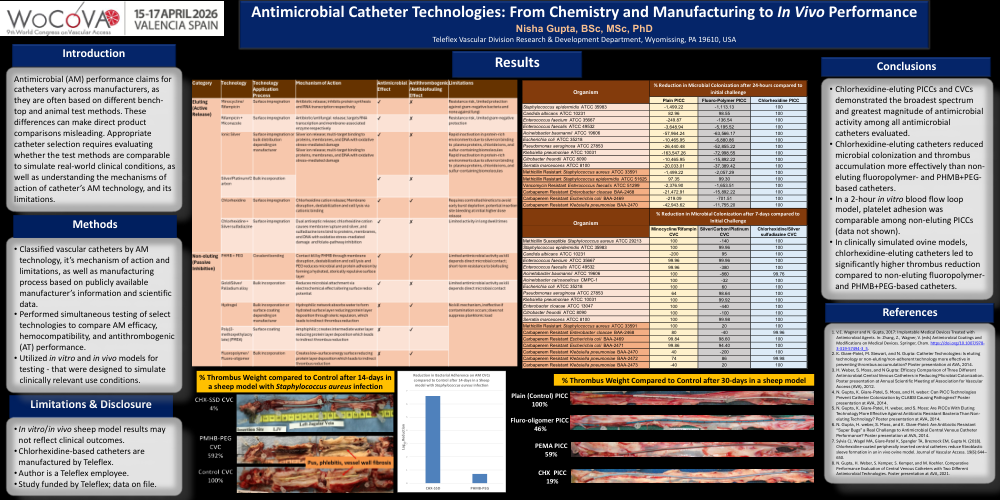
Over the past two decades, several antimicrobial (AM) technologies have been developed for vascular catheters to reduce infectious and thrombotic complications. AM performance depends on the active pharmaceutical ingredients (APIs), their mechanisms of action, and the manufacturing processes used, all of which influence the magnitude and durability of antimicrobial effects. Equally important is the testing methodology, particularly in vitro models that should closely simulate the clinical environment. However, performance claims are often based on disparate bench or animal studies using non-standardized methods, making direct comparisons misleading. Appropriate device selection therefore requires understanding not only the technology’s mode of action but also its potential inactivation mechanisms in situ.
Method
AM vascular catheters were classified according to their underlying antimicrobial technology, manufacturing processes, and modes of action through a systematic review of manufacturer-provided product specification sheets and publicly available technical information. Comparative assessments of antimicrobial efficacy, hemocompatibility, and antithrombogenic performance were then conducted using simultaneous testing of catheter products representing different technologies. Evaluations were performed using a combination of in vitro and in vivo models designed to closely simulate clinically relevant physiological and use conditions.
Results
Based on APIs, AM catheters were classified as antibiotic-treated (minocycline, rifampicin), antiseptic-treated (chlorhexidine, silver sulfadiazine, PHMB), or non-API treated (hydrophilic or hydrophobic). APIs or antimicrobial surface features were incorporated using impregnation, cross-linking, melt blending, or surface modification, and devices were further categorized by mode of action as drug-eluting or non-eluting. Comparison of manufacturer-reported data showed strong antimicrobial claims derived from highly variable test methods. Catheters evaluated using short-term, simplified models accounting for limited physiological factors showed poor correlation with outcomes from long-term, clinically simulated systems. For example, silver-based catheters showed antimicrobial activity in water but reduced activity in blood plasma, likely due to ion inactivation by thiols and chlorides.
Conclusions
Drug-eluting catheters demonstrated superior antimicrobial performance compared with non-eluting technologies under clinically simulated testing. Among drug-eluting devices, chlorhexidine-eluting catheters showed broader and stronger activity against CLABSI pathogens than antibiotic-eluting catheters. While short-term platelet adherence reduction was similar across select technologies, chlorhexidine-eluting catheters demonstrated significantly greater long-term antithrombogenic performance in a 30-day clinically simulated sheep model.