193 posters, 19 videos, 10 audios, 3 topics, 28 sessions, 709 authors, 279 institutions
ePostersLive by SciGen Technologies S.A. All rights reserved.
9th World Congress on Vascular Access 2026
15 - 17 April, 2026 | Valencia, Spain

415
<p>Experiencia de enfermería en la colocación de catéteres de línea media mediante ultrasonido en un Hospital General de la Ciudad de México.</p>
Poster Presenter
Part of Topic
Video
Nursing experience in the placement of midline catheters using ultrasound in a General Hospital in Mexico City.
Authors: Gilberto Hernández Córdova1, Samanta Sánchez Ramírez2.
- Clínica de Terapia de Infusión Intravascular-Hospital General Dr. Manuel Gea González. gilhercor@gmail.com, 5583193006. Ciudad de México, México.
- Clínica de Terapia de Infusión Intravascular- Hospital General Dr. Manuel Gea González.
samy8arm@gmail.com, 5611691496. Ciudad de México, México.
Abstract:
Midline Catheters (LM) are indicated for patients with difficult access, non-vesicant and non-irritant medications, and a stay of less than 30 days (1,2). This implies significant challenges in decision-making for the Nursing Staff (NS) responsible for the installation (3,4). They are associated with lower infection rates compared to central catheters and a lower risk of mechanical complications compared to other devices (4,5,6,7). Ultrasound-guided insertion is associated with a higher success rate and clinically indicated permanence (8).
Objective:
To describe the Nursing Staff's experience in installing LM Catheters using ultrasound in a hospital in Mexico City.
Methods:
Observational, descriptive, retrospective, cross-sectional study; the population consisted of clinical records of patients who had an LM catheter installed by ultrasound, placed by the Nursing Staff, during a two-year period from 01/01/2022 to 12/31/2023. Convenience sample; main variables include the number of attempts, insertion site, complications, reason for removal, bloodstream infection.
Results:
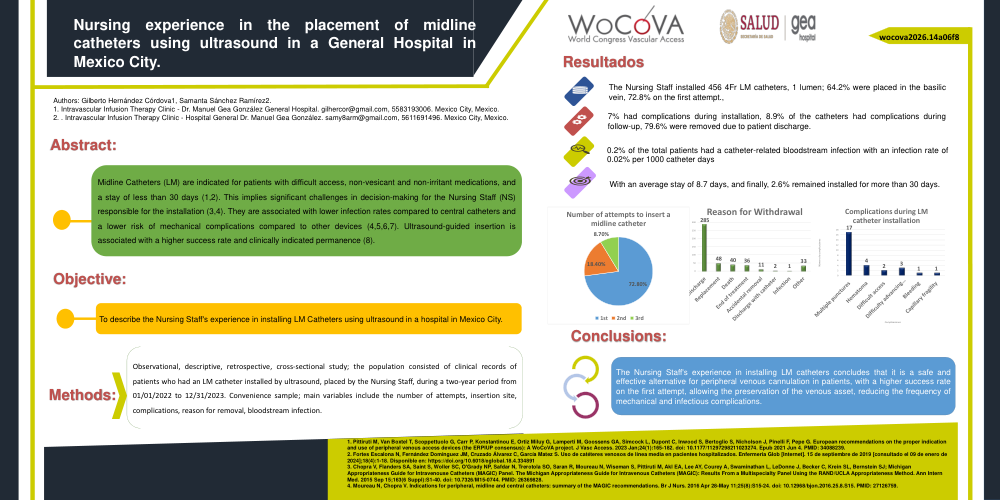
The Nursing Staff installed 456 4Fr LM catheters, 1 lumen; 64.2% were placed in the basilic vein, 72.8% on the first attempt, 7% had complications during installation, 8.9% of the catheters had complications during follow-up, 79.6% were removed due to patient discharge, 0.2% of the total patients had a catheter-related bloodstream infection with an infection rate of 0.02% per 1000 catheter days, with an average stay of 8.7 days, and finally, 2.6% remained installed for more than 30 days.
Conclusions:
The Nursing Staff's experience in installing LM catheters concludes that it is a safe and effective alternative for peripheral venous cannulation in patients, with a higher success rate on the first attempt, allowing the preservation of the venous asset, reducing the frequency of mechanical and infectious complications.
References:
- Pittiruti M, Van Boxtel T, Scoppettuolo G, Carr P, Konstantinou E, Ortiz Miluy G, Lamperti M, Goossens GA, Simcock L, Dupont C, Inwood S, Bertoglio S, Nicholson J, Pinelli F, Pepe G. European recommendations on the proper indication and use of peripheral venous access devices (the ERPIUP consensus): A WoCoVA project. J Vasc Access. 2023 Jan;24(1):165-182. doi: 10.1177/11297298211023274. Epub 2021 Jun 4. PMID: 34088239.
- Fortes Escalona N, Fernández Dominguez JM, Cruzado Álvarez C, García Matez S. Uso de catéteres venosos de línea media en pacientes hospitalizados. Enfermeria Glob [Internet]. 15 de septiembre de 2019 [consultado el 09 de enero de 2024];18(4):1-18. Disponible en: https://doi.org/10.6018/eglobal.18.4.334891
- Chopra V, Flanders SA, Saint S, Woller SC, O'Grady NP, Safdar N, Trerotola SO, Saran R, Moureau N, Wiseman S, Pittiruti M, Akl EA, Lee AY, Courey A, Swaminathan L, LeDonne J, Becker C, Krein SL, Bernstein SJ; Michigan Appropriateness Guide for Intravenouse Catheters (MAGIC) Panel. The Michigan Appropriateness Guide for Intravenous Catheters (MAGIC): Results From a Multispecialty Panel Using the RAND/UCLA Appropriateness Method. Ann Intern Med. 2015 Sep 15;163(6 Suppl):S1-40. doi: 10.7326/M15-0744. PMID: 26369828.
- Moureau N, Chopra V. Indications for peripheral, midline and central catheters: summary of the MAGIC recommendations. Br J Nurs. 2016 Apr 28-May 11;25(8):S15-24. doi: 10.12968/bjon.2016.25.8.S15. PMID: 27126759.
- Adams DZ, Little A, Vinsant C, Khandelwal S. The Midline Catheter: A Clinical Review. J Emerg Med [Internet]. Septiembre de 2016 [consultado el 09 de enero de 2024];51(3):252-8. Disponible en: https://doi.org/10.1016/j.jemermed.2016.05.029
- Elli S, Pittiruti M, Pigozzo V, Cannizzo L, Giannini L, Siligato A, Rondelli E, Foti G, Lucchini A. Ultrasound-guided tip location of midline catheters. J Vasc Access. 2020 Sep;21(5):764-768. doi: 10.1177/1129729820907250. Epub 2020 Feb 28. PMID: 32106761.
- Urtecho M, Torres Roldan VD, Nayfeh T, Espinoza Suarez NR, Ranganath N, Sampathkumar P, Chopra V, Safdar N, Prokop LJ, O'Horo JC. Comparing Complication Rates of Midline Catheter vs Peripherally Inserted Central Catheter. A Systematic Review and Meta-analysis. Open Forum Infect Dis. 2023 Jan 18;10(2):ofad024. doi: 10.1093/ofid/ofad024. PMID: 36751645; PMCID: PMC9898877.
- Bahl, A., Hang, B., Brackney, A., Joseph, S., Karabon, P., Mohammad, A., … Shotkin, P. (2018). Standard long IV catheters versus extended dwell catheters: A randomized comparison of ultrasound-guided catheter survival. The American Journal of Emergency Medicine. doi:10.1016/j.ajem.2018.07.031