193 posters, 19 videos, 10 audios, 3 topics, 28 sessions, 709 authors, 279 institutions
ePostersLive by SciGen Technologies S.A. All rights reserved.
9th World Congress on Vascular Access 2026
15 - 17 April, 2026 | Valencia, Spain

414
<p>Introducing Ultrasound Guided Peripheral IV Insertion to Nursing Students Through a Student Led Workshop</p>
Poster Presenter
Authors
Andrea Lian, Rawane Soboh, Juan Amariles, Mélodie Lewis, Chloe Luu, Mélanie Gauthier, William Landry
Affiliations
McGill University's Vascular Access Student Club (VASC) , McGill University's Vascular Access Student Club (VASC) , McGill University's Vascular Access Student Club (VASC), McGill University's Vascular Access Student Club (VASC)
Part of Topic
Video
Title: Introducing Ultrasound-Guided Peripheral IV Insertion to Nursing Students Through a Student-Led Workshop: Assessing Outcomes and Effectiveness
Authors: Andrea lian, Rawane soboh, Juan José Avila Amariles, Mélodie Lewis, Chloe luu, McGill nursing students, Mélanie Gauthier, RN, M.Int.Care.N, CNCC(C) & William landry RN, MN, Assistant Professors, McGill University
Introduction:
- Patients presenting with difficult intravenous access (DIVA) represent a significant challenge, often resulting in delayed interventions and complications arising from multiple attempts at insertion (1,2,3).
- While evidence supports Ultrasound-Guided Peripheral Intravenous (USGPIV) insertion for DIVA patients (4,5,6), this technique remains widely absent from undergraduate nursing curricula.
Purpose:
- To evaluate the impact of a student-led workshop on perceived knowledge, confidence, and interest in USGPIV insertion
- To explore student perspectives on integrating USGPIV insertion training into undergraduate nursing education.
Method:
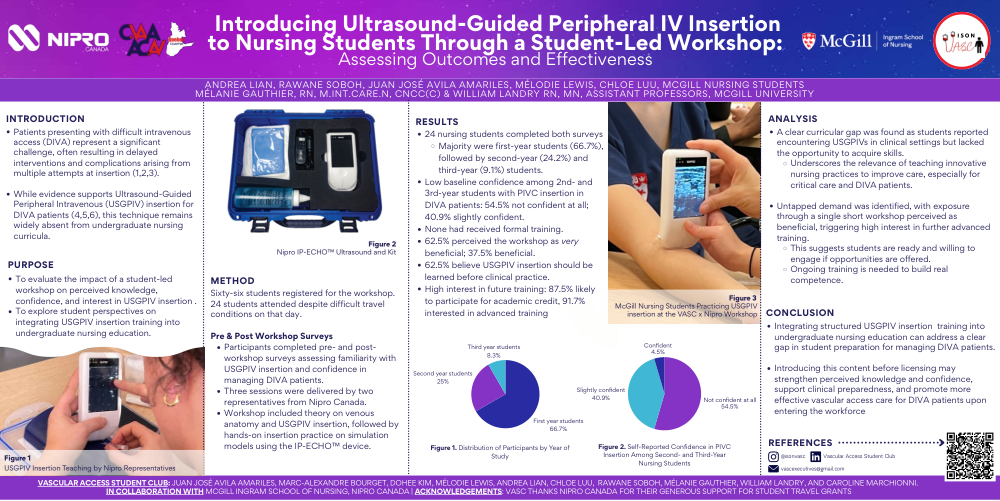
Sixty-six students registered for the workshop. 24 students attended despite difficult travel conditions on that day.
Pre & Post Workshop Surveys
- Participants completed pre- and post-workshop surveys assessing familiarity with USGPIV insertion and confidence in managing DIVA patients.
- Three sessions were delivered by two representatives from Nipro Canada.
- Workshop included theory on venous anatomy and USGPIV insertion, followed by hands-on insertion practice on simulation models using the IP-ECHO™ device.
Results:
- 24 nursing students completed both surveys
- Majority were first-year students (66.7%), followed by second-year (24.2%) and third-year (9.1%) students.
- Low baseline confidence among 2nd- and 3rd-year students with PIVC insertion in DIVA patients: 54.5% not confident at all; 40.9% slightly confident.
- None had received formal training.
- 62.5% perceived the workshop as very beneficial; 37.5% beneficial.
- 62.5% believe USGPIV insertion should be learned before clinical practice.
- High interest in future training: 87.5% likely to participate for academic credit, 91.7% interested in advanced training
Analysis:
- A clear curricular gap was found as students reported encountering USGPIVs in clinical settings but lacked the opportunity to acquire skills.
- Underscores the relevance of teaching innovative nursing practices to improve care, especially for critical care and DIVA patients.
- Untapped demand was identified, with exposure through a single short workshop perceived as beneficial, triggering high interest in further advanced training.
- This suggests students are ready and willing to engage if opportunities are offered.
- Ongoing training is needed to build real competence.
Conclusion:
- Integrating structured USGPIV insertion training into undergraduate nursing education can address a clear gap in student preparation for managing DIVA patients.
- Introducing this content before licensing may strengthen perceived knowledge and confidence, support clinical preparedness, and promote more effective vascular access care for DIVA patients upon entering the workforce