Title: EMPOWERING STUDENT LEADERSHIP IN INFECTION PREVENTION: Enhancing Learning Outcomes and Promoting Safer Practices Across the Care Continuum Using BDNexiva™ Closed IV Systemand Insyte™ Autoguard™ BC Pro catheters with ANTT™
Authors: Mélodie Lewis, Chloe luu, Juan José Avila Amariles, Andrea lian, Rawane soboh, McGill university nursing students and Caroline marchionni, RN, MScAdmin, msca, assistant professor, McGill University
Introduction:
- PIVC insertion is a common procedure that carries risk of infection.
- ANTT™ (Aseptic Non Touch Technique) provides a standardized, evidence-based approach to reduce healthcare-acquired infections (1, 2).
- However, it remains underused or misapplied in many clinical situations (3).
- To bridge this gap, McGill’s Vascular Access Student Club (VASC) hosted a student-led workshop with BDCanada to teach ANTT™ best practices to registered nurses.
Purpose:
- To improve nurses’ understanding and application of ANTT™ principles in PIVC insertion.
- To evaluate the impact of a student-led workshop on knowledge, confidence, and intended practice change.
Method:
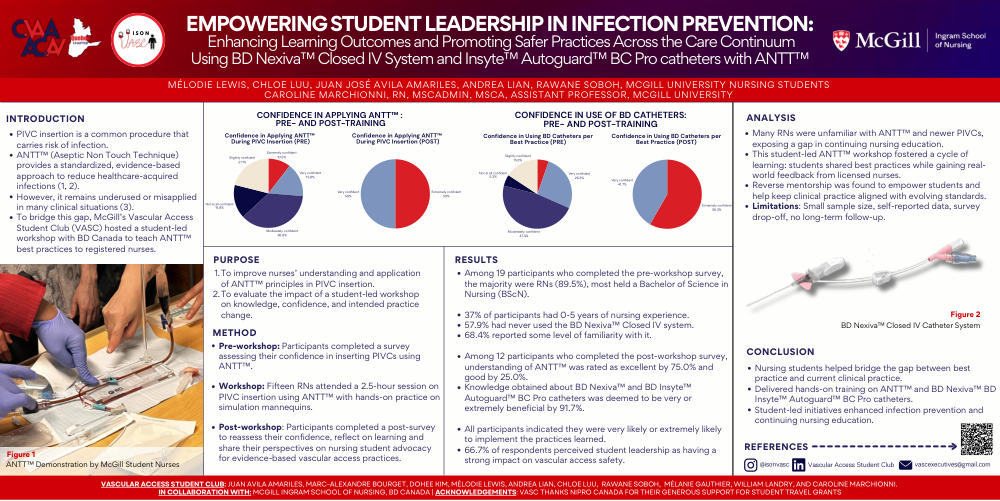
- Pre-workshop: Participants completed a survey assessing their confidence in inserting PIVCs using ANTT™.
- Workshop: Fifteen RNs attended a 2.5-hoursession on PIVC insertion using ANTT™ with hands-on practice on simulation mannequins.
- Post-workshop: Participants completed a post-survey to reassess their confidence, reflect on learning and share their perspectives on nursing student advocacy for evidence-based vascular access practices.
Results:
- Among 19 participants who completed the pre-workshop survey, the majority were RNs (89.5%), most held a Bachelor of Science in Nursing (BScN).
- 37% of participants had 0-5 years of nursing experience.
- 57.9% had never used the BD Nexiva™ Closed IV system.
- 68.4% reported some level of familiarity with it.
- Among 12 participants who completed the post-workshop survey, understanding of ANTT™ was rated as excellent by 75.0% and good by 25.0%.
- Knowledge obtained about BD Nexiva™ and BD Insyte™ Autoguard™ BC Pro catheters was deemed to be very or extremely beneficial by 91.7%.
- All participants indicated they were very likely or extremely likely to implement the practices learned.
- 66.7% of respondents perceived student leadership as having a strong impact on vascular access safety.
Analysis:
- Many RNs were unfamiliar with ANTT™ and newer PIVCs, exposing a gap in continuing nursing education.
- This student-led ANTT™ workshop fostered a cycle of learning: students shared best practices while gaining real-world feedback from licensed nurses.
- Reverse mentorship was found to empowerstudents and help keep clinical practicealigned with evolving standards.
- Limitations: Small sample size, self-reported data, survey drop-off, no long-term follow-up.
Conclusion:
- Nursing students helped bridge the gap between best practice and current clinical practice.
- Delivered hands-on training on ANTT™and BD Nexiva™ BD Insyte™ Autoguard™ BC Pro catheters.
- Student-led initiatives enhanced infectionprevention and continuing nursing education.