193 posters, 19 videos, 10 audios, 3 topics, 28 sessions, 709 authors, 279 institutions
ePostersLive by SciGen Technologies S.A. All rights reserved.
9th World Congress on Vascular Access 2026
15 - 17 April, 2026 | Valencia, Spain

407
<p>Translational Blind Spots in Hemocompatibility Assessment of Intravascular Devices</p>
Poster Presenter
Authors
Affiliations
Part of Topic
Translational Blind Spots in Hemocompatibility Assessment of Intravascular Devices
Nisha Gupta, BSc., MSC., Ph.D.
Teleflex Vascular R&D, Wyomissing PA, USA
Introduction
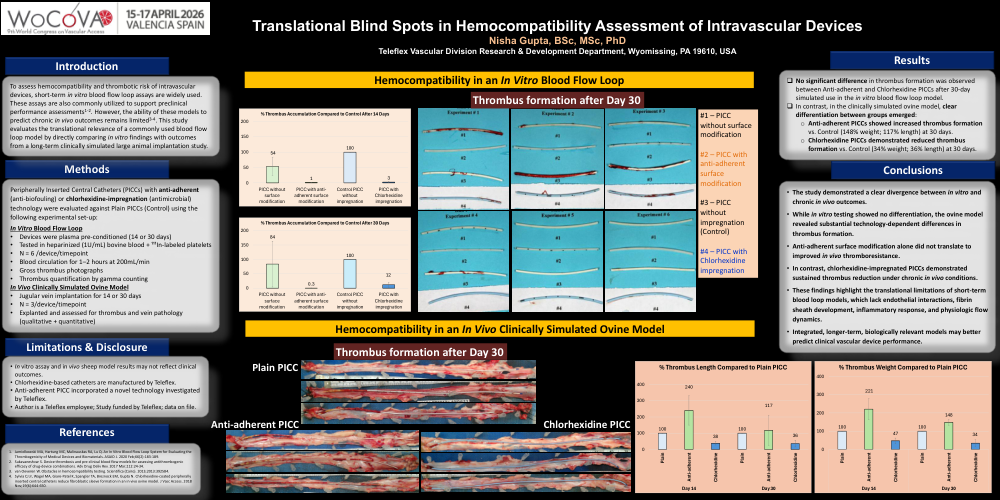
Short-term in vitro blood flow loop assays are widely used to assess hemocompatibility and thrombotic risk of intravascular devices and often support performance and marketing claims. Despite their routine use, the predictive value of these models for chronic in vivo outcomes remains poorly defined. This study evaluates the translational relevance of a commonly used bovine blood flow loop model by directly comparing in vitro results with outcomes from a long-term large-animal implantation study.
Methods
Catheters incorporating an anti-adherent technology were pre-conditioned for 29 days in human serum to simulate extended clinical exposure prior to blood contact. Following pre-conditioning, catheters (n = 3) were evaluated in a bovine blood flow loop model routinely employed for hemocompatibility testing. In parallel, identical catheters (n = 3) were implanted in the jugular veins of sheep for 30 days to assess chronic in vivo thrombus formation. Post-exposure, catheters from both models were visually and qualitatively assessed for thrombus adherence.
Results
No visible or measurable thrombus formation was observed on any catheter following evaluation in the bovine blood flow loop model. In contrast, all catheters explanted from the ovine jugular vein demonstrated significant thrombus adherence, fibroblastic sleeve presence, and vessel inflammation along the catheter surface after 30 days in vivo. This marked discrepancy indicates a failure of the in vitro blood loop model to predict chronic thrombotic outcomes observed under physiologically relevant conditions.
Conclusions
These findings highlight critical translational blind spots in short-term in vitro blood assays, including the absence of endothelial and subendothelial interactions, inability to model fibrin sheath and fibroblastic sleeve formation, limited inflammatory assessment, simplified flow dynamics, and non-physiologic environmental conditions. Reliance on such models alone may lead to overestimation of clinical thromboresistance. A more integrated testing strategy incorporating long-term and biologically relevant models is warranted to better predict vivo device performance.