193 posters, 19 videos, 10 audios, 3 topics, 28 sessions, 714 authors, 278 institutions
ePostersLive by SciGen Technologies S.A. All rights reserved.
9th World Congress on Vascular Access 2026
15 - 17 April, 2026 | Valencia, Spain
399
Outcomes of an Interdisciplinary Vascular Access Program as a Patient Safety Strategy at Fundación Cardioinfantil – LaCardio (2020–2025)
Poster Presenter
Authors
Marcela Parra Medina, Jorge Nieto, David Gallego, Carlos Román
Affiliations
Part of Topic
Audio
Outcomes of an Interdisciplinary Vascular Access Program as a Patient Safety Strategy at Fundación Cardioinfantil – LaCardio (2020–2025)
Introduction
Vascular access devices (VADs) are essential for intravenous therapy; however, inappropriate selection and repeated attempts increase the risk of catheter-related bloodstream infections and mechanical complications. Interdisciplinary vascular access programs seek to standardize care and improve patient safety. This study describes the outcomes of the Vascular Access Program at Fundación Cardioinfantil – LaCardio between January 2020 and June 2025.
Methods
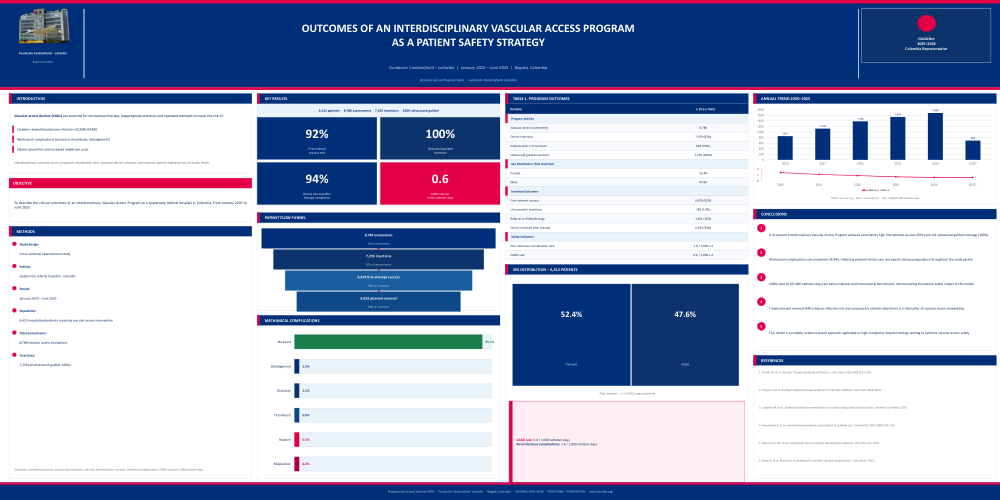
A cross-sectional observational study was conducted in a quaternary referral hospital including 6,412 hospitalized patients requiring vascular access intervention. During the study period, 8,788 assessments were performed, resulting in 7,259 ultrasound-guided insertions. Outcomes included first-attempt success, unsuccessful insertions, referrals to interventional radiology or nephrology, device removal after therapy completion, mechanical complications, and catheter-associated bloodstream infection rates per 1,000 catheter-days.
Results
Among the 6,412 unique patients, 52.4% were female and 47.6% male. Approximately 9.9% required more than one insertion. Of the 8,788 assessments, 7,259 devices were inserted (82%), all ultrasound-guided (100%). First-attempt success was achieved in 6,678 procedures (92%), while 128 insertions (1.4%) were unsuccessful and 1,401 cases (16%) were referred to IR or nephrology. Device removal after therapy completion occurred in 6,823 cases (94%). Mechanical complications were uncommon: 95.1% had no events; dislodgement occurred in 1.5%, occlusion in 1.1%, thrombosis in 0.8%, rupture in 0.5%, and malposition in <0.2%. Non-infectious complications occurred at 1.6 per 1,000 catheter-days and catheter-associated bloodstream infection at 0.6 per 1,000 catheter-days.
Conclusions
These findings describe the safety performance of a structured vascular access model in a high-complexity hospital setting.