193 posters, 19 videos, 10 audios, 3 topics, 28 sessions, 709 authors, 279 institutions
ePostersLive by SciGen Technologies S.A. All rights reserved.
9th World Congress on Vascular Access 2026
15 - 17 April, 2026 | Valencia, Spain
386
<p>Economic-Financial Feasibility and Productivity Increase: A Sustainable Strategy for Expanding Vascular Access Teams (PICC)</p>
Poster Presenter
Authors
Andréia Sousa Amorim Oliveira Amorim, Laura Maggi da Costa Maggi, Átila Daiane Schtshcerbyna Schtshcerbyna, Marina Coelho de Oliveira Coelho, Isadora de Mendonça e Custódio Custódio, Cintia Riograndense, Sidiclei Machado Carvalho Carvalho, Andréa de Oliveira Vieira Vieira , Denise Feula da Silva Silva
Affiliations
Hospital Moinhos de Vento, Hospital Moinhos de Vento, Hospital Moinhos de Vento, Hospital Moinhos de Vento, Hospital Moinhos de Vento,
Part of Topic
Economic-Financial Feasibility and Productivity Increase: A Sustainable Strategy for Expanding Vascular Access Teams (PICC)
Introduction:
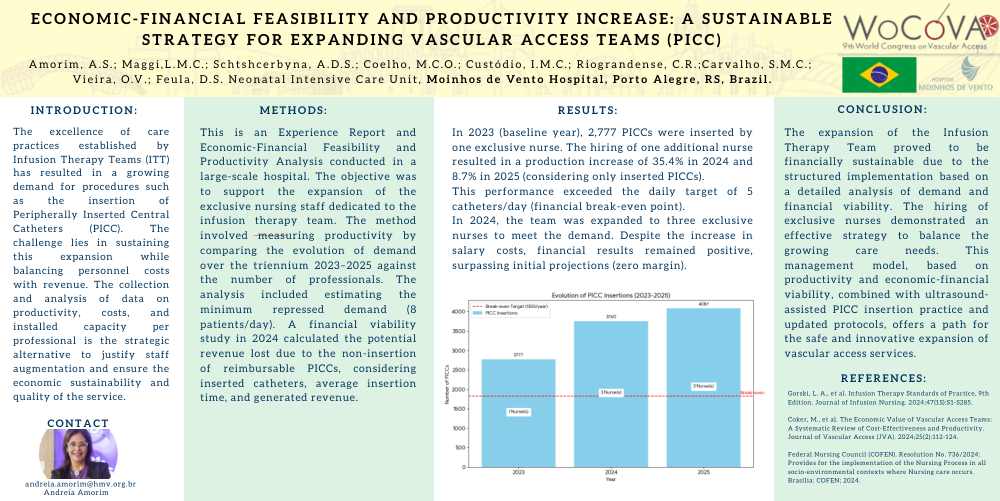
The excellence of care practices established by Infusion Therapy Teams (ITT) has resulted in a growing demand for procedures such as the insertion of Peripherally Inserted Central Catheters (PICC). The challenge lies in sustaining this expansion while balancing personnel costs with revenue. The collection and analysis of data on productivity, costs, and installed capacity per professional is the strategic alternative to justify staff augmentation and ensure the economic sustainability and quality of the service.
Method:
This is an Experience Report and Economic-Financial Feasibility and Productivity Analysis conducted in a large-scale hospital. The objective was to support the expansion of the exclusive nursing staff dedicated to the infusion therapy team. The method involved measuring productivity by comparing the evolution of demand over the triennium 2023–2025 against the number of professionals. The analysis included estimating the minimum repressed demand (8 patients/day). A financial viability study in 2024 calculated the potential revenue lost due to the non-insertion of reimbursable PICCs, considering inserted catheters, average insertion time, and generated revenue.
Results:
In 2023 (baseline year), 2,777 PICCs were inserted by one exclusive nurse. The hiring of one additional nurse resulted in a production increase of 35.4% in 2024 and 8.7% in 2025 (considering only inserted PICCs). This performance exceeded the daily target of 5 catheters/day (financial break-even point). In 2024, the team was expanded to three exclusive nurses to meet the demand. Despite the increase in salary costs, financial results remained positive, surpassing initial projections (zero margin).
Conclusions:
The expansion of the Infusion Therapy Team proved to be financially sustainable due to the structured implementation based on a detailed analysis of demand and financial viability. The hiring of exclusive nurses demonstrated an effective strategy to balance the growing care needs. This management model, based on productivity and economic-financial viability, combined with ultrasound-assisted PICC insertion practice and updated protocols, offers a path for the safe and innovative expansion of vascular access services.