193 posters, 19 videos, 10 audios, 3 topics, 28 sessions, 709 authors, 279 institutions
ePostersLive by SciGen Technologies S.A. All rights reserved.
9th World Congress on Vascular Access 2026
15 - 17 April, 2026 | Valencia, Spain

381
<p>Impact of Implementing a Clinical Excellence Program in the Management of Vascular Access and Related Outcomes</p>
Poster Presenter
Authors
Andréia Sousa Amorim Oliveira Amorim, Atila Schtscherbyna, Marina Coelho de Oliveira Coelho, Gabriela Flores, Isadora de Mendonça e Custódio Custódio, Sabine Azevedo, Laura Maggi da Costa Maggi, Sidiclei Machado Carvalho Carvalho, Cristiane Tejada, Joseline Brito de Oliveira
Affiliations
Hospital Moinhos de Vento, Hospital Moinhos de Vento, Hospital Moinhos de Vento, Hospital Moinhos de Vento,
Part of Topic
Impact of Implementing a Clinical Excellence Program in the Management of Vascular Access and Related Outcomes
Introduction:
Qualified management of vascular access (VA) is crucial for patient safety and the prevention of adverse events. Given the widespread use and impact of these devices, the implementation of a robust, evidence-based, and continuously monitored program is essential for managing and preventing adverse events.
Methods:
This is an experience report conducted in a private general hospital in Porto Alegre, RS, Brazil. The study compared the impact on the outcomes of clinical indicators monitored before (2024) and after (2025) adherence to the excellence program for VA management. Five indicators were analyzed: Rate of early PICC-related infection; Rate of institutional central venous catheter infection; Rate of peripheral access-related bloodstream infections; Rate of PICC-related thrombosis; and Percentage of adherence to the insertion and maintenance bundle.
Results:
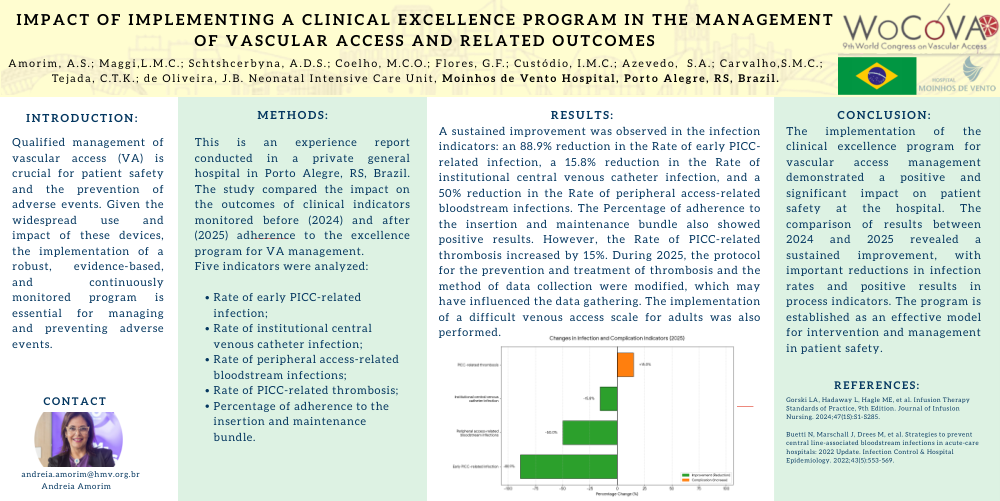
A sustained improvement was observed in the infection indicators: an 88.9% reduction in the Rate of early PICC-related infection, a 15.8% reduction in the Rate of institutional central venous catheter infection, and a 50% reduction in the Rate of peripheral access-related bloodstream infections. The Percentage of adherence to the insertion and maintenance bundle also showed positive results. However, the Rate of PICC-related thrombosis increased by 15%. During 2025, the protocol for the prevention and treatment of thrombosis and the method of data collection were modified, which may have influenced the data gathering. The implementation of a difficult venous access scale for adults was also performed.
Conclusions:
The implementation of the clinical excellence program for vascular access management demonstrated a positive and significant impact on patient safety at the hospital. The comparison of results between 2024 and 2025 revealed a sustained improvement, with important reductions in infection rates and positive results in process indicators. The program is established as an effective model for intervention and management in patient safety.