193 posters, 19 videos, 10 audios, 3 topics, 28 sessions, 709 authors, 279 institutions
ePostersLive by SciGen Technologies S.A. All rights reserved.
9th World Congress on Vascular Access 2026
15 - 17 April, 2026 | Valencia, Spain

366
This website and third-party tools we use rely on cookies for the best user experience. By selecting "I agree", you agree to cookie usage as described in our Privacy Policy.
193 posters, 19 videos, 10 audios, 3 topics, 28 sessions, 709 authors, 279 institutions
ePostersLive by SciGen Technologies S.A. All rights reserved.
15 - 17 April, 2026 | Valencia, Spain
366
Universidade do Estado do Rio de Janeiro, UERJ, State University of Rio de Janeiro, State University of Rio de Janeiro, State University of Rio de Janeiro, State University of Rio de Janeiro
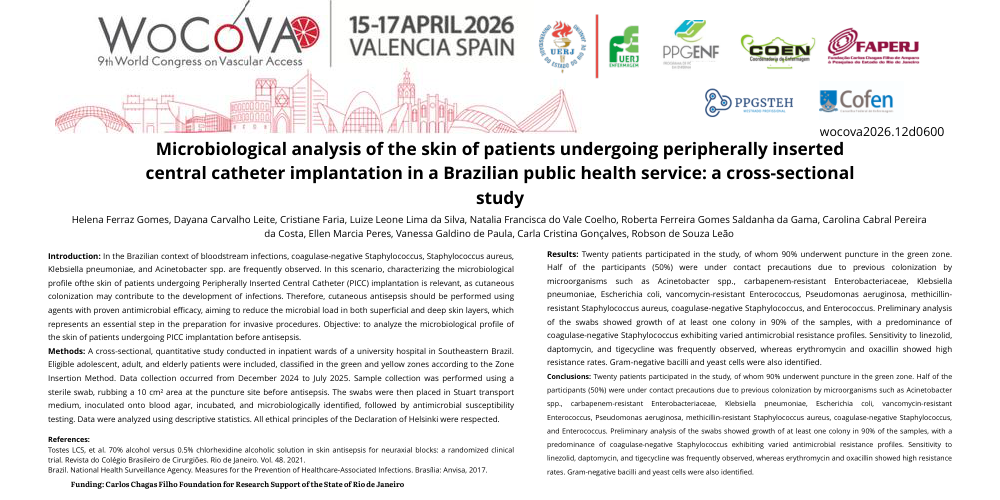
Introduction: In the Brazilian context of bloodstream infections, coagulase-negative Staphylococcus, Staphylococcus aureus, Klebsiella pneumoniae, and Acinetobacter spp. are frequently observed. In this scenario, characterizing the microbiological profile ofthe skin of patients undergoing Peripherally Inserted Central Catheter (PICC) implantation is relevant, as cutaneous colonization may contribute to the development of infections. Therefore, cutaneous antisepsis should be performed using agents with proven antimicrobial efficacy, aiming to reduce the microbial load in both superficial and deep skin layers, which represents an essential step in the preparation for invasive procedures. Objective: to analyze the microbiological profile of the skin of patients undergoing PICC implantation before antisepsis.
Methods: A cross-sectional, quantitative study conducted in inpatient wards of a university hospital in Southeastern Brazil. Eligible adolescent, adult, and elderly patients were included, classified in the green and yellow zones according to the Zone Insertion Method. Data collection occurred from December 2024 to July 2025. Sample collection was performed using a sterile swab, rubbing a 10 cm² area at the puncture site before antisepsis. The swabs were then placed in Stuart transport medium, inoculated onto blood agar, incubated, and microbiologically identified, followed by antimicrobial susceptibility testing. Data were analyzed using descriptive statistics. All ethical principles of the Declaration of Helsinki were respected.
Results: Twenty patients participated in the study, of whom 90% underwent puncture in the green zone. Half of the participants (50%) were under contact precautions due to previous colonization by microorganisms such as Acinetobacter spp., carbapenem-resistant Enterobacteriaceae, Klebsiella pneumoniae, Escherichia coli, vancomycin-resistant Enterococcus, Pseudomonas aeruginosa, methicillin-resistant Staphylococcus aureus, coagulase-negative Staphylococcus, and Enterococcus. Preliminary analysis of the swabs showed growth of at least one colony in 90% of the samples, with a predominance of coagulase-negative Staphylococcus exhibiting varied antimicrobial resistance profiles. Sensitivity to linezolid, daptomycin, and tigecycline was frequently observed, whereas erythromycin and oxacillin showed high resistance rates. Gram-negative bacilli and yeast cells were also identified.
Conclusions: Twenty patients participated in the study, of whom 90% underwent puncture in the green zone. Half of the participants (50%) were under contact precautions due to previous colonization by microorganisms such as Acinetobacter spp., carbapenem-resistant Enterobacteriaceae, Klebsiella pneumoniae, Escherichia coli, vancomycin-resistant Enterococcus, Pseudomonas aeruginosa, methicillin-resistant Staphylococcus aureus, coagulase-negative Staphylococcus, and Enterococcus. Preliminary analysis of the swabs showed growth of at least one colony in 90% of the samples, with a predominance of coagulase-negative Staphylococcus exhibiting varied antimicrobial resistance profiles. Sensitivity to linezolid, daptomycin, and tigecycline was frequently observed, whereas erythromycin and oxacillin showed high resistance rates. Gram-negative bacilli and yeast cells were also identified.