193 posters, 19 videos, 10 audios, 3 topics, 28 sessions, 709 authors, 279 institutions
ePostersLive by SciGen Technologies S.A. All rights reserved.
9th World Congress on Vascular Access 2026
15 - 17 April, 2026 | Valencia, Spain

363
<p>Characterization of totally implanted central venous catheter use in hospitalized adolescents: a descriptive study</p>
Poster Presenter
Authors
Vanessa Galdino De Paula, Helena Ferraz Gomes, Patrícia Porto, Dayana Carvalho Leite, Cristiene Faria, Ariana Chami, Maíra de Jesus, Luana Ferreira de Almeida, Priscila de Andrade, Jaqueline Paiva, Carolina Cabral Pereira da Costa, Ellen Marcia Peres
Affiliations
Universidade do Estado do Rio de Janeiro, UERJ, State University of Rio de Janeiro,
Part of Topic
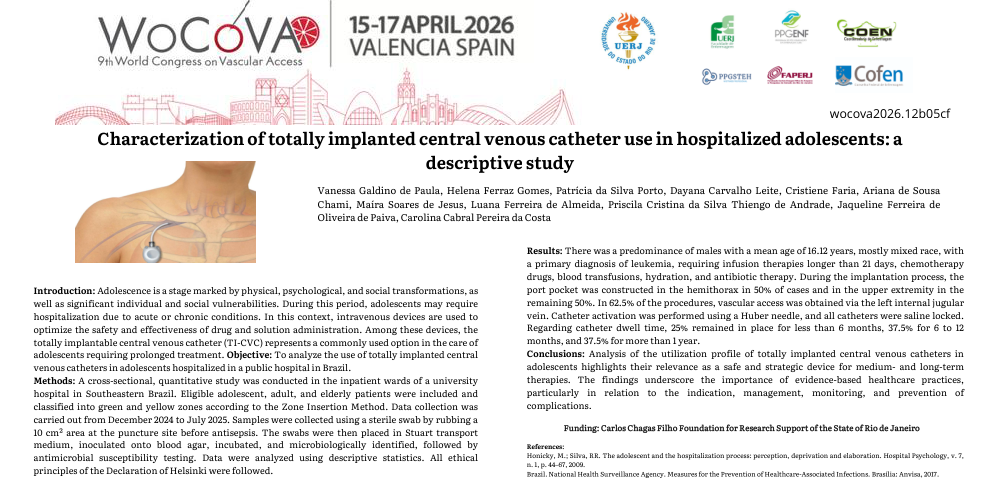
Introduction: Adolescence is a stage marked by physical, psychological, and social transformations, as well as significant individual and social vulnerabilities. During this period, adolescents may require hospitalization due to acute or chronic conditions. In this context, intravenous devices are used to optimize the safety and effectiveness of drug and solution administration. Among these devices, the totally implantable central venous catheter (TI-CVC) represents a commonly used option in the care of adolescents requiring prolonged treatment. Objective: To analyze the use of totally implanted central venous catheters in adolescents hospitalized in a public hospital in Brazil.
Methods: A cross-sectional, quantitative study was conducted in the inpatient wards of a university hospital in Southeastern Brazil. Eligible adolescent, adult, and elderly patients were included and classified into green and yellow zones according to the Zone Insertion Method. Data collection was carried out from December 2024 to July 2025. Samples were collected using a sterile swab by rubbing a 10 cm² area at the puncture site before antisepsis. The swabs were then placed in Stuart transport medium, inoculated onto blood agar, incubated, and microbiologically identified, followed by antimicrobial susceptibility testing. Data were analyzed using descriptive statistics. All ethical principles of the Declaration of Helsinki were followed.
Results: There was a predominance of males with a mean age of 16.12 years, mostly mixed race, with a primary diagnosis of leukemia, requiring infusion therapies longer than 21 days, chemotherapy drugs, blood transfusions, hydration, and antibiotic therapy. During the implantation process, the port pocket was constructed in the hemithorax in 50% of cases and in the upper extremity in the remaining 50%. In 62.5% of the procedures, vascular access was obtained via the left internal jugular vein. Catheter activation was performed using a Huber needle, and all catheters were saline locked. Regarding catheter dwell time, 25% remained in place for less than 6 months, 37.5% for 6 to 12 months, and 37.5% for more than 1 year.
Conclusions: Analysis of the utilization profile of totally implanted central venous catheters in adolescents highlights their relevance as a safe and strategic device for medium- and long-term therapies. The findings underscore the importance of evidence-based healthcare practices, particularly in relation to the indication, management, monitoring, and prevention of complications.