193 posters, 19 videos, 10 audios, 3 topics, 28 sessions, 709 authors, 279 institutions
ePostersLive by SciGen Technologies S.A. All rights reserved.
9th World Congress on Vascular Access 2026
15 - 17 April, 2026 | Valencia, Spain

359
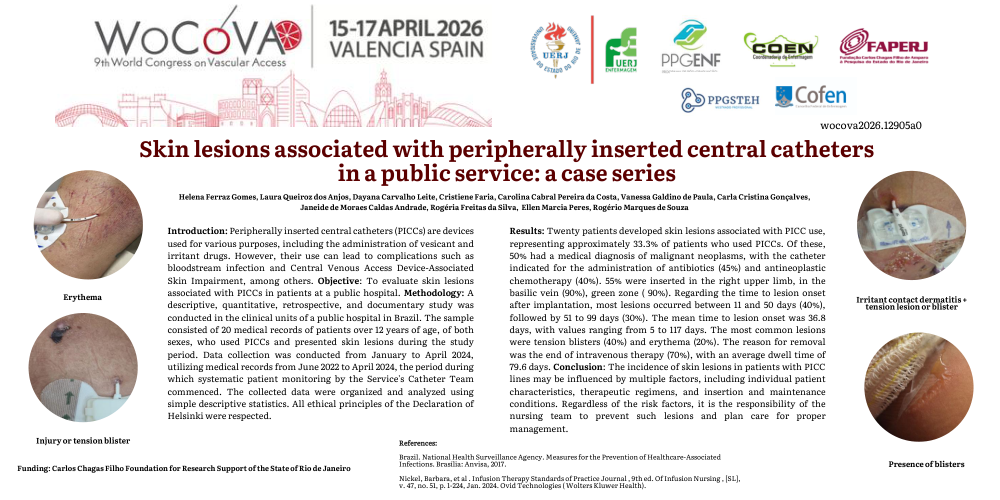
<p>Skin lesions associated with peripherally inserted central catheters in a public service: a case series</p>
Poster Presenter
Authors
Helena Ferraz Gomes, Laura dos Anjos, Dayana Carvalho Leite, Cristiene Faria, Carolina Cabral Pereira da Costa, Vanessa Galdino De Paula, Carla Gonçalves, Janeide Andrade, Rogéria da Silva, Ellen Peres, Rogério de Souza
Affiliations
Universidade do Estado do Rio de Janeiro, UERJ, State University of Rio de Janeiro, State University of Rio de Janeiro,
Part of Topic
Introduction: Peripherally inserted central catheters (PICCs) are devices used for various purposes, including the administration of vesicant and irritant drugs. However, their use can lead to complications such as bloodstream infection and Central Venous Access Device-Associated Skin Impairment, among others. Objective: To evaluate skin lesions associated with PICCs in patients at a public hospital. Methodology: A descriptive, quantitative, retrospective, and documentary study was conducted in the clinical units of a public hospital in Brazil. The sample consisted of 20 medical records of patients over 12 years of age, of both sexes, who used PICCs and presented skin lesions during the study period. Data collection was conducted from January to April 2024, utilizing medical records from June 2022 to April 2024, the period during which systematic patient monitoring by the Service's Catheter Team commenced. The collected data were organized and analyzed using simple descriptive statistics. All ethical principles of the Declaration of Helsinki were respected. Results: Twenty patients developed skin lesions associated with PICC use, representing approximately 33.3% of patients who used PICCs. Of these, 50% had a medical diagnosis of malignant neoplasms, with the catheter indicated for the administration of antibiotics (45%) and antineoplastic chemotherapy (40%). 55% were inserted in the right upper limb, in the basilic vein (90%), green zone ( 90%). Regarding the time to lesion onset after implantation, most lesions occurred between 11 and 50 days (40%), followed by 51 to 99 days (30%). The mean time to lesion onset was 36.8 days, with values ranging from 5 to 117 days. The most common lesions were tension blisters (40%) and erythema (20%). The reason for removal was the end of intravenous therapy (70%), with an average dwell time of 79.6 days. Conclusion: The incidence of skin lesions in patients with PICC lines may be influenced by multiple factors, including individual patient characteristics, therapeutic regimens, and insertion and maintenance conditions. Regardless of the risk factors, it is the responsibility of the nursing team to prevent such lesions and plan care for proper management.