193 posters, 19 videos, 10 audios, 3 topics, 28 sessions, 709 authors, 279 institutions
ePostersLive by SciGen Technologies S.A. All rights reserved.
9th World Congress on Vascular Access 2026
15 - 17 April, 2026 | Valencia, Spain

355
<p>Association between the use of PICC-port on the same day it is inserted and early complications in cancer patients undergoing chemotherapy treatment.</p>
Poster Presenter
Part of Topic
Association between the use of PICC-port on the same day it is inserted and early complications in cancer patients undergoing chemotherapy treatment.
INTRODUCTION
In clinical oncology, the administration of cytostatic agents primarily requires the establishment of a secure, long-term central venous access device. In recent years, the PICC-PORT has emerged as a robust alternative, combining the benefits of peripheral insertion with the stability of totally implantable systems.
Standard clinical practice guidelines typically recommend a latency period of 7 to 10 days post- implantation prior to the initial access. However, the urgency of chemotherapy protocols frequently calls for immediate procedural access. Currently, there is a lack of robust scientific evidence regarding whether intra-procedural puncture constitutes a definitive risk factor for early-onset complications.
OBJECTIVE
To analyze the impact of same-day PICC-PORT access for chemotherapy administration on the rate of early complications (within 30 days post-procedure) in a cohort of outpatient oncology patients.
METHOD
A retrospective observational cohort study was designed and conducted at the University Hospital of the Canary Islands throughout 2025. The sample comprised 140 patients with neoplastic pathology and clinical indication for PICC-PORT implantation.
Two comparative cohorts were established:
1. Immediate Access Group: Puncture and initiation of chemotherapy on Day 0.
2. Deferred Access Group: Initial access performed after a one-week recovery period.
Safety variables were monitored for 30 days. Complications were categorized as wound healing impairment, catheter-related venous thrombosis, and secondary malposition of the catheter tip.
RESULTS
Among the 140 subjects analyzed, 21 early adverse events (15%) were documented. The distribution of complications was:
Impaired wound healing: n=17 (12.2%)*
Catheter-related venous thrombosis: n=3 (2.1%)
Secondary malposition: n=1 (0.7%)
*Wounds that took longer than average to complete their healing process (between 15 and 28 days).
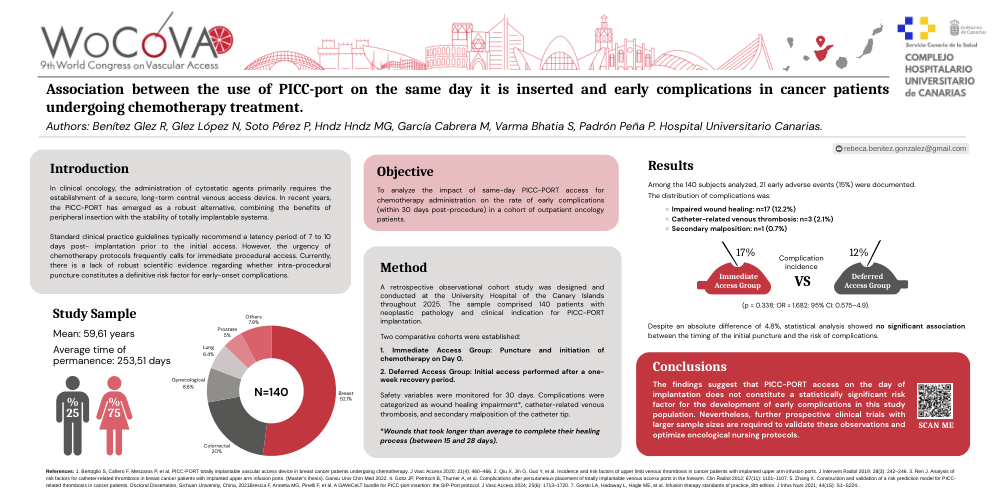
Comparative analysis revealed a complication incidence of 17% in the immediate access group versus 12.2% in the deferred access group. Despite an absolute difference of 4.8%, statistical analysis showed no significant association between the timing of the initial puncture and the risk of complications (p = 0.338; OR = 1.682; 95% CI: 0.575–4.9).
CONCLUSIONS
The findings suggest that PICC-PORT access on the day of implantation does not constitute a statistically significant risk factor for the development of early complications in this study population. Nevertheless, further prospective clinical trials with larger sample sizes are required to validate these observations and optimize oncological nursing protocols.