193 posters, 19 videos, 10 audios, 3 topics, 28 sessions, 709 authors, 279 institutions
ePostersLive by SciGen Technologies S.A. All rights reserved.
9th World Congress on Vascular Access 2026
15 - 17 April, 2026 | Valencia, Spain

347
This website and third-party tools we use rely on cookies for the best user experience. By selecting "I agree", you agree to cookie usage as described in our Privacy Policy.
193 posters, 19 videos, 10 audios, 3 topics, 28 sessions, 709 authors, 279 institutions
ePostersLive by SciGen Technologies S.A. All rights reserved.
15 - 17 April, 2026 | Valencia, Spain
347
Universidade do Estado do Rio de Janeiro, State University of Rio de Janeiro/Federal University of the State of Rio de Janeiro, UERJ, State University of Rio de Janeiro, Federal University of the State of Rio de Janeiro
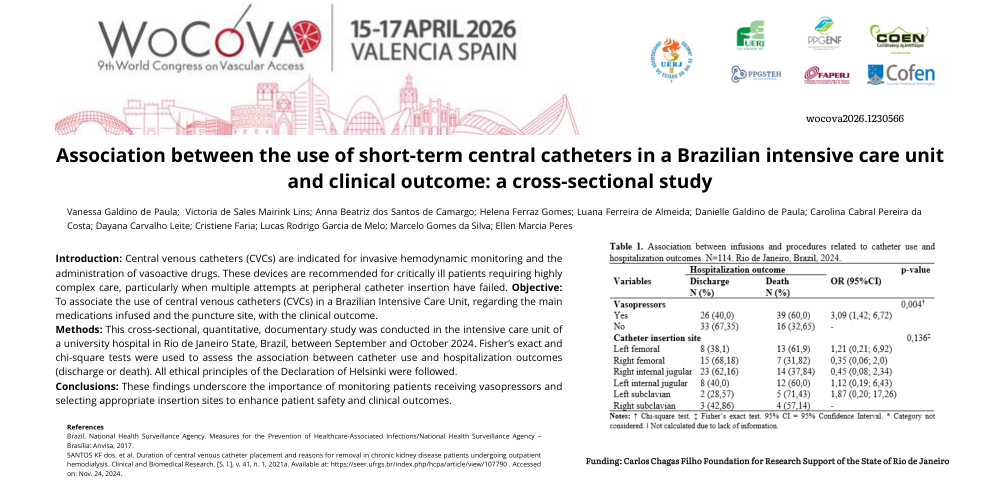
Introduction:Short-term central catheters, such as central venous catheters (CVCs), are indicated for invasive hemodynamic monitoring, administration of vasoactive drugs, blood products, vesicant drugs, and concomitant administration of mutually incompatible medications. They are inserted into the internal jugular or subclavian veins and can remain in place for weeks. These devices are recommended for critically ill patients requiring highly complex care and multiple attempts at peripheral catheter insertion. Objective: To associate the use of central venous catheters (CVCs) in a Brazilian Intensive Care Unit, regarding the main medications infused and the puncture site, with the clinical outcome. Methods: This cross-sectional, quantitative, documentary study was conducted in the general intensive care unit of a university hospital in Rio de Janeiro State, Brazil. Electronic medical records of patients who used CVCs between January and December 2023 were included, while those with incomplete information were excluded. Data collection took place between September and October 2024 using a form with variables related to catheter insertion site, intravenous infusion administered, and hospitalization outcome. Fisher’s exact and chi-square tests were used to assess the association between catheter use and hospitalization outcomes (discharge or death), with odds ratios (OR) and 95% confidence intervals (CI) estimated. All ethical principles of the Declaration of Helsinki were respected. Results: In total, 114 patient records were included. Those who used vasopressors (p=0.004), such as norepinephrine, had three times the chance of death compared to those who did not (OR=3,04; CI 95% 1,42 - 6,72), which may be related to the vasoconstrictor effect of this medication, leading to worse outcomes. Although there was no statistically significant association between puncture sites and discharge or death, mortality was higher in individuals who used the left femoral vein (61.90%) and left internal jugular vein (60.00%), which may be related to the irregular anatomy of these sites and the high risk of deep vein thrombosis. Conclusions: These findings underscore the importance of monitoring patients receiving vasopressors and selecting appropriate insertion sites to enhance patient safety and clinical outcomes.