193 posters, 19 videos, 10 audios, 3 topics, 28 sessions, 709 authors, 279 institutions
ePostersLive by SciGen Technologies S.A. All rights reserved.
9th World Congress on Vascular Access 2026
15 - 17 April, 2026 | Valencia, Spain

340
This website and third-party tools we use rely on cookies for the best user experience. By selecting "I agree", you agree to cookie usage as described in our Privacy Policy.
193 posters, 19 videos, 10 audios, 3 topics, 28 sessions, 709 authors, 279 institutions
ePostersLive by SciGen Technologies S.A. All rights reserved.
15 - 17 April, 2026 | Valencia, Spain
340
From price to value: clinical and economic impact of integrated versus non‑integrated peripheral intravenous catheters (PIVC in national health service (NHS) practice
MD Aquino-Guerrero1, J Birthwhistle2 and L White3
Clinical Specialists, NHS Supply Chain
Background
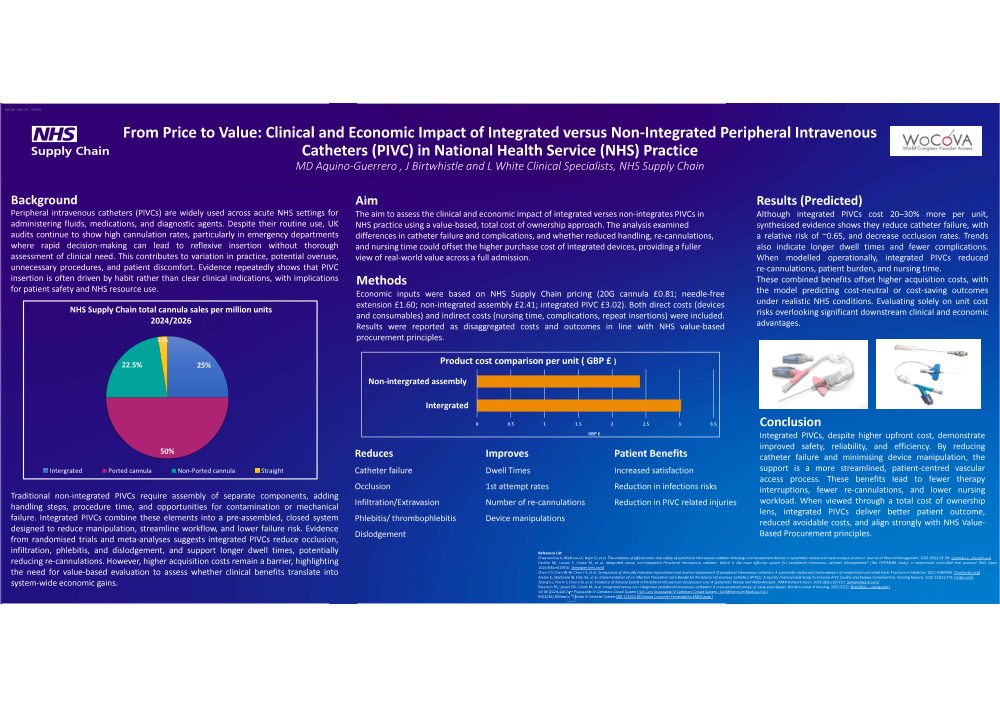
Peripheral intravenous catheters (PIVCs) are among the most common invasive devices in acute care; UK projects report high rates of cannulation in emergency settings, underscoring practice variation and potential overuse. Evidence reviews highlight that insertion is frequently driven by habit, rather than ongoing clinical indication, with implications for patient safety and resource use.
Non-integrated systems require separate extension components and needle-free connectors, whereas integrated designs combine these elements into a single device, reducing manipulation, complications and improving workflow. Evidence signals advantages for failure reduction, occlusion ad dwell time, but higher unit prices can deter switch and overall adoption. An episode-based value assessment is needed to determine whether clinical gains translate into economic value.
Aim
To evaluate the clinical and economic impact of integrated versus non‑integrated PIVCs within NHS practice in England, using a value‑based, total cost of ownership (TCO) framework.
Methods
We developed a cost‑consequence model comparing integrated and non‑integrated PIVCs over an admission episode. The primary clinical endpoint was composite failure (occlusion, infiltration/extravasation, phlebitis/thrombophlebitis, dislodgement). Secondary endpoints included dwell time, first‑attempt success, re‑cannulations, device manipulations, parameterised from published trials and meta‑analysis. Economic inputs used included NHS Supply Chain framework pricing for commonly used devices (pink 20G cannula £0.81; dual‑port needle‑free extension £1.60; combined £2.41; integrated 20G PIVC £3.02). TCO incorporated direct device costs plus indirect costs for complication management, re‑cannulation, nursing time, and consumables, aligned with NHS value-based procurement. No utilities (QALYs) or ICERs were calculated; costs and outcomes were reported disaggregated.
Results (predicted)
Integrated PIVCs have higher unit prices (~20–30% vs selected non‑integrated combinations; £3.02 vs £2.41). Synthesised clinical evidence indicates lower overall catheter failure risk (RR≈0.65) and reduced occlusion with integrated systems, with trends for other complications and extended dwell time. Modelling suggests that fewer failures, fewer re‑cannulations, and reduced manipulation‑related workload may offset acquisition premiums; when indirect costs are included, integrated PIVCs are predicted to be cost‑neutral or cost‑saving within an NHS TCO framework.
Conclusion
Despite higher upfront costs integrated PIVCs align with VBP principles by improving clinical outcomes and reducing downstream resource use. Evidence indicates lower device failure and complication rates, translating into fewer replacements and reduced nursing workload. When assessed through a TCO lens, these have the potential to be cost‑neutral or cost‑saving while enhancing patient safety and experience, supporting sustainable, high‑quality vascular access practice.