193 posters, 19 videos, 10 audios, 3 topics, 28 sessions, 709 authors, 279 institutions
ePostersLive by SciGen Technologies S.A. All rights reserved.
9th World Congress on Vascular Access 2026
15 - 17 April, 2026 | Valencia, Spain
339
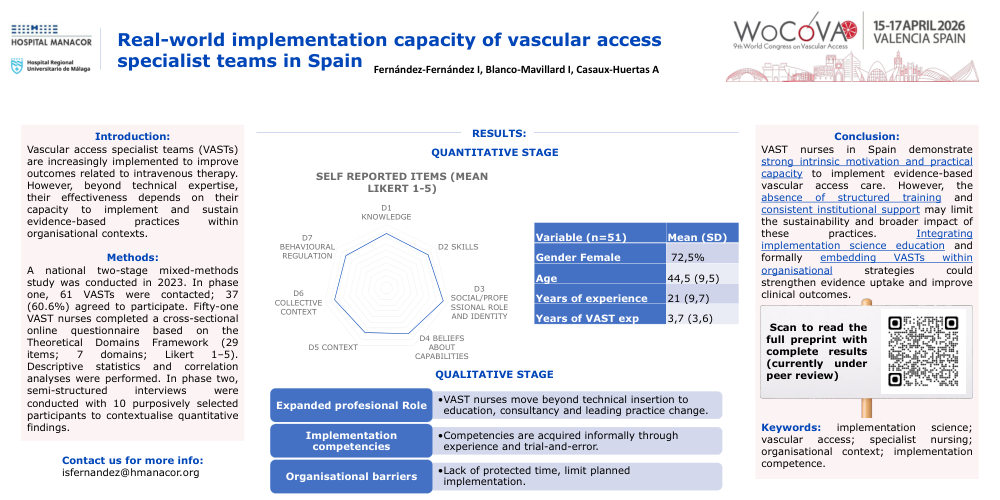
<p>Real-world implementation capacity of vascular access specialist teams in Spain</p>
Poster Presenter
Part of Topic
Introduction:
Vascular access specialist teams (VASTs) are increasingly implemented to improve outcomes related to intravenous therapy. However, beyond technical expertise, their effectiveness depends on their capacity to implement and sustain evidence based practices within organisational contexts
Methods:
A national two stage mixed methods study was conducted in 2023. In phase one, 61 VASTs were contacted 37 (60.6%) agreed to participate. Fifty-one VAST nurses completed a cross sectional online questionnaire based on the Theoretical Domains Framework (29 items; 7 domains; Likert 1-5). Descriptive statistics and correlation analyses were performed. In phase two, semi structured interviews were conducted with 10 purposively selected participants to contextualise quantitative findings.
RESULTS
Conclusion:
VAST nurses in Spain demonstrate strong intrinsic motivation and practical capacity to implement evidence-based vascular access care. However, the absence of structured training and consistent institutional support may limit the sustainability and broader impact of these practices. Integrating implementation science education and formally embedding VASTs within organisational strategies could strengthen evidence uptake and improve clinical outcomes.
Keywords:
implementation science; vascular access; specialist nursing; organisational context; implementation competence.