193 posters, 19 videos, 10 audios, 3 topics, 28 sessions, 709 authors, 279 institutions
ePostersLive by SciGen Technologies S.A. All rights reserved.
9th World Congress on Vascular Access 2026
15 - 17 April, 2026 | Valencia, Spain

333
<p> The DIVAraba predictive tool for the management of difficult intravenous access.</p>
Poster Presenter
Authors
Victoria Armenteros Yeguas, Oiane Báez-Gurruchaga, Estíbaliz Cristóbal-Domínguez, Jessica Díez-Martínez, Ane Ferrero-Udaeta, Laura González-Blas, Beatriz Landa-Portilla, Selene Lurueña-Rodríguez, Edurne Martínez-Hernández, Itsaso Palacios-Rodríguez, María Pereda-Rubio, Celia Sagredo-Ortega, Maria Aranzazu Tomás-López, Maitane Zaballa-Canive
Affiliations
Part of Topic
TITLE: RISK FACTORS OF SHORT PERIPHERAL CATHETER INSERTION FAILURE: BUILDING A NEW DIVA SCORE
AUTHORS:
Victoria Armenteros-Yeguas1,4
Arantza Tomás-Lopez 2,4
Oiane Baez-Gurruchaga 3,4
Laura González-Blas 3,4
Maitane Zaballa-Canive 3,4
Edurne Martínez Hernández3,4
Beatriz Landa-Portilla 3,4
Selene Lurueña-Rodríguez 3,4
Jessica Díez-Martínez3,4
Ane Ferrero-Udaeta3,4
Itsaso Palacios-Rodríguez3,4
María Pereda-Rubio3,4
Celia Sagredo-Ortega3,4
Estíbaliz Cristobal-Domínguez 4,5
1RN, Vascular Access Team Supervisor
2RN, Hematology Department Nursing Supervisor
3RN, Vascular Access Team
4Bioaraba Research Unit, Vascular Care Research Group
5RN, Primary Health Care Nurse
BACKGROUND
The literature related to the difficult intravenous access (DIVA) assessment is still scarce.
OBJECTIVES
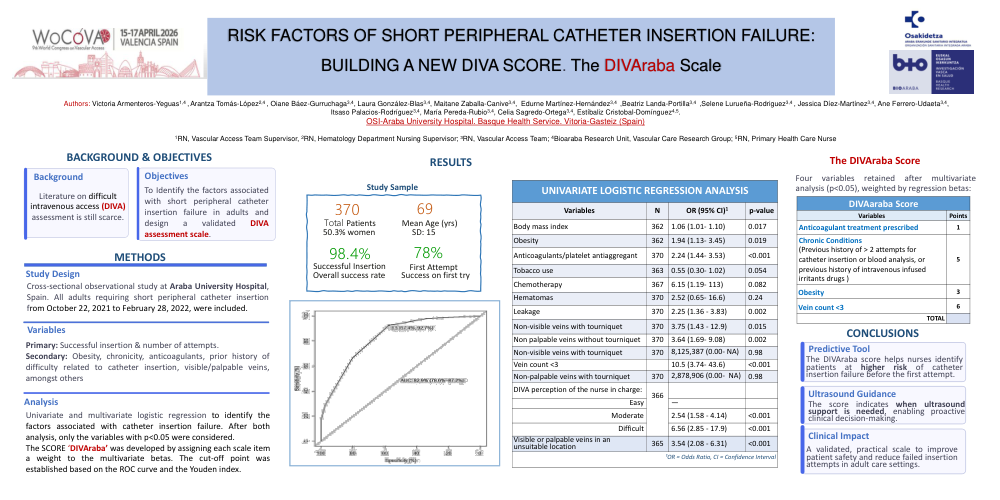
To identify the factors associated with short peripheral catheter insertion failure in adults and design a DIVA assessment scale.
METHODS:
A cross-sectional observational study was conducted at Araba University Hospital (Spain). All the patients who required the insertion of a short peripheral catheter during study period were included.
The main variables were the catheter successful insertion and the number of attempts. The secondary variables were the obesity, chronicity, anticoagulant therapy, previous history of difficulty related to catheter insertion, the presence of visible/palpable veins, amongst others.
A univariate and multivariate logistic regression analysis were performed to identify the factors associated with catheter insertion failure. After both analysis, only the variables with p<0.05 were considered.
The SCORE ‘DIVAraba’ was developed by assigning each scale item a weight to the multivariate betas. The cut-off point was established based on the ROC curve and the Youden index.
RESULTS:
The sample was 370 patients, 50.27% were women and the mean age was 69 years (SD: 15). Successful insertion happened in 98.37% of the cases and in 78% at first attempt.
The factors associated with catheter insertion failure were described in table 1.
After evaluating accuracy, sensitivity and the ROC curves results of 4 different score models, a final score was defined in table 2.
The area under the ROC curve was 82.9 (95% CI: 78.6-87.2).
The cut-off score of ≤2, maximizes sensitivity of 94.76% and specificity of 45.08% in detecting difficult peripheral intravenous access, with a positive predictive value of 77.81% and a negative predictive value of 80.88%
CONCLUSIONS:
This study facilitates a predictive tool that could guide the nurses to identify those patients with higher risk of catheter insertion failure and when the ultrasound support is needed.
KEYWORDS
Vascular access devices, difficult intravenous access, peripheral intravenous catheterization; nursing care; intravenous therapy.