193 posters, 19 videos, 10 audios, 3 topics, 28 sessions, 709 authors, 279 institutions
ePostersLive by SciGen Technologies S.A. All rights reserved.
9th World Congress on Vascular Access 2026
15 - 17 April, 2026 | Valencia, Spain

320
<p>Antimicrobial bathing for the prevention of central line–associated bloodstream infections in non-intensive care units: a scoping review</p>
Poster Presenter
Authors
Thiago Silva, Bruno Dantas, Aline Bitencourt, Isadora Souza, Gillian Ray-Barruel, Patricia Kuerten Rocha, Claire Rickard
Affiliations
Part of Topic
Antimicrobial bathing for the prevention of central line–associated bloodstream infections in non-intensive care units: a scoping review
Thiago Lopes Silva1,2,*; Bruno Gheno Dantas3; Aline de Souza Bitencourt3; Isadora Silva de Souza3; Gillian Ray-Barruel1,2,4; Patricia Kuerten Rocha2,3; Claire Rickard1,2,4
1. School of Nursing, Midwifery and Social Work, Frazer Institute-UQCCR, University of Queensland, Herston, Queensland, Australia; 2. Alliance for Vascular Access Teaching and Research, Schools of Nursing and Midwifery, and Pharmacy and Medical Science, Griffith University, Southport, Queensland, Australia; 3. Nursing Post-graduation Program (PEN/UFSC), Universidade Federal de Santa Catarina (UFSC), Florianopolis (SC), Brazil; 4. Herston Infectious Diseases Institute, Metro North Health, Herston, Queensland, Australia
*Email: t.lopessilva@uq.edu.au
Introduction: Daily chlorhexidine gluconate (CHG) bathing is an antimicrobial strategy with strong evidence for reducing infections in intensive care units (ICU) but effectiveness in other settings remains uncertain. We evaluated evidence for the antimicrobial bathing to prevent central line–associated blood stream infections (CLABSI) in non-ICU settings.
Methods: This scoping review followed JBI guidance and the PCC framework. Databases searched included BDENF, CINAHL, Embase, LILACS, PubMed, SciELO, Scopus, and Web of Science using MeSH terms and keywords. Inclusion criteria were studies evaluating repeated antimicrobial bathing, including primary studies, conference abstracts, clinical trial registrations evaluating repeated antimicrobial bathing in clinical settings were included, with no language or date restrictions. Studies were excluded if full texts were unavailable, duplicates, or if they were reviews, editorials, guidelines, or lacked original data. Single or preprocedural antimicrobial bathing before surgery or procedures was also excluded. Two reviewers independently conducted study selection, screening, and full-text assessment. Extracted data were synthesised to summarise study characteristics and reported CLABSI outcomes.
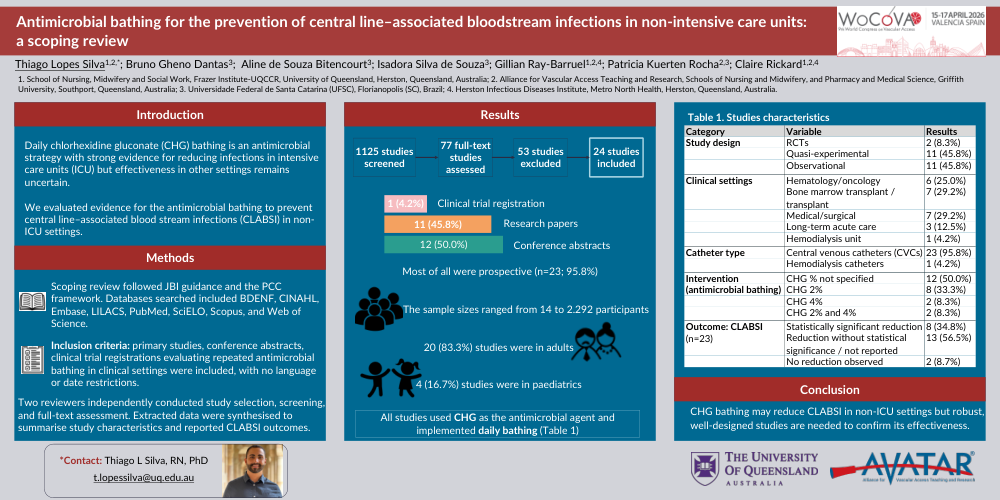
Results: 24 studies were analyzed: 11 (45.8%) research papers,12 (50.0%) conference abstracts, and 1 (4.2%) clinical trial registration. Most (23; 95.8%) were prospective.
2 (8.3%) were RCTs and 11 (45.8%) were Quasi-Experimental, and 11 (45.8%) were observational. The sample sizes ranged from 14 to 2.292 participants. Settings included 6 (25.0%) hematology/oncology; 7 (29.2%) bone marrow transplant or transplant; 7 (29.2%) medical/surgical; 3 (12.5%) long-term acute care; and 1 (4.2%) hemodialysis unit. Twenty (83.3%) studies were in adults; 4 (16.7%) studied paediatrics. Twenty-three (95.8%) studied central venous catheters; 1 (4.2%) examined hemodialysis catheters. The antimicrobial used was CHG in all studies with CHG concentration not specified in 12 (50.0%) studies, 8 (33.3%) used 2%, 2 (8.3%) used 4%, and 2 (8.3%) used both concentrations, and daily bathing was implemented across all studies. Eight studies (34.8%) reported a statistically significant reduction in CLABSI, 13 (56.5%) reported CLABSI reduction but did not report statistical significance or did not demonstrate significance, and 2 studies (8.7%) did not observe a reduction in CLABSI.
Conclusions: CHG bathing may reduce CLABSI in non-ICU settings but robust, well-designed studies are needed to confirm its effectiveness.