193 posters, 19 videos, 10 audios, 3 topics, 28 sessions, 714 authors, 278 institutions
ePostersLive by SciGen Technologies S.A. All rights reserved.
9th World Congress on Vascular Access 2026
15 - 17 April, 2026 | Valencia, Spain
32
Developing an Evidence- and Consensus-Based Tool for Assessing Skin Impairments Associated with Central Venous Access Devices
Poster Presenter
Part of Topic
Title: Developing an Evidence- and Consensus-Based Tool for Assessing Skin Impairments Associated with Central Venous Access Devices
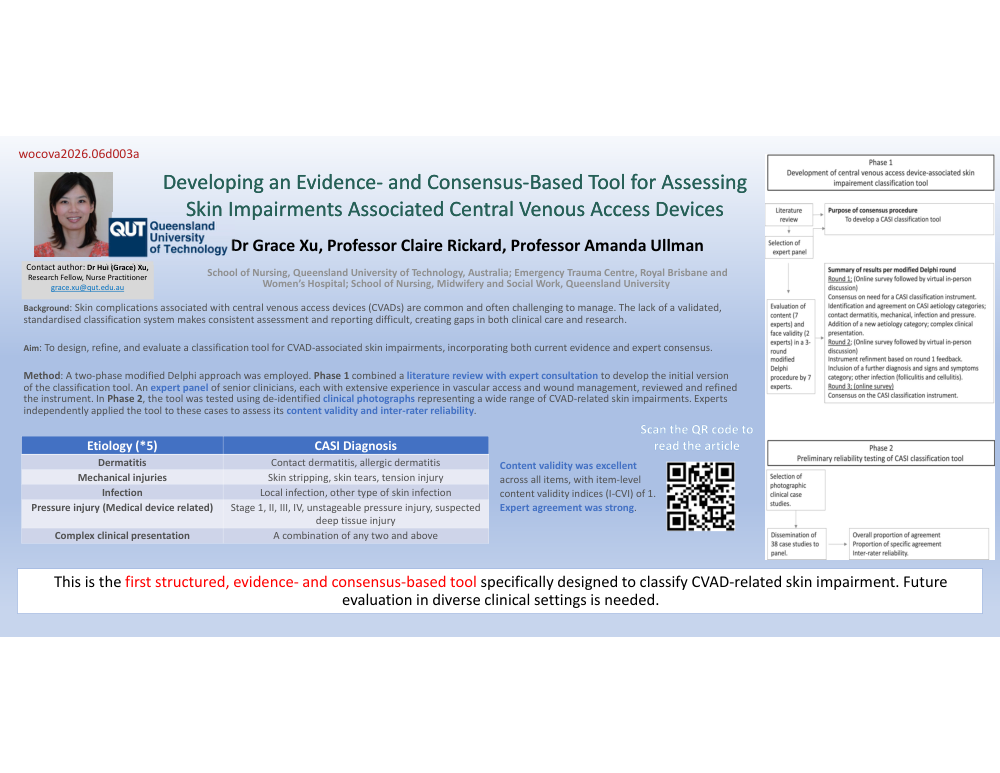
Background: Skin complications associated with central venous access devices (CVADs) are common and often challenging to manage. The lack of a validated, standardised classification system makes consistent assessment and reporting difficult, creating gaps in both clinical care and research.
Aim: To design, refine, and evaluate a classification tool for CVAD-associated skin impairments, incorporating both current evidence and expert consensus.
Methods: A two-phase modified Delphi approach was employed. Phase 1 combined a literature review with expert consultation to develop the initial version of the classification tool. An expert panel of senior clinicians, each with extensive experience in vascular access and wound management, reviewed and refined the instrument. In Phase 2, the tool was tested using de-identified clinical photographs representing a wide range of CVAD-related skin impairments. Experts independently applied the tool to these cases to assess its content validity and inter-rater reliability.
Results: The final instrument categorises CVAD-associated skin impairments into five overarching groups: dermatitis, mechanical injury, infection, pressure injury, and complex clinical presentations. Fourteen subcategories were defined, each with operational definitions and clear clinical signs. Content validity was excellent across all items, with item-level content validity indices (I-CVI) of 1. Expert agreement was strong, demonstrating high reliability for overall categories and excellent concordance for the definitions and descriptors of subcategories.
Conclusion: This study developed the first structured, evidence- and consensus-based tool specifically designed to classify CVAD-related skin impairments. Preliminary testing indicates the instrument is both valid and reliable, offering a foundation for standardised documentation and communication in clinical practice. Further evaluation in diverse clinical settings is needed to confirm its feasibility and potential impact on patient care.