193 posters, 19 videos, 10 audios, 3 topics, 28 sessions, 709 authors, 279 institutions
ePostersLive by SciGen Technologies S.A. All rights reserved.
9th World Congress on Vascular Access 2026
15 - 17 April, 2026 | Valencia, Spain
318
<p>Staff experience of an after-hours vascular access specialist team pilot project: a single-centre, cross-sectional survey</p>
Part of Topic
Staff experience of an after-hours vascular access specialist team pilot project: a single-centre, cross-sectional survey
Berger, S.J.1,2, Francis, P.G.1, Culverwell, E.A.1
1Vascular Access Management andInfection Prevention Service, Canterbury and West Coast, New Zealand; 2Department of Nursing, University of Otago, Christchurch, New Zealand
Introduction
Over a third of adults and up to half of children presenting to hospital meet criteria for difficult intravenous access (DIVA), characterised by non-visible and non-palpable veins either with or without a tourniquet1-3. There was an organisational need for development of a formal escalation pathway after two failed peripheral intravenous catheter insertion attempts, as well as for DIVA patients. Funding was secured for a one-year nurse-led vascular access specialist team pilot project. The Vessel Health Preservation and IntraVenous Access (VIVA) Team delivered a seven-day service prioritising after hours work. As one key pilot project outcome measure, aim was to gain insights into staff experience of the VIVA team at a large tertiary-level university hospital in New Zealand.
Methods
An exploratory cross-sectional survey was conducted using a self-developed online questionnaire with 14 items on a five-point Likert scale and a further four open-ended questions. Dissemination was via internal email and posters placed around campus with a QR code to scan. Participation was anonymous and voluntary. Descriptive analysis of data was undertaken.
Results
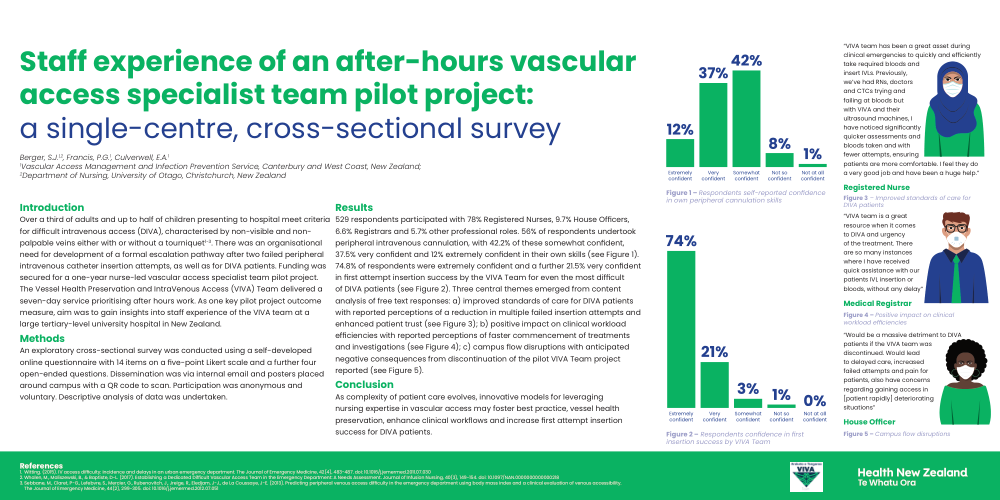
529 respondents participated with 78% Registered Nurses, 9.7% House Officers, 6.6% Registrars and 5.7% other professional roles. 56% of respondents undertook peripheral intravenous cannulation, with 42.2% of these somewhat confident, 37.5% very confident and 12% extremely confident in their own skills. 74.8% of respondents were extremely confident and a further 21.5% very confident in first attempt insertion success by the VIVA Team for even the most difficult of DIVA patients. Three central themes emerged from content analysis of free text responses: a) improved standards of care for DIVA patients with reported perceptions of a reduction in multiple failed insertion attempts and enhanced patient trust; b) positive impact on clinical workload efficiencies with reported perceptions of faster commencement of treatments and investigations; c) campus flow disruptions with anticipated negative consequences from discontinuation of the pilot VIVA Team project reported.
Conclusion
As complexity of patient care evolves, innovative models for leveraging nursing expertise in vascular access may foster best practice, vessel health preservation, enhance clinical workflows and increase first attempt insertion success for DIVA patients.
References
- Witting. (2015). IV access difficulty: incidence and delays in an urban emergency department. The Journal of Emergency Medicine, 42(4), 483-487. doi: 10.1016/j.jemermed.2011.07.030
- Whalen, M., Maliszewski, B., & Baptiste, D-L. (2017). Establishing a Dedicated Difficult Vascular Access Team in the Emergency Department: A Needs Assessment. Journal of Infusion Nursing, 40(3), 149-154. doi: 10.1097/NAN.0000000000000218
- Sebbane, M., Claret, P-G., Lefebvre, S., Mercier, G., Rubenovitch, J., Jreige, R., Eledjam, J-J., de La Coussaye, J-E. (2013). Predicting peripheral venous access difficulty in the emergency department using body mass index and a clinical evaluation of venous accessibility. The Journal of Emergency Medicine, 44(2), 299-305. doi: 10.1016/j.jemermed.2012.07.051