193 posters, 19 videos, 10 audios, 3 topics, 28 sessions, 709 authors, 279 institutions
ePostersLive by SciGen Technologies S.A. All rights reserved.
9th World Congress on Vascular Access 2026
15 - 17 April, 2026 | Valencia, Spain
306
<p><em>Saskatchewan’s First Percutaneous Arteriovenous Fistula Program: Outcomes of a Multidisciplinary Model Delivering Innovative Hemodialysis Access in a Smaller Canadian Province</em></p> <p><em> </em></p> <p> </p>
Poster Presenter
Authors
Affiliations
Part of Topic
Saskatchewan’s First Percutaneous Arteriovenous Fistula Program: Outcomes of a Multidisciplinary Model Delivering Innovative Hemodialysis Access in a Smaller Canadian Province
Background
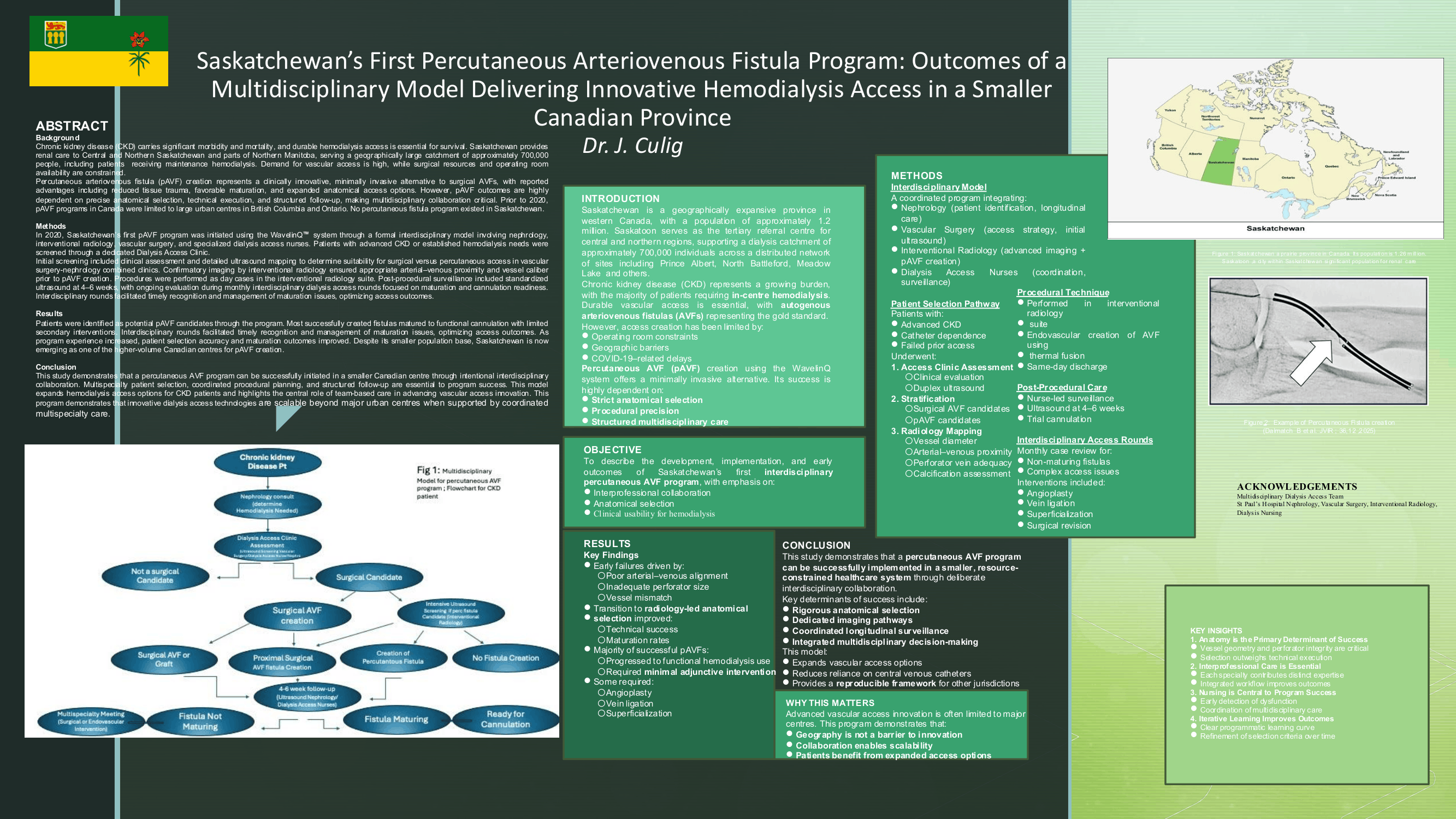
Chronic kidney disease (CKD) carries significant morbidity and mortality, and durable hemodialysis access is essential for survival. Saskatchewan provides renal care to Central and Northern Saskatchewan and parts of Northern Manitoba, serving a geographically large catchment of approximately 700,000 people, including patients receiving maintenance hemodialysis. Demand for vascular access is high, while surgical resources and operating room availability are constrained.
Percutaneous arteriovenous fistula (pAVF) creation represents a clinically innovative, minimally invasive alternative to surgical AVFs, with reported advantages including reduced tissue trauma, favorable maturation, and expanded anatomical access options. However, pAVF outcomes are highly dependent on precise anatomical selection, technical execution, and structured follow-up, making multidisciplinary collaboration critical. Prior to 2020, pAVF programs in Canada were limited to large urban centres in British Columbia and Ontario. No percutaneous fistula program existed in Saskatchewan.
Methods
In 2020, Saskatchewan’s first pAVF program was initiated using the WavelinQ™ system through a formal interdisciplinary model involving nephrology, interventional radiology, vascular surgery, and specialized dialysis access nurses. Patients with advanced CKD or established hemodialysis needs were screened through a dedicated Dialysis Access Clinic.
Initial screening included clinical assessment and detailed ultrasound mapping to determine suitability for surgical versus percutaneous access in vascular surgery-nephrology combined clinics. Confirmatory imaging by interventional radiology ensured appropriate arterial–venous proximity and vessel caliber prior to pAVF creation. Procedures were performed as day cases in the interventional radiology suite. Post-procedural surveillance included standardized ultrasound at 4–6 weeks, with ongoing evaluation during monthly interdisciplinary dialysis access rounds focused on maturation and cannulation readiness. Interdisciplinary rounds facilitated timely recognition and management of maturation issues, optimizing access outcomes.
Results
Between 2020 and 2025, 29 patients were identified as potential pAVF candidates. Thirteen patients (45%) underwent successful percutaneous AVF creation. Two procedures failed, and three patients died from causes unrelated to vascular access. Most successfully created fistulas matured to functional cannulation with limited secondary interventions. Interdisciplinary rounds facilitated timely recognition and management of maturation issues, optimizing access outcomes. As program experience increased, patient selection accuracy and maturation outcomes improved. Despite its smaller population base, Saskatchewan is now emerging as one of the higher-volume Canadian centres for pAVF creation.
Conclusion
This study demonstrates that a percutaneous AVF program can be successfully initiated in a smaller Canadian centre through intentional interdisciplinary collaboration. Multispecialty patient selection, coordinated procedural planning, and structured follow-up are essential to program success. This model expands hemodialysis access options for CKD patients and highlights the central role of team-based care in advancing vascular access innovation. This program demonstrates that innovative dialysis access technologies are scalable beyond major urban centres when supported by coordinated multispecialty care.
Why This Matters
This work demonstrates that advanced vascular access innovation is not limited to large metropolitan centres. Through deliberate interdisciplinary collaboration, a smaller Canadian province successfully implemented a percutaneous fistula program with favorable maturation and cannulation outcomes. This model provides a reproducible framework for expanding hemodialysis access options, reducing reliance on central venous catheters, and improving care delivery for patients with CKD in resource-constrained or geographically dispersed regions.