193 posters, 19 videos, 10 audios, 3 topics, 28 sessions, 709 authors, 279 institutions
ePostersLive by SciGen Technologies S.A. All rights reserved.
9th World Congress on Vascular Access 2026
15 - 17 April, 2026 | Valencia, Spain

303
<p>Efficacy and safety of mini-midlines, midlines and PICCs in a pediatric surgical hospital in uganda: a prospective study</p>
Poster Presenter
Authors
Alessandro Mazza, Ivan Kizito, Hind Salah Ali Gubara, Francesca Rossi, Erik Lucchini, Elena Bonato, Anita Cappellari, Giulia Pedro, Imona Boschveld, Luisa Napolitano
Affiliations
Department of Women's and Children's Health, Padua, Emergency NGO Milano, Emergency Children's Surgical Hospital, Entebbe, Alma Mater Studiorum, University of Bologna, Fondazione Policlinico San Matteo Hospital IRCCS, Pavia
Part of Topic
Audio
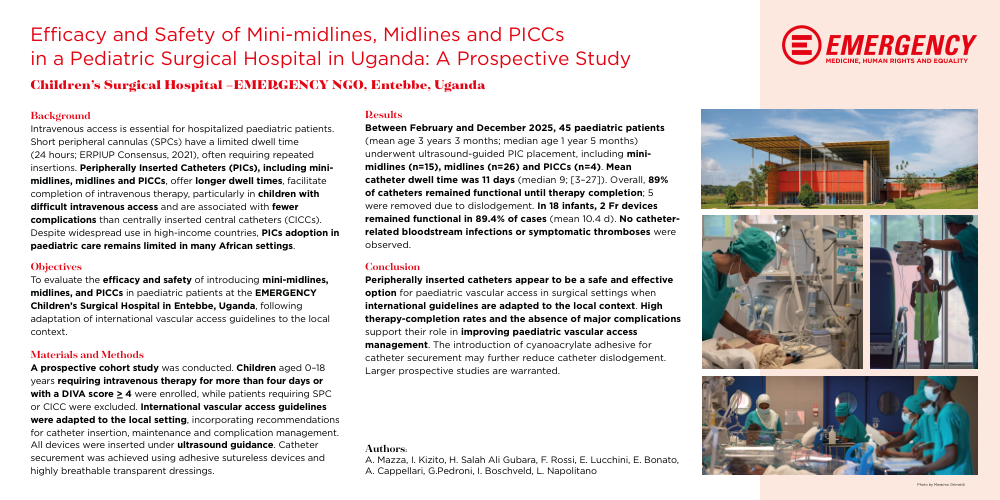
Efficacy and Safety of Mini-midlines, Midlines and PICCs in a Pediatric Surgical Hospital in Uganda: A Prospective Study
Children’s Surgical Hospital – EMERGENCY NGO, Entebbe, Uganda
Authors:
A. Mazza, I. Kizito, H. Salah Ali Gubara, F. Rossi, E. Lucchini, E. Bonato, A. Cappellari, G.Pedroni, I. Boschveld, L. Napolitano
Background
Intravenous access is essential for hospitalized paediatric patients. Short peripheral cannulas (SPCs) have a limited dwell time (24 hours; ERPIUP Consensus, 2021), often requiring repeated insertions. Peripherally Inserted Catheters (PICs), including mini-midlines, midlines and PICCs, offer longer dwell times, facilitate completion of intravenous therapy, particularly in children with difficult intravenous access and are associated with fewer complications than centrally inserted central catheters (CICCs). Despite widespread use in high-income countries, PICs adoption in paediatric care remains limited in many African settings.
Objectives
To evaluate the efficacy and safety of introducing mini-midlines, midlines, and PICCs in paediatric patients at the EMERGENCY Children’s Surgical Hospital in Entebbe, Uganda, following adaptation of international vascular access guidelines to the local context.
Materials and Methods
A prospective cohort study was conducted. Children aged 0–18 years requiring intravenous therapy for more than four days or with a DIVA score ≥4 were enrolled, while patients requiring SPC or CICC were excluded. International vascular access guidelines were adapted to the local setting, incorporating recommendations for catheter insertion, maintenance and complication management. All devices were inserted under ultrasound guidance. Catheter securement was achieved using adhesive sutureless devices and highly breathable transparent dressings.
Results
Between February and December 2025, 45 paediatric patients (mean age 3 years 3 months; median age 1 year 5 months) underwent ultrasound-guided PIC placement, including mini- midlines (n=15), midlines (n=26) and PICCs (n=4). Mean catheter dwell time was 11 days (median 9; [3–27]). Overall, 89% of catheters remained functional until therapy completion; 5 were removed due to dislodgement. In 18 infants, 2 Fr devices remained functional in 89.4% of cases (mean 10.4 d). No catheter-related bloodstream infections or symptomatic thromboses were observed.
Conclusion
Peripherally inserted catheters appear to be a safe and effective option for paediatric vascular access in surgical settings when international guidelines are adapted to the local context. High therapy-completion rates and the absence of major complications support their role in improving paediatric vascular access management. The introduction of cyanoacrylate adhesive for catheter securement may further reduce catheter dislodgement. Larger prospective studies are warranted.