193 posters, 19 videos, 10 audios, 3 topics, 28 sessions, 709 authors, 279 institutions
ePostersLive by SciGen Technologies S.A. All rights reserved.
9th World Congress on Vascular Access 2026
15 - 17 April, 2026 | Valencia, Spain

293
<p>From PICC Expertise to PICC-Port Implantation: A Structured Nurse-Led Pathway for Vascular Access Care </p>
Poster Presenter
Part of Topic
Introduction
Vascular access care is increasingly delivered through multidisciplinary teams, with nurse-led practice well established in PICC insertion and management.
PICC-PORT implantation represents a potential expansion of advanced nursing practice; however, evidence on the feasibility of this transition remains limited.
Aim
To evaluate the feasibility of expanding nurse-led practice to include PICC-PORT implantation in a PICC-experienced team through a structured clinical pathway.
Setting
The study was conducted within a dedicated vascular access outpatient clinic at CRO di Aviano, an oncology referral center, providing centralized insertion, management, and follow-up of vascular access devices.
Methods
A structured implementation pathway was introduced in a dedicated vascular access clinic, involving PICC-experienced nurses and incorporating competency-based training, standardized protocols and integrated follow-up.
The implementation pathway is summarized in the flowchart, highlighting the key steps from existing PICC expertise to PICC-PORT implantation
◊ PICC Expertise
❖ Aseptic technique
❖ US-guided venipuncture
❖ Tunneling
❖ Tip Navigation and Location (IC-ECG or US-Bubble Test)
❖ Management
◊ Structured Training
❖ Hands-on supervised procedure
❖ Subcutaneous pocket creation
❖ Reservoir placement and management
◊ Standardized Protocol
❖ Patient selection criteria
❖ Standard Operating Procedures
❖ SIP-Port protocol
❖ Procedural checklist
◊ Integrated Follow Up
❖ Dedicated clinic
❖ Patient accessibility
❖ Complications management
❖ Continuity of care
Results
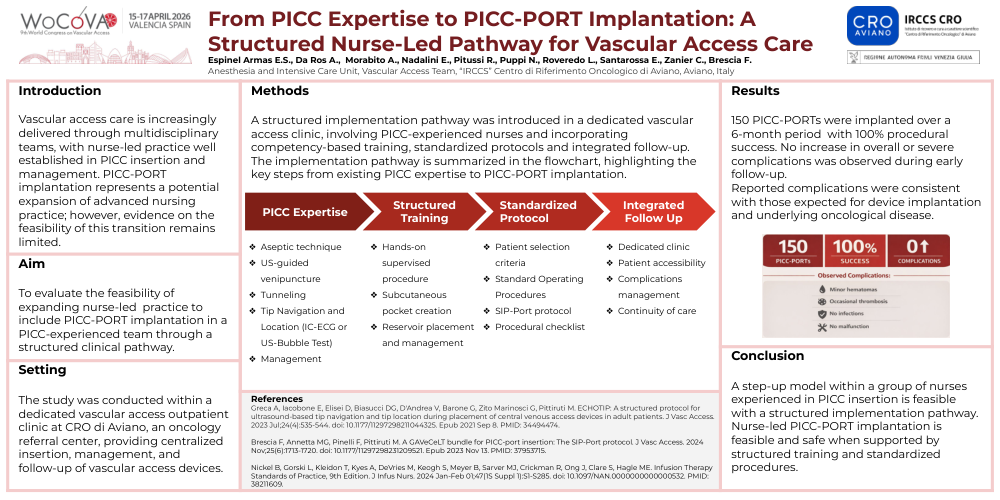
150 PICC-PORTs were implanted over a 6-month period with 100% procedural success. No increase in overall or severe complications was observed during early follow-up.
Reported complications were consistent with those expected for device implantation and underlying oncological disease, including minor hematomas and occasional catheter-related thrombotic events, managed with appropriate antithrombotic therapy. No infectious events, severe complications, or malfunctions of the inserted vascular devices were reported.
Conclusion
A step-up model within a group of nurses experienced in PICC insertion is feasible with a structured implementation pathway. Nurse-led PICC-PORT implantation is feasible and safe when supported by structured training and standardized procedures.