193 posters, 19 videos, 10 audios, 3 topics, 28 sessions, 709 authors, 279 institutions
ePostersLive by SciGen Technologies S.A. All rights reserved.
9th World Congress on Vascular Access 2026
15 - 17 April, 2026 | Valencia, Spain

285
<p>Implementation of Superficial Femoral Midline Catheters: A Vascular Access Team–Driven Experience from a Polish Academic Hospital</p>
Poster Presenter
Part of Topic
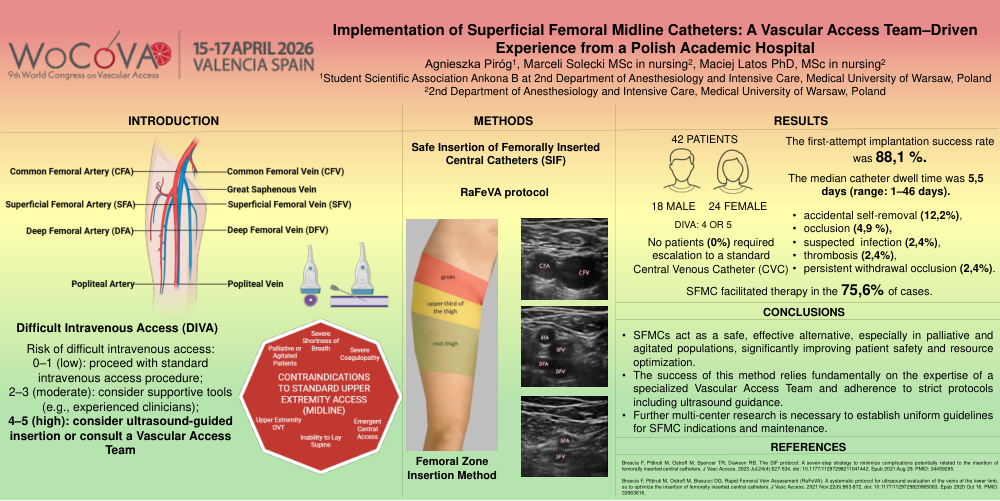
Implementation of Superficial Femoral Midline Catheters: A Vascular Access Team–Driven Experience from a Polish Academic Hospital Agnieszka Piróg1, Marceli Solecki MSc in nursing2, Maciej Latos PhD, MSc in nursing2 1Student Scientific Association Ankona B at 2nd Department of Anesthesiology and Intensive Care, Medical University of Warsaw, Poland 22nd Department of Anesthesiology and Intensive Care, Medical University of Warsaw, Poland INTRODUCTION Common Femoral Artery (CFA), Superficial Femoral Artery (SFA), Deep Femoral Artery (DFA), Popliteal Artery, Common Femoral Vein (CFV), Great Saphenous Vein, Superficial Femoral Vein (SFV), Deep Femoral Vein (DFV), Popliteal Vein. Difficult Intravenous Access (DIVA) Risk of difficult intravenous access: 0–1 (low): proceed with standard intravenous access procedure; 2–3 (moderate): consider supportive tools (e.g., experienced clinicians); 4–5 (high): consider ultrasound-guided insertion or consult a Vascular Access Team. CONTRAINDICATIONS TO STANDARD UPPER EXTREMITY ACCESS (MIDLINE): Palliative or Agitated Patients, Severe Shortness of Breath, Severe Coagulopathy, Upper Extremity DVT, Inability to Lay Supine, Emergent Central Access. METHODS Safe Insertion of Femorally Inserted Central Catheters (SIF) RaFeVA protocol Femoral Zone Insertion Method RESULTS 42 PATIENTS 18 MALE 24 FEMALE DIVA: 4 OR 5 The first-attempt implantation success rate was 88,1 %. The median catheter dwell time was 5,5 days (range: 1–46 days). • accidental self-removal (12,2%), • occlusion (4,9 %), • suspected infection (2,4%), • thrombosis (2,4%), • persistent withdrawal occlusion (2,4%). No patients (0%) required escalation to a standard Central Venous Catheter (CVC). SFMC facilitated therapy in the 75,6% of cases. CONCLUSIONS • SFMCs act as a safe, effective alternative, especially in palliative and agitated populations, significantly improving patient safety and resource optimization. • The success of this method relies fundamentally on the expertise of a specialized Vascular Access Team and adherence to strict protocols including ultrasound guidance. • Further multi-center research is necessary to establish uniform guidelines for SFMC indications and maintenance. REFERENCES Brescia F, Pittiruti M, Ostroff M, Spencer TR, Dawson RB. The SIF protocol: A seven-step strategy to minimize complications potentially related to the insertion of femorally inserted central catheters. J Vasc Access. 2023 Jul;24(4):527-534. doi: 10.1177/11297298211041442. Epub 2021 Aug 29. PMID: 34459295. Brescia F, Pittiruti M, Ostroff M, Biasucci DG. Rapid Femoral Vein Assessment (RaFeVA): A systematic protocol for ultrasound evaluation of the veins of the lower limb, so to optimize the insertion of femorally inserted central catheters. J Vasc Access. 2021 Nov;22(6):863-872. doi: 10.1177/1129729820965063. Epub 2020 Oct 16. PMID: 33063616.