193 posters, 19 videos, 10 audios, 3 topics, 28 sessions, 709 authors, 279 institutions
ePostersLive by SciGen Technologies S.A. All rights reserved.
9th World Congress on Vascular Access 2026
15 - 17 April, 2026 | Valencia, Spain

271
<p>Process Maturity in Peripheral Vascular Access Device Care: A Decade of Surveillance, Education, and Governance</p>
Poster Presenter
Authors
Affiliations
Samaritano Higienópolis Hospital, Hospital Samaritano Higienopolis
Part of Topic
Background
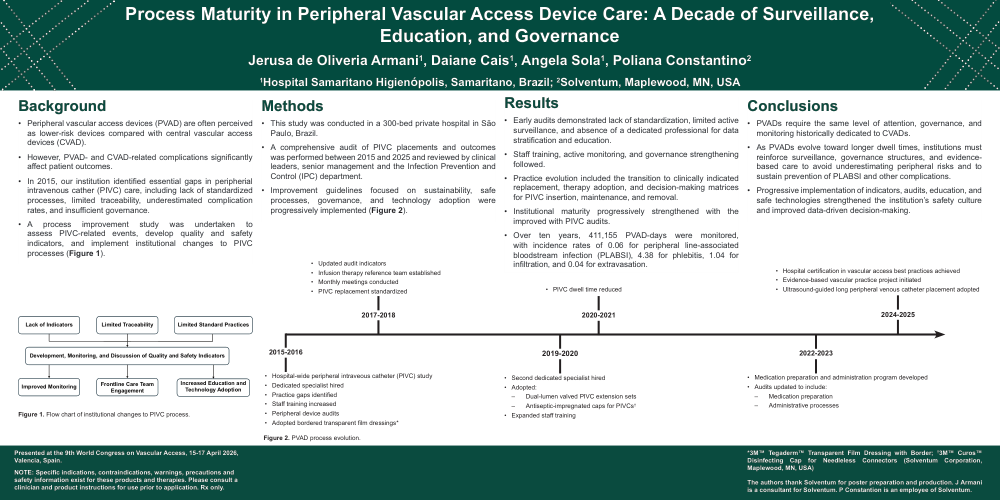
Peripheral Vascular Access Devices (PVAD) are often perceived as lower-risk devices compared with Central Vascular Access Devices (CVAD); however, PVAD- and CVAD-related complications significantly affect patient outcomes. In 2015, our institution identified essential gaps in PVAD care, including lack of standardized processes, limited traceability, underestimated complication rates, and insufficient governance. A process improvement study was undertaken to assess PVAD-related events, develop quality and safety indicators, and implement institutional changes to PVAD processes.
Methods
This study was conducted in a 300-bed private hospital in São Paulo, Brazil. A comprehensive audit of PVAD placements and outcomes was performed between 2015 and 2025 and reviewed by clinical leaders, senior management and the Infection Prevention and Control (IPC) department. Improvement guidelines focused on sustainability, safe processes, governance, and technology adoption were progressively implemented including the establishment of a dedicated IV Team. Practice evolution included the transition from routine time-based replacement to clinically indicated replacement, bordered transparent securement dressings, antiseptic caps, decision-making matrices for insertion, maintenance, and removal, and the introduction of ultrasound-guided long peripheral catheters for difficult intravenous acess patients.
Results
Early audits demonstrated lack of standardization, limited active surveillance, and absence of a dedicated professional for data stratification and education. Staff training, active monitoring, and governance strengthening followed. Over ten years, 411,155 PVAD-days were monitored, with incidence rates of 0.06 for peripheral line-associated bloodstream infection (PLABSI), 4.38 for phlebitis, 1.04 for infiltration, and 0.04 for extravasation. Institutional maturity progressively strengthened, supporting sustained control of complications and consolidation of a strong safety culture.
Conclusion
PVADs require the same level of attention, governance, and monitoring historically dedicated to CVADs. As PVADs evolve toward longer dwell times, institutions must reinforce surveillance, governance structures, and evidence-based care to avoid underestimating peripheral risks and to sustain prevention of PLABSI and other complications. Progressive implementation of indicators, audits, education, and safe technologies strengthened the institution’s safety culture and improved data-driven decision-making.