193 posters, 19 videos, 10 audios, 3 topics, 28 sessions, 709 authors, 279 institutions
ePostersLive by SciGen Technologies S.A. All rights reserved.
9th World Congress on Vascular Access 2026
15 - 17 April, 2026 | Valencia, Spain

270
<p>Standardizing aseptic practice in ultrasound-guided peripheral IV insertion using an integrated probe barrier: a quality improvement initiative</p>
Poster Presenter
Authors
Affiliations
Part of Topic
Video
Audio
Standardizing aseptic practice in ultrasound-guided peripheral IV insertion using an integrated probe barrier:
A quality improvement initiative
Nigel Ruse, RN, MN, CRNI®; Sarah E. Gallie, RN, MN, BScN, BSc, CpedN(C); Nancy Moureau, RN, PhD, CRNI®, CPUI, VA-BC™
Background
Ultrasound-guided peripheral intravenous (UGPIV) insertion is an established technique for patients with difficult intravenous access – common in paediatric patients. UGPIV insertions represents the majority of IV insertions performed by the vascular access service at this Canadian paediatric tertiary care centre.
UGPIV insertions = 65% of IV insertions ~450 per month
The Canadian Vascular Access Association (CVAA) 2024 Standards highlight ANTT® as the standard of care in IV insertion. While ultrasound guidance improves vascular access success, it introduces additional challenges to maintaining ANTT®:
- Workflow variation
- Inconsistent methods of probe protection
- Probe manipulation on key-ste
Purpose
The purpose of this prospective quality improvement initiative was to determine whether a transparent integrated probe barrier dressing, combined with procedure standardization and education, improves workflow and ANTT® adherence during UGPIV insertion.
Methods
The prospective quality improvement initiative applied the Plan-Do-Study- Act framework with pre- and post-implementation observational audits of UGPIV insertions. A select group of nurses (6) within the vascular access service were included in the training and observational audits. Post-implementation feedback was collected on usability and clinician satisfaction.
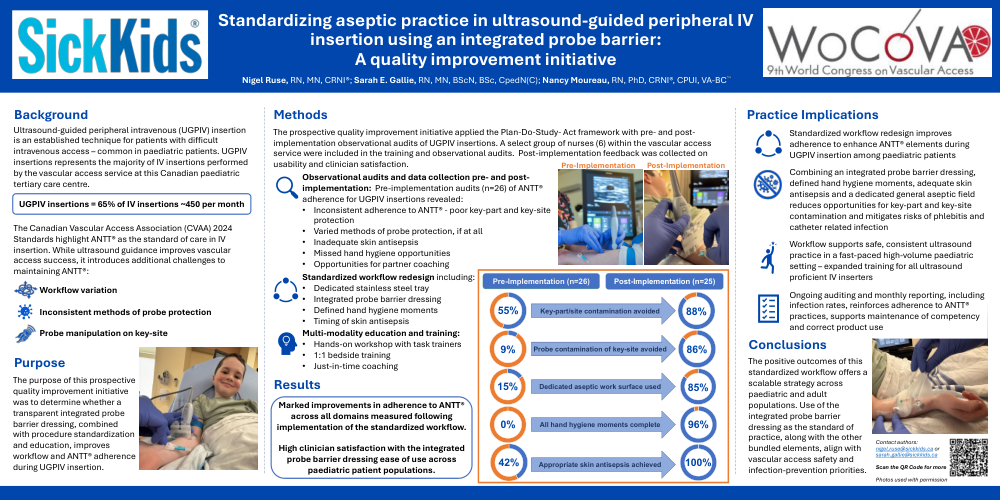
Observational audits and data collection pre- and post-implementation: Pre-implementation audits (n=26) of ANTT® adherence for UGPIV insertions revealed:
•Inconsistent adherence to ANTT® - poor key-part and key-site protection
•Varied methods of probe protection, if at all
•Inadequate skin antisepsis
•Missed hand hygiene opportunities
•Opportunities for partner coaching
Standardized workflow redesign including:
•Dedicated stainless steel tray
•Integrated probe barrier dressing
•Defined hand hygiene moments
•Timing of skin antisepsis
Multi-modality education and training:
•Hands-on workshop with task trainers
•1:1 bedside training
•Just-in-time coaching
Results
Marked improvements in adherence to ANTT® across all domains measured following implementation of the standardized workflow (See poster for data visualization). High clinician satisfaction with the integrated probe barrier dressing ease of use across paediatric patient populations.
Practice Implications
- Standardized workflow redesign improves adherence to enhance ANTT® elements during UGPIV insertion among paediatric patients
- Combining an integrated probe barrier dressing, defined hand hygiene moments, adequate skin antisepsis and a dedicated general aseptic field reduces opportunities for key-part and key-site contamination and mitigates risks of phlebitis and catheter related infection
- Workflow supports safe, consistent ultrasound practice in a fast-paced high-volume paediatric setting – expanded training for all ultrasound proficient IV inserters
- Ongoing auditing and monthly reporting, including infection rates, reinforces adherence to ANTT® practices, supports maintenance of competency and correct product use
Conclusions
The positive outcomes of this standardized workflow offers a scalable strategy across paediatric and adult populations. Use of the integrated probe barrier dressing as the standard of practice, along with the other bundled elements, align with vascular access safety and infection-prevention priorities.