193 posters, 19 videos, 10 audios, 3 topics, 28 sessions, 709 authors, 279 institutions
ePostersLive by SciGen Technologies S.A. All rights reserved.
9th World Congress on Vascular Access 2026
15 - 17 April, 2026 | Valencia, Spain

257
This website and third-party tools we use rely on cookies for the best user experience. By selecting "I agree", you agree to cookie usage as described in our Privacy Policy.
193 posters, 19 videos, 10 audios, 3 topics, 28 sessions, 709 authors, 279 institutions
ePostersLive by SciGen Technologies S.A. All rights reserved.
15 - 17 April, 2026 | Valencia, Spain
257
Hospital general universitario de Castellón .UCI, Hospital Arnau de Vilanova, Hospital Arnau de Vilanova, Hospital Arnau de Vilanova, EVES, Hospital de la Ribera , Hospital Dr. Moliner , ( Hospital Arnau de Vilanova
Totally Implanted Venous Access Devices: Complications, Clinical and Sociodemographic Profile in Patients with PICC-PORT and Thoracic PORT Devices within a 2023–2025 Cohort
INTRODUCTION
Totally implanted venous access devices (TIVADs), such as the Thoracic Port and the PICC-Port, are essential for the safe administration of long-term intravenous therapies, particularly in oncology patients. Evaluating their complication rates and analyzing their distribution across clinical specialties is key to optimizing clinical and healthcare decision-making. The objective of this study is to analyze the sociodemographic data and complications associated with Port and PICC-Port devices in a cohort of patients treated between 2023 and 2025.
MATERIAL AND METHODS
A retrospective observational study was conducted between 2023 and 2025. Patients with TIVADs (Thoracic Port and PICC-Port) were included. The variables analyzed were sociodemographic data, device type, clinical specialty, and associated complications.
RESULTS
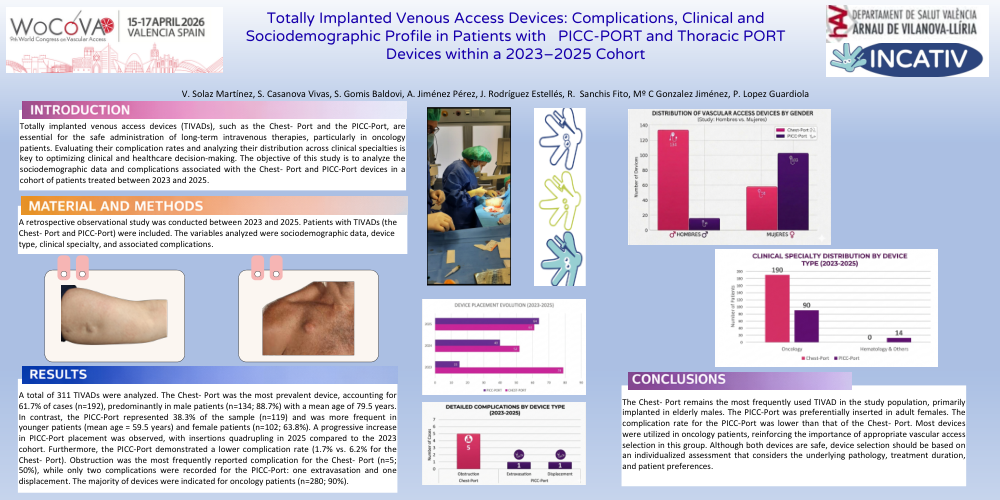
A total of 311 TIVADs were analyzed. The Thoracic Port was the most prevalent device, accounting for 61.7% of cases (n=192), predominantly in male patients (n=134; 88.7%) with a mean age of 79.5 years. In contrast, the PICC-Port represented 38.3% of the sample (n=119) and was more frequent in younger patients (mean age = 59.5 years) and female patients (n=102; 63.8%). A progressive increase in PICC-Port placement was observed, with insertions quadrupling in 2025 compared to the 2023 cohort. Furthermore, the PICC-Port demonstrated a lower complication rate (1.7% vs. 6.2% for the Thoracic Port). Obstruction was the most frequently reported complication for the Thoracic Port (n=5; 50%), while only two complications were recorded for the PICC-Port: one extravasation and one displacement. The majority of devices were indicated for oncology patients (n=280; 90%).
CONCLUSIONS
The Thoracic Port remains the most frequently used TIVAD in the study population, primarily implanted in elderly males. The PICC-Port was preferentially inserted in adult females. The complication rate for the PICC-Port was lower than that of the Thoracic Port. Most devices were utilized in oncology patients, reinforcing the importance of appropriate vascular access selection in this group. Although both devices are safe, device selection should be based on an individualized assessment that considers the underlying pathology, treatment duration, and patient preferences.