193 posters, 19 videos, 10 audios, 3 topics, 28 sessions, 709 authors, 279 institutions
ePostersLive by SciGen Technologies S.A. All rights reserved.
9th World Congress on Vascular Access 2026
15 - 17 April, 2026 | Valencia, Spain

255
<p>Building and Implementing a Multidisciplinary Team (MDT) for Vascular Access Led by Advanced Practice Vascular Access Nurses</p>
Poster Presenter
Part of Topic
Building and Implementing a Multidisciplinary Team (MDT) for Vascular Access Led by Advanced Practice Vascular Access Nurses
Hua He¹, Lihong Wang², Qian Zhou², Yangyang Zhang², Min Zhang³
¹Xi'an Peihua College Hospital, Xi’an, China
²Tangdu Hospital, Air Force Medical University, Xi’an, China
³Xi’an International Medical Center Hospital, Xi’an, China
Objective With advances in medical technology and evolving healthcare models, the role of advanced practice vascular access nurses in improving care quality and patient outcomes has become increasingly prominent.
Methods Team Formation Stage: Initially, 10 part-time nurse managers PICC-specialized nurses from five departments (including Hematology) formed a collaborative team under their respective departmental management, establishing the foundational model of teamwork. Team Development Stage: The team evolved into a “2 full-time + N part-time nurses + N part-time physicians” collaborative model, responsible for daily management of all vascular access devices and complex case consultations, thereby establishing a specialized vascular access nursing service. Team Maturation Stage: After six years of development, the team matured into a well-structured MDT led by advanced practice vascular access nurses. Building upon six core functional subgroups established during the development phase, the team further refined its organizational structure and role delineation, enabling members to effectively manage complex clinical scenarios and resolve challenging vascular access–related issues.
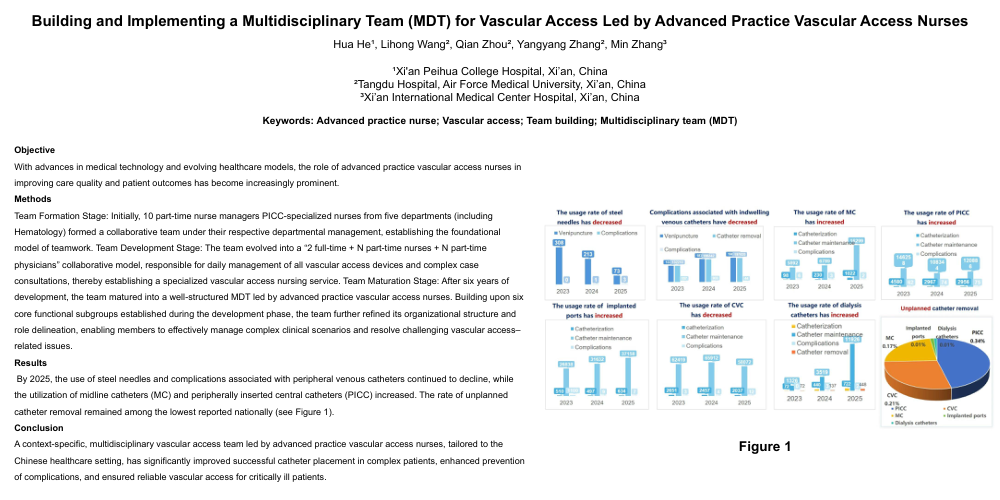
Results By 2025, the use of steel needles and complications associated with peripheral venous catheters continued to decline, while the utilization of midline catheters (MC) and peripherally inserted central catheters (PICC) increased. The rate of unplanned catheter removal remained among the lowest reported nationally.
Conclusion A context-specific, multidisciplinary vascular access team led by advanced practice vascular access nurses, tailored to the Chinese healthcare setting, has significantly improved successful catheter placement in complex patients, enhanced prevention of complications, and ensured reliable vascular access for critically ill patients.
Keywords: Advanced practice nurse; Vascular access; Team building; Multidisciplinary team (MDT)